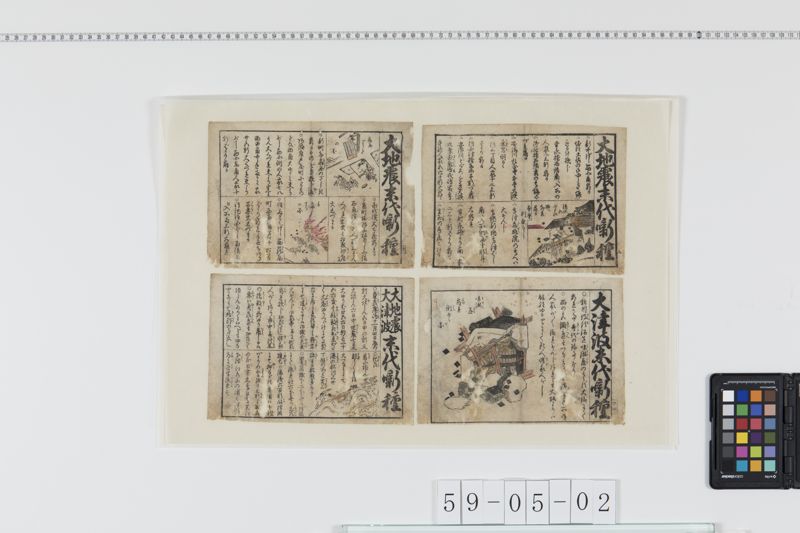
翻刻
【一枚目】
《箱:八》
《題:大地震末代噺種》
△新中ばし筋北角崩る
△堀江土佐の御やしき塀
三間斗損じ
△幸永橋西詰南へ入所の
人家二三軒崩る
△御池橋西詰裏の寺塀ぐ
づれ落る
△安治川順正寺本道大損し
茶間(ちやのま)倒るゝ
△同三丁目人家十二三軒
ばかり崩る
△同国津橋東西壱軒づゝ崩
△安治川どぐろ近辺大損じ
△九条 前垂島(まへだれしま)戎島富島
寺島人か五六十軒大崩レ
【挿し絵あり】
清水
の
ぶたひ
西へ
くづれ
落る
本堂
別状なし
△高津 慈照(じせう)院の高へい
大そんじ
△高地新地高津ばし
南へ入所 納屋(なや)十 軒(けん)斗
大崩れ
△幸町東 樋(ひ)より南へ家
二三十軒ばかり崩る
△生玉(いくだま)の鳥居こける
【二枚目・右下】
《箱:ツ四》
《題:大津波末代噺種》
○摂州 伝法(でんぼ)酒造 味醂蔵(みりんくら)のこらず大浪にて
崩れ候事奇代(きたい)の珍事なり
○西の宮 灘辺(なだへん)もつなみに□□□き所の
人家少ヽ流れ損じ何れとも大坂よりは
余程ゆるやかにて死人 怪我(けが)人少し
【挿し絵あり】
味醂(みりん)
蔵(くら)
崩れ
倒(たふ)るゝ
図(づ)
【三枚目・左上】
《箱:六》
《題:大地震末代噺種》
【挿し絵あり】
扇屋
ざしき
の
図
○新町東扇(あふぎ)屋のざしき
崩るその近辺損じ多(おゝ)し
○阿波座戸屋町小間もの
だな西角大ゆがみ夫より
少し西北側の人家七八
けん大くづれ夫より半丁
西の角やしき両かわ家
廿五軒大くづれ夫より
少し西北東角人家十
軒ばかり崩る
○永代浜大土蔵崩れる
○京町掘羽子板ばし北詰
西角浜□□□□さんげん
くづれ出火と相成 即座(そくざ)に
火しづまる
【挿し絵あり】
手
あや
まち
の図
○同両こくばし筋 籠(かご)屋
町西南□□□十六間
ばかり崩れ手過ちあり
早速(さつそく)火しづまる
○同紀伊国ばし南詰西?
え入所両三軒大崩れ
【四枚目・左下】
《割書:大地震|大津波》《題:末代噺種》
○芸州(あき)広島(ひろしま)十一月四日辰の
刻大 地(ぢ)しん五日申の刻又
大地しん六日中 地震(ぢしん)七日又
大ゆり尤も四五六日朝迄二十
五六度 其余(そのよ)数取(かずとり)出来(でき)がた
く大底(たいてい)ゆりつゞけにて家の
内に居られず皆々 野宿(のじゆく)
にて凌(しの)ぎ申候城の矢倉(やぐら)
大そんじ御家中并に町家
崩れ損じおびたゝし怪我(けが)
人少々あり支柱(しちう)并に往来(わうらい)
の橋(はし)数(す)ヶ所ゆり落(をと)し申候
○東(ひがし)は奥州(おうしう)辺(へん)もおなじく
地しんありといへどもゆる
やかにして格別(かくべつ)の事なし
【挿し絵あり】
○紀州(きしう)
若(わか)山地しん
烈(はげ)しく其後
大つなみにて
湊(みなと)の船川上卅
丁 余(よ)の所迄 突上(つきあげ)
砕(くだ)ける船数多なり
○田 辺(なべ)後城下二分通り津波
にて流(なが)れ跡六分通り出火(しゆつくは)
焼亡(しやうばう)○湯浅六百軒 余(よ)津波
にて押(おし)ながす広浦?は千 軒(げん)
ばかりの処(ところ)残り三 軒(けん)に成右
の外 日(ひ)方名高日高黒江
下津(しもつ)江水等の浦〳〵津波の
為(ため)に過(くは)半 流出(りうしつ)す
現代語訳
【一枚目】
**大地震・末代噺種**
△新中橋筋の北角が崩れる
△堀江・土佐藩の御屋敷の塀が三間ほど損じる
△幸永橋西詰から南へ入った所の人家二、三軒が崩れる
△御池橋西詰裏の寺の塀が崩れ落ちる
△安治川・順正寺の本堂が大きく損じ、茶の間が倒れる
△同(安治川)三丁目の人家十二、三軒ほどが崩れる
△同(安治川)国津橋の東西それぞれ一軒ずつ崩れる
△安治川どぐろ(土蔵群)近辺が大きく損じる
△九条・前垂島・戎島・富島・寺島の人家五、六十軒が大崩れする
【挿し絵:清水の舞台が西へ崩れ落ちる。本堂は別状なし。】
△高津・慈照院の高塀が大きく損じる
△高地・新地・高津橋から南へ入った所の納屋十軒ほどが大崩れする
△幸町・東樋より南へ家二、三十軒ほどが崩れる
△生玉の鳥居が倒れる
---
【二枚目・右下】
**大津波・末代噺種**
○摂州・伝法の酒造・味醂蔵が残らず大波にて崩れた事は、奇代の珍事である。
○西宮・灘辺りも津波にて(被害を受け)、その地域の人家が少々流れ・損じたが、いずれも大坂よりはよほど穏やかで、死人・怪我人は少なかった。
【挿し絵:味醂蔵が崩れ倒れる図】
---
【三枚目・左上】
**大地震・末代噺種**
【挿し絵:扇屋・座敷の図】
○新町東・扇屋の座敷が崩れ、その近辺の損じが多い。
○阿波座・戸屋町の小間物店の西角が大きくゆがみ、そこから少し西・北側の人家七、八軒が大崩れし、そこから半丁西の角屋敷・両側の家二十五軒が大崩れし、さらに少し西・北東角の人家十軒ほどが崩れる。
○永代浜の大土蔵が崩れる。
○京町堀・羽子板橋北詰西角の浜(□□□)三軒が崩れ、出火となったが即座に火が鎮まる。
【挿し絵:手過ちの図(失火の様子)】
○同(京町堀)両国橋筋・籠屋町西南(□□□)十六間ほどが崩れ、手過ち(失火)があったが、早速火が鎮まる。
○同・紀伊国橋南詰西へ入った所の両三軒が大崩れする。
---
【四枚目・左下】
**大地震・大津波 末代噺種**
○安芸州・広島では、十一月四日の辰の刻(午前八時頃)に大地震があり、五日の申の刻(午後四時頃)にまた大地震、六日には中程度の地震、七日にまた大揺れ。四・五・六日の朝までに二十五、六度、その他は数え切れないほど揺れが続き、家の中に居られず、皆々野宿で凌いだ。城の矢倉(櫓)が大きく損じ、御家中ならびに町家の崩れ・損じがおびただしく、怪我人が少々あった。支柱ならびに往来の橋が数ヶ所揺り落とされた。
○東(方面)は奥州辺りも同じく地震があったといえども、穏やかで格別のことはなかった。
【挿し絵】
○紀州・和歌山では地震が激しく、その後大津波にて湊の船が川上三十丁余りの所まで突き上げられ、砕ける船が数多あった。
○田辺では城下の二分通りが津波にて流れ、その跡の六分通りが出火・焼亡した。
○湯浅では六百軒余りが津波にて押し流された。
○広浦(?)は千軒ほどあった所が残り三軒となった。
○その他、日方・名高・日高・黒江・下津・江水などの浦々が津波のため過半が流出した。
英語訳
**[Sheet 1]**
**Great Earthquake — Tales for Future Generations**
△ The north corner of the Shin-Nakabashi street collapsed.
△ The perimeter wall of the Tosa domain residence in Horie was damaged for approximately three ken (about 5.4 meters).
△ Two or three houses south of the west end of Yukinaga Bridge collapsed.
△ The wall of the temple behind the west end of Oike Bridge crumbled and fell.
△ The main hall of Junshōji Temple on the Ajikawa (Aji River) was severely damaged, and the tearoom collapsed.
△ About twelve or thirteen houses in the Third Block along the Ajikawa collapsed.
△ One house on each side of Kunitsuhashi Bridge on the Ajikawa collapsed.
△ The area near the Ajikawa doguро (warehouse district) suffered major damage.
△ Fifty or sixty houses in Kujō, Maedareshima, Eboshima, Tomishima, and Terajima suffered major collapses.
**[Illustration: The stage of Kiyomizu Temple collapsed westward. The main hall sustained no damage.]**
△ The high wall of Jishōin Temple in Kōzu suffered major damage.
△ About ten warehouses south of the Kōzu Bridge in Kōchi/Shinchi suffered major collapses.
△ About twenty or thirty houses south of the eastern drainage channel in Saiwaimachi collapsed.
△ The torii gate at Ikutama Shrine toppled over.
---
**[Sheet 2, lower right]**
**Great Tsunami — Tales for Future Generations**
○ In Denpō, Settsu Province, all of the sake brewery's mirin (sweet rice wine) storehouses were destroyed by the great wave — a truly extraordinary and rare event.
○ In the Nishinomiya and Nada areas, the tsunami also caused some houses to be washed away or damaged, but compared to Osaka, the damage was considerably milder, with fewer deaths and injuries.
**[Illustration: A mirin storehouse collapsing and falling over.]**
---
**[Sheet 3, upper left]**
**Great Earthquake — Tales for Future Generations**
**[Illustration: The sitting room of the Ōgiya establishment.]**
○ The sitting room of the Ōgiya (fan shop/establishment) in the east of Shinmachi collapsed, with extensive damage in the surrounding area.
○ In Awaza, Toya-machi, the western corner of a small goods shop was severely warped. From there, seven or eight houses slightly to the west and on the north side suffered major collapse; from there, twenty-five houses on both sides of the corner block half a chō (about 55 meters) to the west suffered major collapse; and from there, about ten houses at the slightly western northeast corner collapsed.
○ A large storehouse at Eitaihama collapsed.
○ At the north end west corner of Hagoitabashi in Kyōmachi-bori, three houses at the waterfront (□□□) collapsed, a fire broke out but was immediately extinguished.
**[Illustration: A scene of an accidental fire.]**
○ In the same area (Kyōmachi-bori), along Ryōgokubashi street in Kagoya-machi, approximately sixteen ken (about 29 meters) on the southwest side (□□□) collapsed; an accidental fire broke out but was quickly extinguished.
○ In the same area, two or three houses south of the south end of Kiinokuni Bridge, entering to the west, suffered major collapse.
---
**[Sheet 4, lower left]**
**Great Earthquake and Great Tsunami — Tales for Future Generations**
○ In Hiroshima, Aki Province (present-day Hiroshima Prefecture), a great earthquake struck at the Hour of the Dragon (around 8 a.m.) on the 4th day of the 11th month. On the 5th day at the Hour of the Monkey (around 4 p.m.), another great earthquake struck. On the 6th day there was a moderate earthquake, and on the 7th day another large tremor. From the 4th through the morning of the 6th day, the earth shook twenty-five or twenty-six times, and beyond that the shaking was too frequent to count — essentially continuous trembling. People could not remain inside their homes and had to sleep outdoors to get through it. The castle turrets were severely damaged, and the damage and collapses among samurai residences and townspeople's houses were enormous, with a small number of injured. Several support pillars and bridges along the roads were shaken down.
○ To the east, the Ōshū (Mutsu) region also experienced earthquakes, but they were mild and nothing particularly noteworthy occurred.
**[Illustration]**
○ In Wakayama, Kii Province, the earthquake was severe, and afterward a great tsunami pushed ships in the harbor up the river more than thirty chō (approximately 3.3 kilometers) inland, where they were smashed to pieces — many ships were destroyed.
○ In Tanabe, about two-tenths of the castle town was washed away by the tsunami, and six-tenths of the remaining area was consumed by fire that broke out afterward.
○ In Yuasa, more than six hundred houses were swept away by the tsunami.
○ In Hiroura (?), a place that once had about one thousand houses, only three remained.
○ Beyond these, the coastal villages of Higata, Nataka, Hidaka, Kuroe, Shimotsu, Emizu, and others were more than half destroyed and washed away by the tsunami.