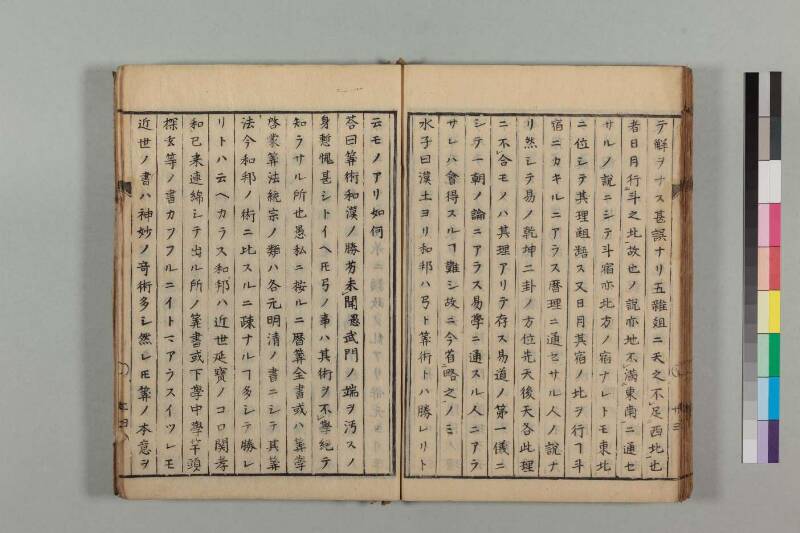
翻刻
テ解ヲナス甚誤ナリ五雜俎ニ天之不_レ足西北_一也
者日月行_二斗之北_一故也ノ説亦地不_レ満_二東南_一二通セ
サルノ説ニシテ斗宿亦北方ノ宿ナレトモ東北ニ
ニ位シテ其理粗語ス又日月其宿ノ北ヲ行コト斗
宿ニカキルニアラス暦理ニ通セサル人ノ説ナ
リ然シテ易ノ乾坤二卦ノ方位先天後天各此理
ニ不_レ合モノハ其理アリテ易道ノ第一儀ニ
シテ一朝ノ論ニアラス易学ニ通スル人ニアラ
サレハ会得スルコト難シ故ニ今省_二略之_一ノミ
水子曰漢土ヨリ和邦ハ弓ト算術トハ勝レリト
云モノアリ如何
答曰算術和漢ノ勝劣未_レ聞愚武門ノ端ヲ汚スノ
身軽愧甚シトイヘトモ弓ノ事ハ其術ヲ不_レ学絶テ
知ラサル所也愚私ニ按ルニ暦算全書或ハ算學
啓蒙算法統宗ノ類ハ各元明清ノ書ニシテ其算
法今和邦ノ術ニ比スルニ疎ナルコト多シテ勝レ
リトハ云ヘカラス和邦ハ近世延宝ノコロ関考
和已来連綿シテ出ル所ノ算書或下学中学竿頭
探玄等ノ書カフフルニイトマアラスイツレモ
近世ノ書ハ神妙ノ奇術多シ然レトモ算ノ本意ヲ
現代語訳
(前頁よりの続き)と解釈するのは甚だ誤りである。『五雑俎』に「天が西北において満ちていない(不足している)のは、日月が斗宿の北を運行するからである」という説があるが、これもまた「地が東南において満ちていない」という説と通じておらず、斗宿もまた北方の星宿ではあるが、東北に位置しており、その理はおおよそ述べた通りである。また、日月がその星宿の北を運行することは、斗宿に限ったことではなく、暦の理に通じていない者の説である。しかして、易の乾坤二卦の方位については、先天・後天それぞれにおいてこの理に合わないものには、それなりの理由があり、易道の第一の根本義であって、一朝一夕に論じられるものではない。易学に通じた人でなければ会得することは難しい。ゆえに今はこれを省略するのみである。
水子(問者)が言う:「中国(漢土)と比べて、日本(和邦)は弓と算術において優れているという者がいるが、いかがでしょうか。」
答えて言う:「算術における和漢の優劣については未だ聞いたことがない。私(愚)は武門の末席を汚す身として、大いに恥ずかしいとは言いながらも、弓については、その術を学んでおらず、全く知らないところである。私が思うに、『暦算全書』、あるいは『算学啓蒙』・『算法統宗』の類は、それぞれ元・明・清の書物であって、その算法を今の日本の術と比べると、粗略なことが多く、優れているとは言えない。日本においては、近世、延宝の頃より関(孝和)・(建部)賢弘以来、次々と刊行されてきた算書、あるいは『下学』・『中学』・『竿頭探玄』等の書物は、数え上げる暇もないほどで、いずれも近世の書は神妙な奇術が多い。しかしながら、算の本意を…(次頁へ続く)」
英語訳
(Continued from previous page) To interpret it as such is a great error. The "Wuzazu" (Five Assorted Offerings) states that "the reason heaven is deficient in the northwest is because the sun and moon travel north of the lunar mansion Dou (斗)," but this explanation also fails to connect with the theory that "the earth is deficient in the southeast." Although the Dou lunar mansion is indeed a northern mansion, it is positioned in the northeast, and the rationale for this has been roughly explained above. Furthermore, the sun and moon traveling north of a lunar mansion is not limited to the Dou mansion alone — this is the opinion of someone not well-versed in the principles of the calendar. As for the positions of the two trigrams Qian (乾) and Kun (坤) in the Yi (易/I Ching), those aspects that do not conform to this principle in either the Earlier Heaven (先天) or Later Heaven (後天) arrangements have their own reasons, as this constitutes the most fundamental principle of the Way of Yi, and cannot be settled in a single discussion. It is difficult to comprehend without being well-versed in Yi studies. Therefore, I will simply omit this for now.
The questioner (Suishi) asks: "There are those who say that compared to China (Kando), Japan (Wahou) excels in archery and mathematics — what do you think of this?"
The answer: "Regarding the superiority or inferiority of Japanese and Chinese mathematics, I have not heard any definitive conclusion. Though I am deeply ashamed, as one who merely occupies the lowest rank among the warrior class, regarding archery, it is something I have never studied and know absolutely nothing about. In my own estimation, works such as the 'Lixuan Quanshu' (Compendium of Calendar Calculations), the 'Suanxue Qimeng' (Introduction to Mathematics), and the 'Suanfa Tongzong' (Systematic Treatise on Arithmetic) are books of the Yuan, Ming, and Qing dynasties respectively, and when their methods of calculation are compared to present-day Japanese techniques, they are found to be crude in many respects and cannot be said to be superior. In Japan, since the Enpō era in recent times — beginning with Seki (Takakazu) and Takebe (Katahiro) — the succession of mathematical books published, such as 'Shita Gaku' (Elementary Learning), 'Chuu Gaku' (Intermediate Learning), 'Kantou Tangen' (Profound Exploration at the Pole), and others, have been too numerous to count, and the recent works are full of wondrous and extraordinary techniques. However, as for the true meaning of mathematics... (continued on next page)"