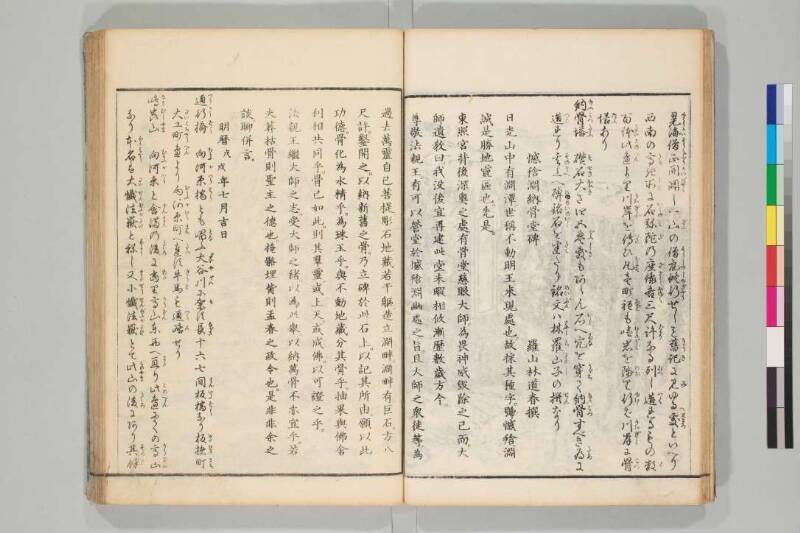
翻刻
【右丁】
晃海僧正(くわうかいそうじやう)開闢(かいびやく)し一 山(ざん)も僧衆(そうしゆ)修行(しゆぎやう)せしこと《振り仮名:𦾔記|きうき》に見(み)ゆる處(ところ)といへり
西南の高(たか)き所(ところ)に石弥陀(いしのみだ)の座像(ざざう)各(おの〳〵)三尺 許(ばかり)なる列(れつ)し造(つく)れるもの数(す)
百 体(たい)此邊(このへん)より川岸(かはぎし)を傳(つた)ひ凡(およそ)壱町 程(ほど)も嶮岩(けんがん)を陟(のぼ)り行(ゆけ)ば川岸(かはぎし)に骨(こつ)
塔(たふ)あり
納骨塔(なふこつたふ) 礎石(そせき)大(おほき)さ四五 疊敷(でふしき)もあらん石(いし)へ穴(あな)を穿(うがち)て納骨(なふこつ)すべき為(ため)に
造(つく)れり其上(そのうへ)へ碑銘石(ひのめいのいし)を建(たて)たり銘文(めいぶん)は林羅山子(はやしらざんし)の撰(せん)なり
憾𤚥淵納骨堂碑 羅山林道春撰
日光山中有淵潭。世稱不動明王來現處也。故採其種字。號憾𤚥淵
誠是勝地靈區也。先是。
東照宮背後深奥之處有骨堂。慈眼大師。為畏神威毀除之已而。大
師遺敎曰。我没後宜再建此堂。未暇相攸漸歷數歲。方今。
尊敬法親王。有可以營堂於憾𤚥淵幽處之旨。且大師之衆徒等。為
【左丁】
過去萬靈自已菩提。彫石地藏若干軀。造立淵畔。淵畔有巨石。方八
尺許。鑿開之。以納新舊之骨。乃立碑於此石上。以記其所由。願以此
功德。骨化為水精乎。為珠玉乎。與不動地藏分其骨乎。抽果與佛舍
利相共同乎。骨已如此。則其羣靈。或上天。或成佛。以可證之乎。
法親王繼大師之志。受大師之緖。以為此舉。以納萬骨不亦宜乎。若
夫葬枯骨則聖主之德也。掩骼埋胔則孟春之政令也。是非非余之
談。聊併言。
明歷《割書:戊| 戌》年七月吉日
通行橋(つうかうばし) 向河原橋(むかふがはらはし)とも唱(とな)ふ大谷川(だいやがは)に架(か)す長(ながさ)十六七 間(けん)板橋(いたばし)なり板挽町(いたひきまち)
大工町(だいくちやう)邊(へん)より向河原町(むかふがはらまち)へ達(たつ)す牛馬(ぎうば)も通路(つうろ)せり
鳴蟲山(なきむしやま) 向河原(むかふがはら)と含満(がんまん)の後(うしろ)に當(あた)り高山(かうざん)東西へ亘(わた)り此邊(このへん)にての高山(かうざん)
なり本名(ほんみやう)は大懴法嶽(たいせんぼふがたけ)と称(しよう)し又(また)小懴法嶽(せうせんぼふがたけ)とて此山(このやま)の後(うしろ)にあり其餘(そのよ)
現代語訳
【右丁】
晃海僧正が開拓し、一山も僧衆が修行したことが旧記に見えるところだという。
西南の高い所に石の阿弥陀の座像で、各々三尺ほどあるものが列をなして造られているものが数百体ある。この辺りから川岸を伝って、およそ一町ほども険しい岩を登って行けば川岸に骨塔がある。
納骨塔 礎石の大きさは四、五畳敷ほどもあろう石に穴を穿って納骨するために造られている。その上に碑銘石を建てている。銘文は林羅山子の撰である。
憾満淵納骨堂碑 羅山林道春撰
日光山中に淵がある。世に不動明王が来現した処と称されている。故にその種字を採って、憾満淵と号す。
まことにこれは勝地霊区である。これより先、
東照宮背後の深奥の処に骨堂があった。慈眼大師が、神威を畏れてこれを毀除した。そのうち、大師の遺教に曰く「我が没後、この堂を再建すべし」と。まだ場所を選定する暇がなく、次第に数歳を経た。ちょうど今、
尊敬法親王が、憾満淵の幽処に堂を営むことができる旨があった。かつ大師の衆徒等が、
【左丁】
過去万霊自己菩提のために、石地蔵若干体を彫り、淵の畔に造立した。淵の畔に巨石があり、方八尺ほどである。これを鑿ち開いて、新旧の骨を納めるようにした。すなわちこの石の上に碑を立てて、その由来を記す。願わくはこの功徳により、骨は水精となるか、珠玉となるか、不動地蔵と骨を分かつか、果を抽んでて仏舎利と相共に同じくするか。骨が既にこのようであれば、その群霊は、あるいは天に上り、あるいは成仏して、これを証すことができるであろう。
法親王が大師の志を継ぎ、大師の緒を受けて、この挙を為す。万骨を納めるに、また宜しからんや。それ枯骨を葬るは聖主の徳であり、骼を掩い胔を埋めるは孟春の政令である。これは余の論ではない。聊か併せて言う。
明暦戊戌年七月吉日
通行橋 向河原橋とも唱える。大谷川に架ける。長さ十六、七間の板橋である。板挽町、大工町辺りから向河原町へ達する。牛馬も通行する。
鳴虫山 向河原と含満の後ろに当たり、高山が東西に亘る。この辺りでの高山である。本名は大懺法嶽と称し、また小懺法嶽というのがこの山の後ろにある。その余は
英語訳
【Right Page】
It is said that the monk-archbishop Kōkai developed this place, and that the entire mountain community of monks practiced here, as can be seen in the old records.
In the high place to the southwest, there are several hundred seated stone Amida Buddha statues, each about three feet tall, arranged in rows. From this area, following the riverbank for about one chō and climbing up steep rocks, there is a bone pagoda by the riverbank.
Bone Repository Pagoda: The foundation stone is large, perhaps four or five tatami mats in size, with holes carved into the stone for the purpose of storing bones. A stone stele with inscriptions has been erected on top of it. The inscription was composed by Hayashi Razan.
Ganman-buchi Bone Repository Hall Stele Composed by Razan Hayashi Dōshun
There is a deep pool in Mount Nikkō. It is said to be the place where Fudō Myōō appeared. Therefore, taking that seed syllable, it is called Ganman-buchi.
Truly this is a sacred and spiritual place. Previously,
there was a bone hall in the deep recesses behind Tōshōgū Shrine. The Great Master Jigen, fearing the divine authority, had it destroyed. Later, the Great Master's final teaching said: "After my death, this hall should be rebuilt." There was no time to select a suitable location, and several years gradually passed. Just now,
the Venerable Prince Sonkei has indicated that a hall can be built in the secluded area of Ganman-buchi. Moreover, the Great Master's disciples,
【Left Page】
for the sake of all past spirits and their own enlightenment, carved several stone Jizō statues and erected them on the bank of the pool. There is a giant stone on the bank of the pool, about eight feet square. This was carved open to store old and new bones. A monument was erected on this stone to record its origin. It is hoped that through this merit, the bones will become crystal or jewels, or share bones with Fudō and Jizō, or extract fruit to be united with Buddha's relics. If the bones are already thus, then those spirits may ascend to heaven or attain Buddhahood, which can be verified.
The Prince continues the Great Master's aspiration and receives the Great Master's tradition in making this undertaking. Is it not fitting to store ten thousand bones? Burying dried bones is the virtue of a sage ruler, and covering bones and burying corpses is the governmental decree of early spring. This is not my personal opinion, but I mention it briefly.
Meireki, Year of the Earth Dog, Seventh Month, Auspicious Day
Tsūkō Bridge: Also called Mukōgawara Bridge. It spans the Daiya River. It is a plank bridge sixteen to seventeen ken long. It connects from the Itahiki-machi and Daiku-chō areas to Mukōgawara-machi. Cattle and horses also pass through.
Nakimushi Mountain: Located behind Mukōgawara and Ganman, this high mountain extends east to west and is the highest mountain in this area. Its original name is called Daisen-hōgatake, and there is also Shōsen-hōgatake behind this mountain. The rest...