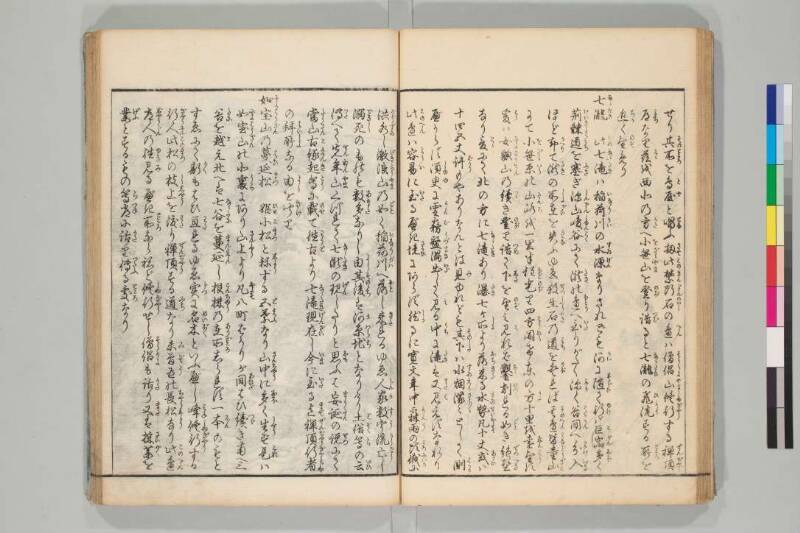
翻刻
【右丁】
せり其所(そのところ)を鳥屋(とや)と唱(とな)ふ扨(さて)此(この)禁断石(きんだんのいし)の邊(へん)は僧侶(そうりよ)山修行(やましゆぎやう)する禅頂(ぜんぢやう)
道(みち)なり兹(こゝ)を西北の方(かた)へ小笹山(をざゝやま)を登(のぼ)り詰(つむ)ると七瀧(なゝたき)の飛流(ひりう)する所(ところ)を
近(ちか)く望(のぞ)めり
七瀧(なゝたき) 此(この)七滝(なゝたき)は稲荷川(いなりかは)の水源(すいげん)なりされども河(かは)に随(したがひ)て行(ゆけ)ば巨嵓(こがん)多(おほ)く
荊棘(けいきよく)道(みち)を塞(ふさ)ぎ深山(しんざん)峻谷(しゆんこく)にて瀧(たき)の邊(ほとり)へ至(いた)りがたく深(ふか)く谷間(こくかん)へ分入(わけいる)
ほど却(かへり)て瀧(たき)の所在(しよざい)を失(うしな)ふゆゑ殺生石(せつしやうせき)の道(みち)を登(のぼ)れば其邊(そのへん)皆(みな)童山(どうざん)
にて小笹原(をざゝはら)の山路(さんろ)を一里半 程(ほど)登(のぼ)り四 方(はう)開(ひら)け東の方(かた)十里を遠望(ゑんばう)す
爰(こゝ)は女貌山(によばうさん)の續(つゞ)き登(のぼ)り詰(つめ)て下(した)を望(のぞ)み見(み)れば鑿削(ほりけづ)れる如(ごと)き絶壁(ぜつへき)
なり爰(こゝ)にて北の方に七滝(なゝたき)あり瀑(たき)七ヶ所(しよ)より落來(おちきた)る水㔟(すゐせい)凡(およそ)十丈 或(あるひ)は
十四五丈 許(ばかり)もやありなんとは見(み)ゆれども其下(そのした)は水烟(すゐえん)濛(もう)〻(〳〵)として測(はかる)
べからず須臾(しゆゆ)に雲霧(うんむ)盤渦(うづまき)出(いだ)して見(み)る中(うち)に滝(たき)は又(また)見(み)えずなれり
此邊(このへん)は容易(ようい)に至(いた)るべき境(さかひ)にあらず然(しか)るに寛文年中 霖雨(りんう)の頃(ころ)俄(にはか)に
【左丁】
洪水(こうずゐ)し激浪(げきらう)山(やま)の如(ごと)く稲荷川(いなりがは)へ落(おと)し來(きた)れるゆゑ人家(じんか)数宇(すう)流亡(りうばう)し
溺死(できし)のものも数多(あまた)なりし由(よし)其後(そのゝち)は河原地(かはらち)となりけり土俗等(どぞくら)の云(いひ)
傳(つた)へて先年(せんねん)山(やま)くづれて七瀧(なゝたき)の現(げん)したりと思(おも)ふは妄誕(まうたん)の説(せつ)にて
當山(たうさん)古縁起等(こえんきとう)に載(のせ)て徃古(わうご)より七滝(なゝたき)現在(げんざい)し今(いま)に至(いた)る迄(まで)禅頂行者(ぜんぢやうぎやうじや)
の拜所(はいしよ)なる由(よし)を聞(きけ)り
如宝山(によはうざん)の蔓延松(はひまつ) 姫小松(ひめこまつ)と称(しよう)する五葉(ごえふ)なり山中(さんちゆう)に多(おほ)く生(しやう)ず是(これ)は
如宝山(によはうざん)の北 裏(うら)にあり山上(さんしやう)より凡(およそ)八町ばかりが間(あひだ)はひ續(つゞ)き南へ三
谷(たに)を越(こ)え北へは七谷(なゝたに)を蔓延(まんえん)し根株(こんちゆう)の在所(ありどころ)しられず一 本(ほん)のもと
すゑにて斯(かく)もはひ亘(わた)れるゆゑ実(じつ)に名木(めいぼく)といふべし峰修行(みねしゆぎやう)する
行人(ぎやうにん)此松(このまつ)の枝上(ししやう)を渡(わた)り禅頂(ぜんぢやう)する道(みち)なり未曽有(みぞう)の長松(ちやうしよう)なり此邊(このへん)
常人(じやうじん)の徃見(ゆきみ)るべき所(ところ)ならねど修行(しゆぎやう)せし僧侶(そうりよ)も話(かた)り又(また)は採薬(さいやく)を
業(げふ)とするもの等(ら)常(つね)に話(かた)り傳(つたふ)る處(ところ)なり
現代語訳
【右丁】
せりがその場所を鳥屋と呼んでいる。さて、この禁断石の辺りは僧侶が山修行する禅頂道である。ここを西北の方へ小笹山を登り詰めると、七瀧の飛流する所を近くに望むことができる。
七瀧 この七滝は稲荷川の水源である。しかし川に沿って行けば巨岩が多く、荊棘が道を塞ぎ、深山峻谷であって滝の辺りまで至ることは困難で、深く谷間へ分け入るほど却って滝の所在を見失ってしまう。そのため殺生石の道を登れば、その辺りは皆童山であって、小笹原の山路を一里半ほど登り、四方が開け東の方十里を遠望する。ここは女貌山の続きで、登り詰めて下を望み見れば、鑿で削ったような絶壁である。ここで北の方に七滝があり、滝が七ヶ所より落ち来る水勢は、およそ十丈、或いは十四五丈ばかりもあるだろうと見えるが、その下は水煙が濛々として測ることができない。しばらくすると雲霧が渦巻いて出て、見ているうちに滝はまた見えなくなってしまった。この辺りは容易に至ることのできる境界ではない。しかるに寛文年中、長雨の頃、俄かに
【左丁】
洪水し、激浪が山のように稲荷川へ落として来たため、人家数軒が流亡し、溺死した者も数多くあった由で、その後は河原地となってしまった。土俗らが言い伝えて、先年山崩れして七瀧が現れたと思うのは妄誕の説であって、当山の古縁起等に載せて、往古より七滝が現在し今に至るまで禅頂行者の拝所である由を聞いている。
如宝山の蔓延松 姫小松と称する五葉である。山中に多く生ずる。これは如宝山の北裏にあり、山上よりおよそ八町ばかりの間這い続き、南へ三谷を越え、北へは七谷を蔓延し、根株の在り処は知られない。一本の元末でこのようにも這い渡っているので、実に名木というべきである。峰修行する行人がこの松の枝上を渡り禅頂する道である。未曽有の長松である。この辺りは常人の往見するべき所ではないが、修行した僧侶も話し、また採薬を業とする者らが常に話し伝える処である。
英語訳
【Right Page】
The place where seri (water dropwort) grows is called Toya (bird house). Now, the area around this Kindan-ishi (forbidden stone) is the Zenchō-dō, a path where Buddhist monks perform mountain ascetic practices. From here, climbing northwest up Ozasa-yama to its peak, one can view the cascading waters of Nanataki (Seven Falls) nearby.
Nanataki (Seven Falls) These seven falls are the source of the Inari River. However, following the river, there are many giant rocks and thorns blocking the path, and with deep mountains and steep valleys, it is difficult to reach the vicinity of the falls. The deeper one ventures into the valley, the more one loses sight of the falls' location. Therefore, if one climbs the path of Sesshō-seki (Killing Stone), the entire area consists of barren mountains. Climbing about one and a half ri along mountain paths through small bamboo grass plains, with views opening in all directions and a distant prospect of ten ri to the east. This is a continuation of Nyobō-san (Lady Mountain). Climbing to the peak and looking down, one sees sheer cliffs as if carved and chiseled. Here, to the north lie the seven falls, where water cascades from seven locations with a force of approximately ten jō, or perhaps fourteen to fifteen jō, though the bottom is shrouded in billowing water spray that cannot be measured. Presently, clouds and mist swirl up, and while watching, the falls disappear from view again. This area is not a realm easily reached. However, during the Kanbun era, during a period of continuous rain, suddenly
【Left Page】
there was a flood, and raging waves like mountains crashed down into the Inari River, causing several houses to be swept away and many people to drown. Afterwards, the area became a riverbed. The local people传说 that the mountain collapsed in previous years and the Seven Falls appeared, but this is a false theory. According to the ancient temple records of our mountain, the Seven Falls have existed since ancient times and continue to serve as a place of worship for Zenchō practitioners to this day.
The Creeping Pine of Nyohō-zan This is a five-needle pine called Hime-komatsu (Princess Pine). Many grow in the mountains. This one is located on the north back side of Nyohō-zan. It creeps continuously for about eight chō from the mountaintop, extending south over three valleys and north over seven valleys, with its root stock's location unknown. Being one tree that creeps and spans in this manner, it can truly be called a famous tree. It serves as a path where ascetic practitioners performing peak training cross over the pine's branches for Zenchō practice. It is an unprecedented long pine. Though this area is not a place for ordinary people to visit and observe, it is a place constantly spoken of and传承 by monks who have practiced asceticism and those who make their living gathering medicinal plants.