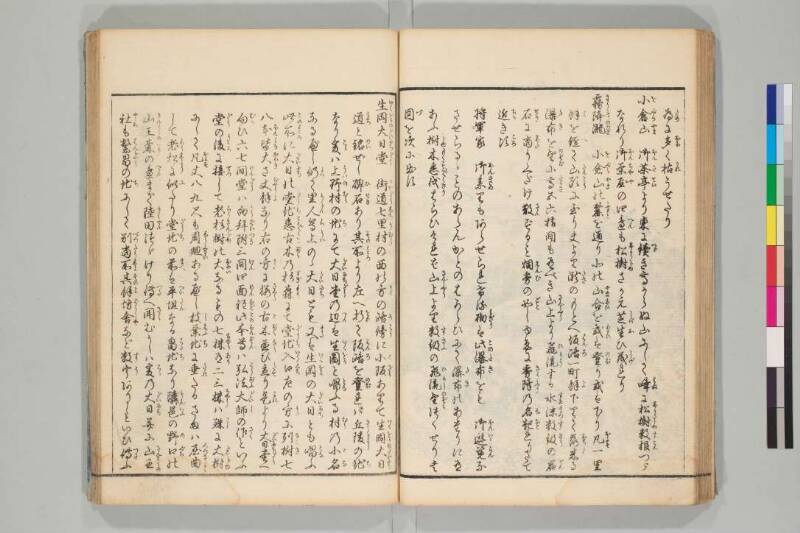
翻刻
【右丁】
為(ため)に多(おほ)く枯(かれ)うせたり
小倉山(をぐらやま) 御茶亭(おんさてい)より東に續(つゞ)き高からぬ山にして峰(みね)に松樹(しようじゆ)数根(すこん)つら
なれり御茶屋(おんちやや)の四 邊(へん)も松樹(しようじゆ)さかえ芝(しば)生(お)ひ茂(しげ)れり
霧降瀧(きりふりのたき) 小倉山(をぐらやま)の麓(ふもと)を通り北の山合(やまあひ)を或(あるひ)は登(のぼ)り或は下り凡(およそ)一里
餘(よ)を經(へ)て山頭(さんとう)に至り夫より瀧(たき)のもとへ坂路(はんろ)一町 餘(よ)下りて落來(おちく)る
瀑布(たき)を望(のぞむ)に高(たかさ)五六拾間も有べき山上(さんしやう)より飛流(ひりう)する水沫(すゐまつ)数級(すきう)の岩(がん)
石(せき)に當(あた)りくだけ散(さん)ずること烟雾(えんむ)の如(ごと)しゆゑに雾降(きりふり)の名(な)起(おこ)れりさて
近(ちか)き頃(ころ)
将軍家 御参(おんまゐ)りもあらせられける砌(みぎり)は此(この)瀑布(たき)をも 御遊覧(おんいうらん)な
させらるゝことのあらんかとのはからひにて瀑布(たき)のあたりに有
あふ樹木(じゆもく)悉(こと〴〵く)伐(きり)はらひければ山上(さんしやう)より数級(すきふ)の飛流(ひりう)望(のぞみ)つくせり其
図(づ)を次に出す
【左丁】
生岡大日堂(いくをかのだいにちだう) 街道(かいだう)七里村(しちりむら)の西の方(かた)の路傍(ろはう)に小阪(こざか)ありて生岡大日(いくをかのだいにち)
道(みち)と銘(めい)ぜし碑石(ひせき)あり其所(そのところ)より左へ折(をれ)て阪路(はんろ)を登(のぼ)れば丘陵(きうりよう)の地(ち)
なり爰(こゝ)は上野村(うはのむら)の地(ち)にて大日堂(だいにちだう)の辺(へん)は生岡(いくをか)と唱(とな)ふる村(むら)の小名(こな)
なるべし仍(よつ)て里人等(りじんら)上(うは)のゝ大日(だいにち)とも又(また)は生岡(いくをか)の大日(だいにち)とも唱(とな)ふ
此所(このところ)に大日(だいにち)の堂地(だうち)悉(こと〴〵く)古木(こぼく)の杉森(すぎもり)にて堂地入口(だうちいりくち)左の方(かた)に列樹(なみき)七
八 本(ほん)皆(みな)大(おほき)さ丈餘(ぢやうよ)なり右の方(かた)に桜(さくら)の古木(こぼく)並(なら)び立(たて)り是(これ)より大日堂(だいにちだう)へ
向(むか)ひ六七 間(けん)堂(だう)は向拜附(かうばいつき)三 間(けん)四 面(めん)程(ほど)此(この)本尊(ほんぞん)は弘法大師(こうぼふだいし)の作(さく)といふ
堂(だう)の後(うしろ)に接(せつ)して老杉樹(らうさんじゆ)の大(おほい)なるもの七 株(ちゅう)有(あり)二三 株(ちゆう)は殊(こと)に大樹(たいじゆ)
にして凡(およそ)丈八九尺も周廽(しうくわい)あるべし枝葉(しえふ)地(ち)に垂(たれ)たるさまは屈曲(くつきよく)
して老松(らうしよう)に似(に)たり堂地(だうち)の前(まへ)は平坦(へいたん)なる畠地(はたち)なり隣邑(りんいふ)の野口(のぐち)の
山王森(さんわうのもり)の邊(へん)まで陸田(りくでん)つゞけり傳(つた)へ聞(きく)むかしは爰(こゝ)の大日(だいにち)并に山王(さんわうの)
社(やしろ)も繁昌(はんじやう)の地(ち)にして別當所(べつたうしよ)其餘(そのよ)坊舍(ばうしや)など数宇(すう)ありしといひ傳(つた)ふ
現代語訳
【右丁】
そのために多くの木々が枯れて失われた。
小倉山 御茶亭から東に続く高くない山で、峰には松の木が数本連なっている。御茶屋の四方も松の木が繁茂し、芝が生い茂っている。
霧降滝 小倉山の麓を通り、北の山あいを登ったり下ったりして約一里余りを経て山頂に至り、そこから滝のもとへ坂道を一町余り下って落ちてくる滝を望むことができる。高さは五、六十間もあろうかと思われる山上から飛び流れる水しぶきが、幾段もの岩石に当たって砕け散ることが煙霧のようであるため、霧降という名前が起こったのである。さて近頃、将軍家が御参詣なさった折には、この滝も御遊覧になることがあろうかとの配慮で、滝の周辺にある樹木をすべて伐り払ったため、山上から幾段もの飛流を見通すことができる。その図を次に示す。
【左丁】
生岡大日堂 街道の七里村の西方の路傍に小さな坂があって、「生岡大日道」と銘を刻んだ碑石がある。その所から左に折れて坂道を登ると丘陵地である。ここは上野村の地で、大日堂の辺りは生岡と称する村の小字名であろう。よって里人たちは上野の大日とも、また生岡の大日とも称している。
この所の大日の堂地はすべて古い杉の森で、堂地入口の左の方に並木が七、八本あり、みな太さが一丈余りである。右の方には桜の古木が並び立っている。これより大日堂へ向かって六、七間のところに堂があり、向拝付きの三間四面程度である。この本尊は弘法大師の作と言われている。
堂の後ろに接して老杉の大きなものが七株あり、二、三株は特に大きな樹で、おおよそ一丈八、九尺も周囲があろう。枝葉が地に垂れた様子は屈曲して老松に似ている。堂地の前は平坦な畑地で、隣村の野口の山王森の辺りまで陸田が続いている。伝え聞くところによると、昔はここの大日並びに山王の社も繁栄の地で、別当所その他坊舎なども数軒あったと言い伝えられている。
英語訳
【Right Page】
As a result, many trees withered and were lost.
Mount Ogura: A low mountain continuing eastward from the tea pavilion, with several pine trees lining the peak. Pine trees also flourish around the tea house on all sides, and grass grows thick.
Kirifuri Falls: Passing through the foot of Mount Ogura, going up and down through the northern mountain valleys for about one ri and more to reach the mountain top, then descending about one chō down a slope path to view the waterfall that cascades down. The water spray flying down from the mountain top, which appears to be fifty to sixty ken high, strikes against multiple tiers of rocks and scatters like smoke and mist, hence the name "Kirifuri" (mist-falling) arose. Recently, when the Shogun made his pilgrimage, considering that he might also view this waterfall during his tour, all the trees around the waterfall were cleared away, so the multi-tiered cascade from the mountain top can be seen completely. The illustration is shown next.
【Left Page】
Ikuoka Dainichi Hall: On the roadside west of Shichiri Village along the highway, there is a small slope with a stone monument inscribed "Ikuoka Dainichi Road." Turning left from that spot and climbing the slope path leads to hilly terrain. This is the land of Uwano Village, and the area around Dainichi Hall is likely a hamlet called Ikuoka within the village. Therefore, the local people call it either "Uwano no Dainichi" or "Ikuoka no Dainichi."
The grounds of Dainichi at this location are entirely covered with an ancient cedar forest. At the entrance to the temple grounds, there are seven or eight trees in a row on the left side, all with a girth of more than one jō. On the right side, ancient cherry trees stand in a line. About six or seven ken toward Dainichi Hall stands the hall, which is about three ken square with a worship hall attached. The principal image is said to be the work of Kōbō Daishi.
Behind the hall, adjacent to it, stand seven large old cedar trees. Two or three of them are particularly large trees, with a circumference of about one jō and eight or nine shaku. The way their branches and leaves droop to the ground is curved and resembles old pine trees. In front of the temple grounds is flat farmland, with rice fields continuing to the area of Sannō Forest in the neighboring village of Noguchi. According to tradition, in ancient times this Dainichi and the Sannō shrine were also sites of prosperity, with several bettō-sho (head temples) and other temple buildings.