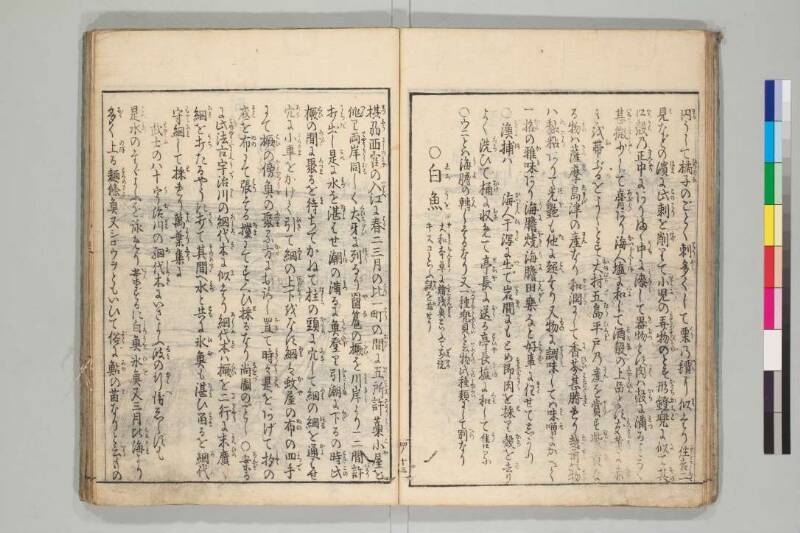
翻刻
【右丁】
円(まる)うして橘子(たちばな)のごとく刺(はり)多(おゝ)くして栗(くり)の氈(いか)に似(に)たり住吉(すみよし)二(ふた)
見(み)などの浜(はま)に此刺(このはり)を削(けづ)りて小児(せうに)の弄物(もてあそびもの)のとす形(かたち)鎧兜(かぶと)に似(に)て其(その)
口(くち)殻(から)の正中(まんなか)にありまゝ中(うちに)漆(うるし)して器物(きぶつ)とす肉(にく)は殻(から)を満(みつ)ることなく
甚(はなはた)微少(すくなく)して膏(あぶら)あり海人(かいじん)塩(しほ)に和(くわ)して酒殽(さかな)の上品(しやうひん)とす尤(もつとも)黄(き)に赤(あか)
きを帯(お)ぶるをよしとす大村(おほむら)五島(ごたう)平戸(ひらど)の産(さん)を賞(せう)す紫(むらさき)黄(き)な
る物(もの)は薩摩(さつま)島津(しまづ)の産(さん)なり和潤(やわらか)にして香芬(にほひ)甚(はなはだ)勝(まさ)れり越前(ゑちぜん)の物(もの)
は黏粘(ねばり)ありて光艶(つや)も他(た)に超(こへ)たり又 物(もの)に調味(てうみ)しては味噌(みそ)にかへて
一格( かく)の雅味(かみ)あり海胆焼(うにやき)海胆田楽(うにでんがく)なと好事(こうず)に《振り仮名:任|まゝ#1》せてしかり
○漁捕(ぎよほ)は 海人(かいしん)干潟(ひかた)に出(い)で岩間(いわま)にもとめ即(すなはち)肉(にく)を採(と)り殻(かち)を去(さ)り
よく洗(あら)ひて桶(おけ)に収(おさ)めて亭長(とひや)に送(おく)る亭長(とひや)塩(しほ)に和(くわ)して售(う)る
○ウニとは海胆(うに)の転したるなり又 一種(いつしゆ)兜貝(かふとかい)と云(いふ)物(もの)此(この)種類(しゆるい)にして別(へつ)なり
○白魚(しろうを)《割書:大和本草(やまとほんさう)に膾残魚(くわいさんぎよ)といふて前説(ぜんせつ) |キスコといふ説(せつ)を非(ひ)せり》
【左丁】
摂州(せつしう)西宮(にしのみや)の入江(いりへ)に春(はる)二三月の比(ころ)一町( てう)の間(あいだ)に五所(いつところ)許(ばかり)藁小屋(わらこや)を
作(つく)り両岸(りやうきし)同(おな)しく犬牙(くひちがひ)に列(つら)なり罶簄(やな)の橛(くひ)を川岸(かわきし)より一二間 許(ばかり)
打出(うちだ)し是(これ)に水(みづ)を湛(たゞよ)はせ潮(しほ)の満(みつ)るに魚(うを)登(のぼ)り引潮(ひきしほ)に下(くだ)るの時(とき)此(この)
橛(くひ)の間(あいだ)に聚(あつま)るを待(ま)ちてかねて柱(はしら)の頭(かしら)に穴(あな)して網(あみ)の綱(つな)を通(かよ)はせ
穴(あな)に小車(こくるま)をかけて引(ひき)て網(あみ)の上下(あげおろし)をなす網(あみ)は蚊屋(かや)の布(ぬの)の四手(よつで)
にて橛(くひ)の傍(からはら)魚(うを)の聚(あつま)る方(かた)におろし置(おき)て時々(とき〴〵)是(これ)をあげて杓(しやく)の
底(そこ)を布(ぬの)にて張(はり)たる攩(たま)にてすくひ採(と)るなり尚(なを)図(づ)のごとし○案(あんず)る
に此法(このはう)古(いにしへ)宇治川(うぢかわ)の網代木(あしろき)に似(に)たり網代木(あしろき)は橛(くひ)を二行(にぎやう)に末広(すへひろ)く
網(あみ)を打(うち)たるやうに打(うち)て其間(そのあいだ)へ水(みづ)と共(とも)に氷魚(ひお)も湛(たゞよ)ひ留(とゞま)るを網代(あしろ)
守網(もりあみ)して採(と)れり万葉集(まんようしう)に
武士(ものゝふ)は八十 宇治川(うぢがわ)の網代木(あしろき)にいさよふ波(なみ)の行衛(ゆくへ)しらずも
是(これ)水(みづ)のたゞよふを詠めり案(あん)ずるに白魚(しろうを)氷魚(ひを)又三月 此海(このうみ)より
多(おゝ)く上(のぼ)る麺條魚(とろめさこ)又シロウヲともいひて俗(ぞく)に鮎(あゆ)の苗(こ)なりと云(いう)もの
現代語訳
【右丁】
円(まる)くして橘(たちばな)のようで、刺(とげ)が多くて栗のいが(殻斗)に似ている。住吉や二見などの浜では、この刺を削って小児の玩具とする。形は鎧兜に似ていて、その口は殻の正中央にある。中に漆を塗って器物とする。肉は殻を満たすことなく、非常に少量で油分がある。海人(漁師)は塩に和えて酒の肴の上品とする。特に黄色に赤みを帯びたものが良いとされる。大村・五島・平戸の産を珍重する。紫がかった黄色のものは薩摩島津の産で、やわらかくて香りが非常に優れている。越前のものは粘りがあって艶も他に優る。また料理に調味料として用いては味噌の代わりに独特の上品な味がある。海胆焼きや海胆田楽など好事家の任せにするがよい。
○漁法は海人が干潟に出て岩間に求め、すぐに肉を採り殻を取り去り、よく洗って桶に収めて問屋に送る。問屋は塩に和えて売る。
○「ウニ」とは「海胆」が転じたものである。また一種で兜貝というものがこの種類で別のものである。
○白魚(大和本草に膾残魚といって前説のキスコという説を否定している)
【左丁】
摂州西宮の入江で春の二、三月頃、一町の間に五か所ほど藁小屋を作り、両岸同じように食い違いに並び、やなの杭を川岸より一、二間ほど打ち出し、これに水をたたえ、潮の満ちるときに魚が上り、引き潮に下るときにこの杭の間に集まるのを待って、あらかじめ柱の頭に穴をあけて網の綱を通し、穴に滑車をかけて引いて網の上げ下ろしをなす。網は蚊帳の布の四手で、杭のそば、魚の集まる方におろし置いて、時々これを上げて柄杓の底を布で張った玉(網)ですくい取るのである。なお図の通りである。
○考えるに、この方法は古の宇治川の網代木に似ている。網代木は杭を二行に末広がりに網を打ったように打って、その間へ水と共に氷魚もただよい留まるのを網代守が網して採った。万葉集に
「武士は八十宇治川の網代木にいさよう波の行方知らずも」
これは水のただようのを詠んだものである。考えるに白魚・氷魚、また三月にこの海より多く上る麺条魚(とろめさこ)もまたシロウヲといって、俗に鮎の稚魚だという。
英語訳
[Right page]
Round like a citrus fruit, with many spines resembling a chestnut burr. At beaches like Sumiyoshi and Futami, these spines are shaved off to make toys for children. The shape resembles armor and helmets, with the mouth at the center of the shell. The interior is lacquered to make vessels. The flesh does not fill the shell completely, being very small in quantity but containing oil. Fishermen mix it with salt to make a superior sake accompaniment. Those with a yellowish-red color are considered best. Products from Omura, Goto, and Hirado are prized. The purplish-yellow ones are from Satsuma Shimazu domain, being soft with exceptionally fine fragrance. Those from Echizen have stickiness and luster superior to others. When used as seasoning in cooking, it provides a refined flavor in place of miso. Grilled sea urchin and sea urchin dengaku should be left to the discretion of connoisseurs.
○The fishing method: fishermen go out to tidal flats and search among the rocks, immediately extracting the meat and removing the shells, washing them well and storing in buckets to send to wholesalers. The wholesalers mix them with salt and sell them.
○"Uni" is a transformation of "kaitan" (sea urchin). There is also a type called kabuto-gai (helmet shell) which belongs to this category but is different.
○Whitebait (in Yamato Honzo it is called kaisangyo, rejecting the previous theory of calling it "kisuko")
[Left page]
At the inlet of Nishinomiya in Settsu Province, during spring in the second and third months, about five straw huts are built within the distance of one cho, arranged alternately on both banks like dog teeth. Stakes for fish weirs are driven out about one to two ken from the riverbank, holding back water. When the tide rises, fish ascend, and when it ebbs and they descend, they gather between these stakes. Waiting for this, holes are pre-drilled in the tops of posts to thread net ropes through, and pulleys are attached to the holes to raise and lower the nets. The nets are made of mosquito net cloth in four directions, lowered beside the stakes where fish gather, and periodically raised to scoop up fish with a scoop net made by stretching cloth over the bottom of a ladle. This is as shown in the diagram.
○I believe this method resembles the ancient ajiroki (fish weirs) of the Uji River. The ajiroki had stakes driven in two rows in a widening pattern like a spread net, and both water and small sweetfish would drift and remain between them, which ajiro guards would net and catch. In the Man'yoshu:
"The warrior at eighty Uji River's fish weir stakes, the waves that hesitate - their destination unknown"
This poem describes the drifting of water. I believe that whitebait, ice fish, and the noodle-like fish (toromesako) that ascend in large numbers from this sea in the third month are also called shiro-uo, commonly said to be young ayu (sweetfish).