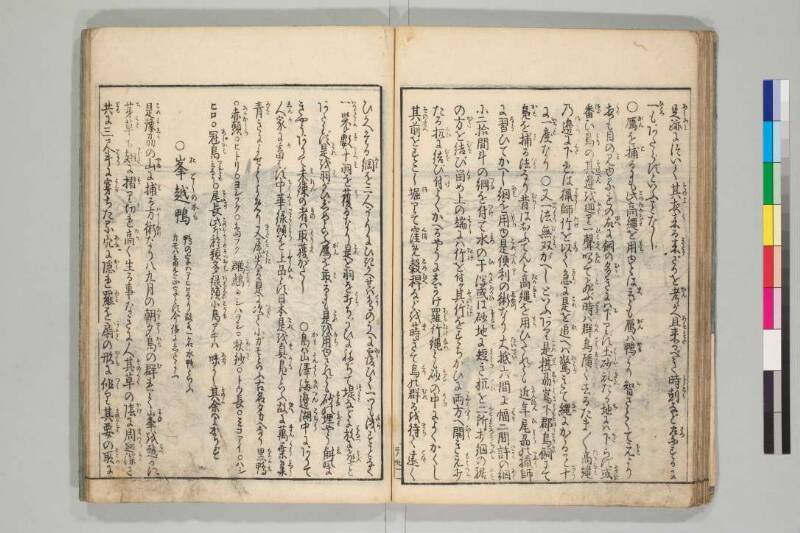
翻刻
【右丁】
足跡(あしあと)について其夜(そのよ)来(く)る来(きたら)ざるを考(かん)がへ旦(あす)来(きた)るべき時刻(じこく)など察(さつ)するに
一(ひとつ)もあたらずといふことなし
○雁(がん)を捕(と)るにも此(この)高縄(たかなわ)を用(もち)ゆとは云(いへ)ども雁(がん)は鴨(かも)より智(ち)さとくて元(もと)より
夜(よる)も目(め)の見(み)ゆるもの故(ゆへ)に飼の多(おゝ)きには下(お)りず土砂(どしや)乱(みだれ)たる地(ち)には下(くだ)らず或(あるひは)
番(つが)ひ鳥(とり)の其辺(そのへん)を廻(めぐ)り一声(ひとこへ)鳴(なひ)て飛(と)ぶ時(とき)は群鳥(くんてう)随(したかつ)て去(さ)るたま〳〵高縄(たかなわ)
の辺(ほとり)に下(くだ)れば猟師(りやうし)竹(たけ)を以(もつ)て急(きう)に是(これ)を追(お)へば驚(おとろ)きて縄(なは)にかゝること十(ぢう)
に一度(いちど)なり○又/一法(いつはう)無双(むさう)がへしといふあり是(これ)摂州(せつしう)島下郡(しまもとこほり)鳥飼(とりかい)にて
鳧(かも)を捕(と)る法(はう)なり昔(むかし)はおふてんと高縄(たかなわ)を用(もち)ひたれども近年(きんねん)尾州(ひしう)の猟師(りやうし)
に習(なら)ひてかへし網(あみ)を用(もち)ゆ是(これ)便利(べんり)の術(しゆつ)なり大抵(たいてい)六間に幅(はゞ)二間/許(はかり)の網(あみ)
に二拾間斗の綱(つな)を付(つけ)て水(みつ)の干潟(ひかた)或(あるひ)は砂地(すなち)に短(みじか)き杭(くひ)を二所(ふたところ)打(うち)網(あみ)の裾(すそ)
の方(かた)を結(むす)び留(とゞ)め上の端(はし)には竹(たけ)を付け其竹(そのたけ)をすぢかひに両方(りやうはう)へ開(ひら)き元(もと)打(うち)
たる杭(くひ)に結(むす)び付(つけ)よくかへるやうにしかけ羅(あみ)竹(たけ)縄(なは)とも砂(すな)の中(うち)によくかくし
其(その)前(まへ)をすこし掘(ほ)りて窪(くぼ)め穀(こめ)稗(ひへ)などを蒔(ま)きて鳥(とり)の群(むれ)るを待(まち)て遠(とほ)く
【左丁】
ひかへたる網(あみ)を二人がゝりにひきかへせば鳥(とり)のうへに覆(おゝ)ひて一つも洩(もら)すことなく
一挙(いつきよ)数十羽(すじつは)を獲(う)るなり是(これ)を羽を打(うち)ちがひにねぢて堤(つゝみ)などに放(はなつ)に飛(とぶ)こと
あたわず是(これ)を羽(は)がひじめといふ雁(がん)を取(と)るにも是(これ)を用(もち)ゆされども砂(すな)の埋(うづみ)やう餌(ゑ)のま
きやうありて未練(みれん)の者(もの)は取獲(とりえ)がたし ○ 鳧(かも)は山沢(さんたく)海辺(かいへん)湖中(こちう)にありて
人家(しんか)に畜(か)はず中華(ちうくわ)緑頭(りよくとう)を上品(しやうひん)とす日本/是(これ)を真鳧(まかも)といふ故(ゆへ)に万葉集(まんようしう)
青(あを)きによせてよめり又(また)尾尖(をさき)は是に次(つぎ)て小ガモといふ古名タカヘなり黒鴨(くろかも)
◦赤頭(あかかしら)◦ヒトリ◦ヨシフク◦島フク 鸊鷉(かいつぶり)◦シハヲシ◦秋紗(あいさ)◦トウ長◦ミコアイ◦ハシ
ヒロ◦冠鳧(あじかも)《割書:アシとも|云なり》◦尾長(をなが)此外(このほか)種類(しゆるい)多(おゝし)緑頭(あをくひ)小鳧(こがも)アヂハ味(あぢ)よし其余(そのよ)はよからず
◯峯越鴨(おごしのかも)《割書:鴨の字はアヒロなり故に一名水鴨といふ|カモは鳧を正字とす今俗にしたかふ》
是(これ)予州(よしう)の山(やま)に捕(と)る法術(はうじゆつ)なり八九月の朝夕(あさゆう)鳧(かも)の群(む)れて峯(みね)を越(こへ)るに
茅草(ちくさ)も翅(つばさ)に摺(す)り切(き)れ高(たか)く生る事なきに人/其草(そのくさ)の陰(かけ)に周廻(まはり)深(ふか)さ
共(とも)に三尺/斗(はかり)に穿(うが)ちたる穴(あな)に隠(かく)れ羅(あみ)を扇(あふぎ)の形(かたち)に作(つく)り其要(そのかなめ)の所(ところ)に
現代語訳
足跡について、その夜来るか来ないかを考え、明日来るべき時刻などを察するのに、一つも当たらないということはない。
○雁を捕るにもこの高縄を用いるとはいうものの、雁は鴨より知恵があって、もともと夜も目が見えるものなので、餌の多いところには降りず、土砂の乱れた地には下りない。あるいは番いの鳥がその辺りを回って一声鳴いて飛ぶ時は、群れの鳥も従って去る。たまたま高縄の辺りに下りれば、猟師が竹を使って急にこれを追えば、驚いて縄にかかることは十に一度である。
○また一つの方法で「無双返し」というものがある。これは摂津国島本郡鳥飼で鴨を捕る方法である。昔は多くは高縄を用いたけれども、近年尾張国の猟師に習って返し網を用いる。これは便利な術である。大体六間に幅二間ほどの網に二十間ほどの綱を付けて、水の干潟あるいは砂地に短い杭を二箇所打ち、網の裾の方を結び留め、上の端には竹を付け、その竹を筋違いに両方へ開き、元々打った杭に結び付けて、よく返るように仕掛け、網・竹・縄とも砂の中によく隠し、その前を少し掘って窪め、米・稗などを蒔いて鳥の群れるのを待って遠く
控えた網を二人がかりで引き返せば、鳥の上に覆って一つも漏らすことなく、一挙に数十羽を獲るのである。これを羽を打ち違いにねじって堤などに放つと飛ぶことができない。これを「羽締め」という。雁を取るのにもこれを用いるけれども、砂の埋め方、餌の蒔き方があって、未練な者は取り獲ることが難しい。
○鴨は山沢・海辺・湖中にいて、人家では飼わない。中国では緑頭を上品とする。日本ではこれを真鴨という。そのため万葉集では青きによせて詠んだ。また尾尖はこれに次いで小ガモという。古名はタカヘである。黒鴨・赤頭・ヒトリ・ヨシフク・島フク・鸊鷉・シハヲシ・秋紗・トウ長・ミコアイ・ハシヒロ・冠鴨(アシとも言う)・尾長、この外種類は多い。緑頭・小鴨・アジハは味がよく、その余はよくない。
◯峯越鴨(鴨の字はアヒロである。故に一名水鴨という。カモは鳧を正字とする。今俗に従う)
これは予州の山で捕る方法である。八九月の朝夕、鴨の群れて峯を越えるのに、茅草も翅に摺り切れ、高く生えることがないのに、人はその草の陰に、周囲とも深さ三尺ほどに穿った穴に隠れ、網を扇の形に作り、その要の所に
英語訳
Regarding the footprints, when considering whether they will come that night or not, and estimating what time they should come tomorrow, there is never a case where the prediction misses the mark.
○Although the high rope method is also used for catching geese, geese are more intelligent than ducks and can naturally see at night, so they do not descend where there is much feed, nor do they come down to disturbed sandy ground. When a pair of birds circles the area and flies away with a single cry, the flock follows them. Even if they happen to descend near the high ropes, when hunters suddenly chase them with bamboo poles, they become startled and get caught in the ropes only once in ten attempts.
○There is also another method called "musō-gaeshi" (peerless return net). This is a method for catching ducks used in Torikai, Shimamoto District, Settsu Province. In the past, the high rope method was often used, but in recent years they learned from hunters in Owari Province to use return nets. This is a convenient technique. Generally, a net about six ken long and two ken wide has a rope of about twenty ken attached. Short stakes are driven into two places in the tidal flats or sandy ground, the hem of the net is tied and secured, bamboo poles are attached to the upper edge, these bamboo poles are opened diagonally in both directions and tied to the originally driven stakes so they can return well. The net, bamboo, and ropes are all well hidden in the sand, and the area in front is dug slightly to create a depression where rice, millet, etc. are scattered to wait for the birds to flock, then from a distance
the net is pulled back by two people working together, covering the birds above so that not one escapes, capturing dozens of birds in one stroke. The wings are twisted in alternating directions and when released on embankments, they cannot fly. This is called "wing binding." This method is also used for catching geese, but there are specific ways to bury in sand and scatter bait, making it difficult for inexperienced people to catch them.
○Ducks live in mountain marshes, seashores, and lakes, and are not kept in human homes. In China, the green-head is considered the finest quality. In Japan, this is called "true duck." Therefore, in the Man'yōshū, it was composed with reference to its blue-green color. Also, the pintail ranks second to this and is called "small duck." Its ancient name is Takahe. There are black ducks, red-heads, wigeons, various species of pochards, grebes, various diving ducks, mergansers, long-tailed ducks, and many other species. Green-heads, small ducks, and spot-billed ducks taste good, but the others are not so good.
○Minoegoshi-gamo (The character for duck is "ahiro." Therefore, it's also called "water duck." The correct character for "kamo" is "fu." Here we follow common usage.)
This is a hunting method used in the mountains of Iyo Province. In the mornings and evenings of August and September, when flocks of ducks cross over the peaks, the grass is worn down by their wings and doesn't grow tall. Hunters hide in holes dug about three shaku deep in the shade of this grass, making nets in the shape of fans, with the pivot point at