翻刻
【右丁】
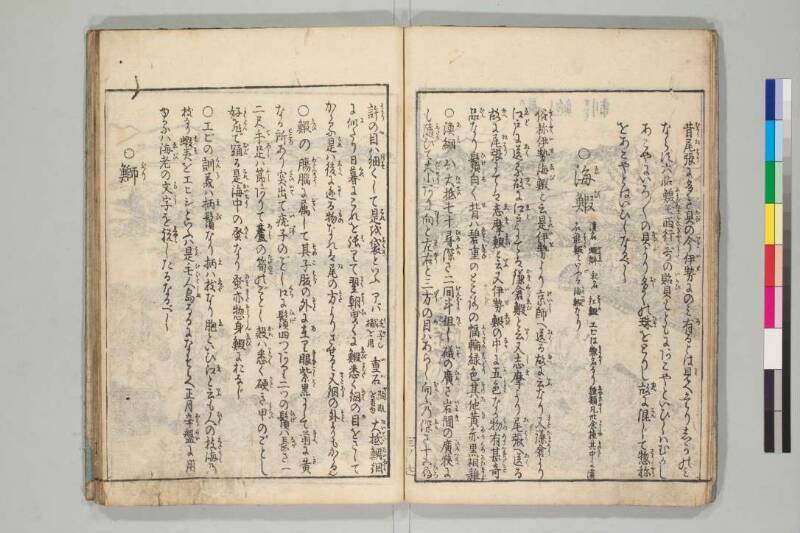
昔(むかし)尾張(おはり)に多き貝(かひ)の今(いま)伊勢(いせ)にのみ有(あ)るとは見(み)へたりしかのみ
ならず六帖 鰒玉(あわびたま)西行哥(さいぎやううた)の貽貝(いかい)もともにあこやといひしはむかし
あこやにいろ〳〵の貝(かひ)より多(おゝ)くの珠(たま)をとりし故(ゆへ)に混(こん)じて総称(さうしやう)
をあこやとはいひしなるべし
○海鰕(ゑび) 《割書:漢名 蝦魁(かくわい) 釈名 紅鰕(こうか) エビは総名(そうめう)なり種類(しゆるい)凡(およそ)卅余種( よしゆ)其中(そのなか)に漢|名 龍鰕(りうか)といふは海鰕(うみへひ)なり》
俗称(そくしやう)伊勢海鰕(いせゑび)と云 是(これ)伊勢(いせ)より京師(けいし)へ送(おく)る故(ゆへ)に云(いふ)なり又(また)鎌倉(かまくら)より
江戸(ゑど)に送(おく)る故(ゆへ)に江戸(ゑど)にては鎌倉鰕(かまくらゑび)と云(いう)又 志摩(しま)より尾張(おはり)へ送(おく)る
故(ゆへ)に尾張(おはり)にては志摩鰕(しまゑび)と云(いふ)又 伊勢鰕(いせゑび)の中(なか)に五色(ごしき)なる物(もの)有(あり)甚(はなはだ)奇(き)
品(ひん)なり鬚(ひけ)白(しろ)く背(せ)は碧(あをく)重(かさね)のところの幅輪(ふくりん)《振り仮名:緑色|みどり 》其他(そのた)黄(き)赤(あか)黒(くろ)相雑(あひまじる)
○漁網(あみ)は大抵(たいてい)七十尋( ひろ)深(ふか)さ二間( けん)斗(ばかり)但(たゞ)し礒(いそ)の広(ひろ)さ岩間(いわま)の広狭(ひろせま)に
も随(したが)ひて大小(だいせう)あり向(むかう)と左右(さゆう)と三方( ばう)の目(め)はあらし向(むか)ふの深(ふか)さ十五尋( ひろ)
【左丁】
許(はかり)の目(め)は細(ほそ)くして是(これ)を袋(ふくろ)といふアバ《割書:泛子(うけ)也|桶(をけ)を用》重石(いは)《割書:ヤ》《割書:陶瓶|を用ゆ》大抵(たいてい)鯛網(たいあみ)
に似(に)たり《振り仮名:日暮| くれ》にこれを張(は)りて翌朝(よくてう)曳(ひ)くに鰕(ゑび)悉(こと〴〵)く網(あみ)の目(め)をさして
かゝる是(これ)は後(しりへ)に逃(にく)る物(もの)なれは尾(お)の方(かた)よりさせり又(また)網(あみ)の外(そと)よりもかゝる也
○鰕(ゑび)の膓(わたは)脳(なう)に属(ぞく)して其子(そのこ)腹(はら)の外(そと)に在(あ)り眼(まなこ)紫黒(しこく)にして前(まへ)に黄(き)
なる所(ところ)あり突出(とひいて)て疣子(いぼ)のごとし口(くち)に鬚(ひげ)四つあり二つの鬚(ひげ)は長(なが)さ一
二尺 手足(てあし)は節(ふし)ありて蘆(あし)の筍(たけのこ)のごとし殻(かは)は悉(こと〳〵)く硬(かた)き甲(よろい)のごとし
好(よく)飛(とん)で踊(おど)る是(これ)海中(かいちう)の蚤(のみ)なり蚤(のみ)亦(また)惣身(そうしん)鰕(ゑび)におなじ
○エビの訓義(くんき)は柄鬚(えび)なり柄(え)は枝(ゑだ)なり胞(ゑ)といひ江(え)と云(いふ)も人(ひと)の枝海(えたうみ)の
枝なり蝦夷(ゑそ)をエヒシといふは是(これ)毛人島(けひとしま)なるになそらへ正月 辛盤(ほうらい)に用
ゆるは海老(ゑび)の文字(もし)を祝(しゆく)したるなるべし
○鰤(ぶり)
現代語訳
【右丁】
昔は尾張に多かった貝が、今では伊勢にのみ存在するということが見て取れるが、それだけではない。『六帖』の鰒玉(あわび玉)や西行の歌の貽貝(いがい)も、ともにあこやと呼んでいたのは昔のことである。あこやで様々な貝から多くの真珠を採取していたため、混同して総称をあこやと言ったのであろう。
○海老 《漢名:蝦魁、釈名:紅蝦。エビは総名で、種類はおよそ三十余種。その中で漢名で龍蝦というのは海老のことである》
俗称で伊勢海老という。これは伊勢から京都へ送るためにそう呼ぶのである。また鎌倉から江戸に送るため、江戸では鎌倉海老という。また志摩から尾張へ送るため、尾張では志摩海老という。また伊勢海老の中に五色の美しいものがあり、非常に珍しい品である。髭は白く、背は青く、重なった部分の縁取りは緑色で、その他黄・赤・黒が入り混じっている。
○漁網は大体七十尋、深さ二間ほど。ただし磯の広さや岩間の広狭に応じて大小がある。正面と左右三方の目は粗く、正面の深さ十五尋
【左丁】
ほどの目は細かくして、これを袋という。浮子(桶を用いる)、重石(陶瓶を用いる)で、大体鯛網に似ている。日暮れにこれを張って翌朝引くと、海老はすべて網の目に刺さって引っかかる。これは後ろに逃げる性質があるので、尾の方から刺さるのである。また網の外からも引っかかる。
○海老の腸は脳に属し、その卵は腹の外にある。目は紫黒色で前に黄色い所があり、突出して疣のようである。口に髭が四つあり、二つの髭は長さ一、二尺。手足は節があって葦の筍のようである。殻はすべて硬い甲のようである。よく飛び跳ねる。これは海中の蚤である。蚤もまた全身が海老に似ている。
○エビの語源は柄鬚(えび)である。柄(え)は枝のことで、胞(え)といい江(え)というのも人の枝、海の枝である。蝦夷(えぞ)をエヒシというのは、これが毛人島であることになぞらえたものである。正月の蓬莱に用いるのは、海老の文字を祝ったものであろう。
○鰤(ぶり)
英語訳
【Right Page】
What can be seen is that shells that were once abundant in Owari now exist only in Ise, but that's not all. The abalone pearls (awabi-dama) from the "Rokujō" and the freshwater mussels (ikai) from Saigyō's poems were all called "akoya" in ancient times. Since many pearls were harvested from various shells at Akoya, they became confused and the general term "akoya" was used.
○Sea Shrimp 《Chinese name: Kakawai, Alternative name: Kōka. Ebi is a general term with approximately thirty-odd varieties. Among these, what the Chinese call ryūka refers to sea shrimp》
Commonly called Ise lobster. This is because they are sent from Ise to Kyoto. Also, since they are sent from Kamakura to Edo, in Edo they are called Kamakura shrimp. Also, since they are sent from Shima to Owari, in Owari they are called Shima shrimp. Among Ise lobsters, there are five-colored specimens that are extremely rare. The whiskers are white, the back is blue, the edges of the overlapping sections are green, and yellow, red, and black are intermixed.
○The fishing net is generally seventy fathoms long and about two ken deep. However, there are large and small variations depending on the width of the rocky shore and the spacing between rocks. The mesh facing forward and on both sides (three directions) is coarse, with the forward depth being about fifteen fathoms.
【Left Page】
The mesh at that depth is fine and is called the "bag." With floats (using buckets) and sinkers (using ceramic bottles), it generally resembles a sea bream net. This is set at dusk and pulled the next morning, and all the shrimp get caught by piercing through the mesh. Since they have the nature of escaping backwards, they pierce through tail-first. They also get caught from outside the net.
○The shrimp's intestines belong to the brain, and their eggs are outside the abdomen. The eyes are purple-black with yellow areas in front, protruding like warts. There are four whiskers at the mouth, with two whiskers being one to two shaku long. The limbs have joints like reed shoots. The shell is entirely like hard armor. They jump and leap well. This is the flea of the sea. Fleas also have their entire body similar to shrimp.
○The etymology of "ebi" is "e-hige" (handle-whisker). "E" means branch, also called "e" (bud) and "e" (bay), representing human branches and sea branches. Calling the Ezo people "Ehishi" is likening them to the hairy people's island. Using them in New Year's Hōrai decorations is probably celebrating the auspicious characters of "ebi" (sea elder).
○Yellowtail (Buri)