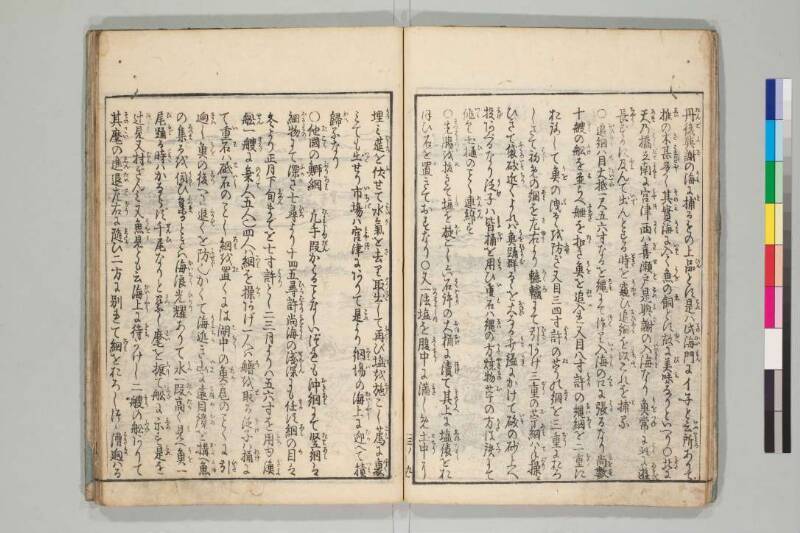
翻刻
【右丁】
丹後(たんご)与謝(よさ)の海(うみ)に捕(と)るもの《振り仮名:上品| ひん》とす是(これ)は此(この)海門(かいもん)にイネと云(いふ)所(ところ)ありて
《振り仮名:椎の木|しい き 》甚(はなはだ)多(おゝ)し其実(そのみ)海(うみ)に入(いり)て魚(うを)の飼(ゑ)とす故(ゆへ)に美味(びみ)なりといへり○北(きた)に
《振り仮名:天の橋立|あま はしだて》南(みなみ)に宮津(みやつ)西(にし)は喜瀬戸(きせと)是(これ)与謝(よさ)の入海(いりうみ)なり魚(うを)常(つね)に此(こゝ)に遊(あそび)
長(ちやう)ずるに及(およ)んで出(いで)んとする時(とき)を窺(うかゞ)ひ追網(おひあみ)を以(もちて)これを捕(と)る
○追網(おひあみ)は目(め)大抵(たいてい)一尺五六寸なるを縄(なわ)にて作(つく)り入海(いりうみ)の口(くち)に張(はる)るなり尚(なを)数(す)
十艘( そう)の船(ふね)を並(な)らべ■(ふなばた)#1を扣(たゝ)き魚(うを)を追入(おいい)れ又目八寸 許(はかり)の縄網(なはあみ)を《振り仮名:二重| ぢう》に
おろして魚(うを)の洩(も)るゝを防(ふせ)ぎ又目三四寸 許(ばかり)の荢(お)#2の網(あみ)を《振り仮名:三重| ぢう》におろ
しさて初(はじ)めの網(あみ)を左右(さゆう)より轆轤(ろくろ)にて引(ひき)あげ《振り仮名:三重| ぢう》の荢網(おあみ)#2は手操(てぐり)に
ひきて袋(ふくろ)礒(いそ)近(ちか)くよれば魚(うを)踊群(おどりむ)るゝを大(おほひ)なる打鎰(うちかき)にかけて礒(いそ)の砂上へ
投(なげ)あぐるなり泛子(うけ)は皆(みな)桶(おけ)を用(もち)ひ重石(いわ)は縄(なわ)の方(かた)焼物(やきもの)荢(お)#2の方(かた)は鉄(てつ)にて
作(つく)り《振り仮名:土樋| ひ》のことく連綿(れんめん)す
○先(まづ)膓(はらはた)を抜(ぬ)きて塩(しほ)を施(ほど)こし六石( こく)許(ばかり)の大桶(おほおけ)に漬(つけ)て其上(そのうへ)に塩俵(しほたはら)をお
ほひ石(いし)を置(お)きておすなり○又 一法(いつはう)塩(しほ)を腹中(ふくちう)に満(みた)しめ土中(とちう)に
【左丁】
埋(うつ)み筵(むしろ)を伏(ふ)せて水気(すいき)を去(さ)り取出(とりいだ)して再(ふたゝ)び塩(しほ)を施(ほど)こし薦(こも)に裹(つゝ)
みても出(いだ)せり市場(いちば)は宮津(みやつ)にありて是(これ)より網場(あみば)の海上(かいしやう)に迎(むか)へて積(つみ)
帰(かへ)るなり
○他国(たこく)の鰤網(ぶりあみ) 凡(およそ)手段(しゆだん)かはることなしいづれも沖網(おきあみ)にて竪網(たてあみ)は
細物(ほそもの)にて深(ふか)さ七尋( ひろ)より十四五尋( ひろ)許(ばかり)尚(なを)海(うみ)の浅深(せんしん)にも任(まか)す網(あみ)の目(め)は
冬より正月下旬( じゆん)までを七寸 許(ばかり)とし二三月よりは五六寸を用(もち)ゆ漁(ぎよ)
船(せん)一艘( さう)に乗人(のりて)五人也四人は網(あみ)を操(くり)あげ一人は艪(ろ)を取(と)る泛子(うけ)は桶(おけ)に
て重石(いわ)は砥石(といし)のことし網(あみ)を置(お)くには湖中(こちう)の《振り仮名:魚簄|ゑり》のことくに引(ひき)
廻(まは)し魚(うを)の後(しり)へに退(しりぞ)くを防(ふせぐ)也かくて海(うみ)近(ちか)き山(やま)に遠眼鏡(とほめかね)を搆(かま)へ魚(うほ)
の集(あつま)るを伺(うかゞ)ひ集(あつま)るときは海浪(かいらう)光耀(ひかり)ありて水(みつ)一段( だん)高(たか)く見(み)へ魚(うを)一
尾(び)踊(おど)る時(とき)はかならず千尾(せんひ)なりと察(さつ)し麾(ざい)を振(ふり)て船(ふね)に示(しめ)す是(これ)を
辻見(つしみ)又 《振り仮名:村ぎんみ|むら 》又 魚見(うをみ)とも云 海上(かいしやう)に待(まち)うけし《振り仮名:二艘| そう》の船(ふね)ありて
其(その)麾(さい)の進退(しんたい)左右(さゆう)に随(したが)ひ二方に別れて網(あみ)をおろしつゝ漕廻(こきま)はる
現代語訳
【右丁】
丹後の与謝の海で捕れるものを上品とする。これは、この海門にイネという所があって、椎の木が非常に多い。その実が海に入って魚の餌となるので美味であるという。北に天橋立、南に宮津、西は喜瀬戸、これが与謝の入海である。魚は常にここで遊び、成長して出ようとする時を狙って、追網でこれを捕る。
追網は目が大体一尺五六寸になるものを縄で作り、入海の口に張るのである。さらに数十艘の船を並べて船縁を叩き、魚を追い入れ、また目八寸ほどの縄網を二重におろして魚が漏れるのを防ぎ、また目三四寸ほどの荢網を三重におろす。そして最初の網を左右から轆轤で引き上げ、三重の荢網は手繰りで引いて袋状にし、磯近くに寄せば魚が踊り群れるのを大きな打鎰にかけて磯の砂上へ投げ上げるのである。浮きは皆桶を用い、重石は縄の方は焼物、荢の方は鉄で作り、土樋のように連綿と続く。
まず内臓を抜いて塩を施し、六石ほどの大桶に漬けて、その上に塩俵をかぶせ、石を置いて押すのである。また一つの方法として、塩を腹中に満たし土中に
【左丁】
埋めて筵を伏せて水気を去り、取り出して再び塩を施し、薦に包んでも出荷する。市場は宮津にあって、これより網場の海上に迎えに行って積んで帰るのである。
他国の鰤網も、およそ手段は変わることがない。いずれも沖網で、竪網は細物で深さ七尋から十四五尋ほど、さらに海の浅深にも任せる。網の目は冬から正月下旬までを七寸ほどとし、二三月からは五六寸を用いる。漁船一艘に乗る人は五人で、四人は網を繰り上げ、一人は櫓を取る。浮きは桶で、重石は砥石のようである。網を置くには湖中の魚簄のように引き回し、魚が後ろへ退くのを防ぐ。こうして海に近い山に遠眼鏡を構え、魚の集まるのを伺い、集まる時は海浪に光があって水が一段高く見え、魚一尾が踊る時は必ず千尾であると察し、旗を振って船に示す。これを辻見、また村ぎんみ、また魚見とも言う。海上に待ち受けた二艘の船があって、その旗の進退左右に従い、二方に分かれて網をおろしつつ漕ぎ回る。
英語訳
【Right Page】
What is caught in the sea of Yosa in Tango is considered high quality. This is because there is a place called Ine at this bay entrance, where there are very many chinquapin trees. Their nuts fall into the sea and become fish food, so [the fish] are said to be delicious. To the north is Amanohashidate, to the south is Miyazu, and to the west is Kiseto - this is the inlet sea of Yosa. Fish always play here, and when they have grown and are about to leave, [fishermen] watch for this timing and catch them with driving nets.
The driving nets have mesh of about one shaku five to six sun made with rope, and are stretched across the mouth of the inlet. Furthermore, dozens of boats are lined up and the gunwales are struck to drive the fish in. Also, rope nets with eight-sun mesh are lowered in double layers to prevent fish from escaping, and nets with three to four-sun mesh are lowered in triple layers. Then the first net is pulled up from left and right with windlasses, the triple-layered nets are pulled by hand into bag shapes, and when brought close to the shore where the fish leap and swarm, they are scooped up with large dip nets and thrown onto the sandy shore. The floats are all made from buckets, and the sinkers are made of pottery for the rope [nets] and iron for the other nets, connected continuously like earthen pipes.
First the intestines are removed and salt is applied, then [the fish] are pickled in large tubs of about six koku capacity, with salt bales placed on top and stones placed to press them down. Another method is to fill the belly cavity with salt and bury [the fish] in soil,
【Left Page】
covering with mats to remove moisture, then taking them out and applying salt again, wrapping them in straw mats for shipping. The market is in Miyazu, and from there [merchants] go out to meet [the boats] on the sea at the fishing grounds and load up to return.
Yellowtail nets in other provinces use generally the same methods. They are all offshore nets, with vertical nets made of fine material, seven to fourteen or fifteen fathoms deep, further depending on the depth of the sea. The net mesh is about seven sun from winter until late January, and from February to March, five to six sun mesh is used. Five people ride in one fishing boat - four operate the nets and one handles the oar. The floats are buckets and the sinkers are like whetstones. When setting the nets, they are deployed in a circle like fish weirs in lakes to prevent fish from retreating backwards. Thus, telescopes are set up on mountains near the sea to watch for fish gathering. When they gather, there is light on the sea waves and the water appears raised one level higher. When one fish leaps, it is judged that there must be a thousand fish, and flags are waved to signal the boats. This is called tsushimi, or mura-ginmi, or also uwo-mi (fish watching). Two boats wait on the sea and follow the advance, retreat, left and right movements of those flags, separating in two directions and rowing around while lowering their nets.