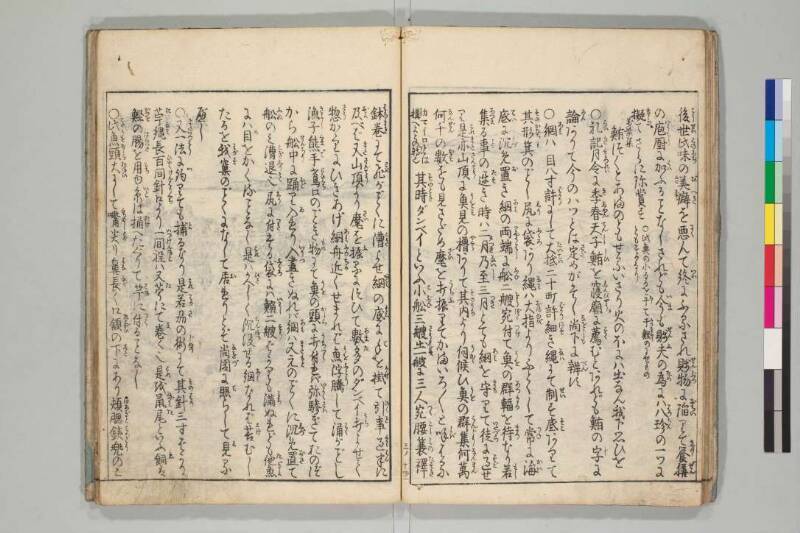
翻刻
【右丁】
後世(こうせい)此味(このあぢ)の美癖(びへき|ムマスキ)を悪(にく)んて終(つい)にふるされ賤物(せんぶつ)に陥(おちい)りて饗膳(きやうぜん)
の庖厨(はうちう)に加(くは)ふることなしされども今(いま)も賤夫(せんふ)の為(ため)には八珍(はつちん)の一ツに
擬(なすらへ)てさらに珍賞す《割書:○此魚の小なるを干(ほし)て干鰹(かつをふし)のにせもの|ともするなり》
《割書:万葉集|》
鮪つくとあまのともせるいさり火のほには出なん我下思ひを
○礼記月令(らいきぐわつれい)に季春(きしゆん)天子(てんし)鮪(しひ)を寝廟(しんびやう)に薦(すゝ)むとあれども鮪の字(じ)に
論(ろん)ありて今(いま)のハツとは定(さだ)めがたし尚(なを)下(しも)に弁(べん)す
○網(あみ)は目八寸 許(ばかり)にして大抵(たいてい)二十町 許(ばかり)細(ほそ)き縄(なは)にて制(せい)す底(そこ)ありて
其形(そのかたち)箕(み)のごとし尻(しり)に袋(ふくろ)あり縄(なは)は大指(おほゆび)よりふとくして常(つね)に海(かい)
底(てい)に沈(しづ)め置(お)き網(あみ)の両端(りやうはし)に船(ふね)二艘( そう)宛(づゝ)付(つけ)て魚(うを)の群輻(あつまる)を待(まつ)なり若(もし)
集(あつま)る事(こと)の遅(おそ)き時は二 ̄タ月(つき)乃至(ないし)三月( つき)とても網(あみ)を守(まも)りて徒(いたづら)に過(すご)せ
り是亦(これまた)山頂(さんてう)に魚見(うをみ)の櫓(やくら)ありて其内(そのうち)より伺候(うかゝ)ひ魚(うを)の群集(くんじう)何万(なんまん)
何千(なんぜん)の数(かす)をも見さだめ麾(ざい)を打振(うちふ)りてかまいろ〳〵と呼(よば)はる
《割書:カマイロとは|搆(かま)へよとの転(てん)也》其時(そのとき)ダンベイといふ小船(こぶね)三艘( さう)出(イダス)一艘に三人 宛(づゝ)腰簑(こしみの)襗(たすき)#1
【左丁】
鉢巻(はちまき)にて飛(とぶ)がごとくに漕(こき)よせ網(あみ)の底(そこ)に手を掛(かけ)て引事(ひくこと)過半(くわはん)に
及(およ)べば又(また)山頂(さんてう)より麾(さい)を振(ふ)るにつひて数多(あまた)のダンベイ打(うち)よせて
惣(さう)かゝりにひきあげ網(あみ)舟(ふね)近(ちか)くせまれば魚(うを)浮騰(ふとう)して湧(わく)がごとし
漁子(きよし)熊手(くまで)鳶口(とひくち)のごとき物(もの)にて魚(うを)の頭(かしら)に打付(うちつく)れば弥(いよ〳〵)驂(さは)ぎたておのづ
から船中(せんちう)に踊(おど)り入(ゐ)れり入尽(いりつ)きぬれば網(あみ)は又(また)元(もと)のごとくに沈(しづ)め置(おき)て
船(ふね)のみ漕退(こぎしりそく)也 尻(しり)に付(つき)たる袋(ふくろ)には鰯(いわし)二艘( そう)ばかりも満(みち)ぬれども他魚(たぎよ)
には目(め)をかくることなし是(これ)は久(ひさ)しく沈没(ちんほつ)せる網(あみ)なれば苔(こけ)むし
たるを我(わが)巣(す)のごとくになして居(お)れりとぞ尚(なを)図(づ)に照(て)らして見(み)る
べし
○又(また)一法(いつはう)に釣(つ)りても捕(と)るなり是(これ)若州(わかさ)の術(じゆつ)にて其針(そのはり)三寸ばかり
荢縄(おなわ)#2長 百間(ひやくけん)針口(はりくち)より一間(いつけん)程(ほと)は又 荢(お)#2にて巻(ま)く也 是(これ)を鼠尾(ねづみお)といふ飼(ゑ)は
鰹(かつを)の腸(はらはた)を用(もち)ゆ糸(いと)は桶(おけ)へたぐりて竿(さほ)に付(つく)ることなし
○此魚(このうを)頭(かしら)大(おほひ)にして嘴(くちばし)尖(とが)り鼻(はな)長(なが)く口 頜(おとがひ)の下(した)にあり頬(ほ)腮(あぎと)鉄兜(てつとう)のこ
現代語訳
【右丁】
後の世になってこの魚の味の美味しさを好むことを嫌って、ついには古くさい安物の魚とみなされるようになり、宴席の料理に加えることがなくなった。しかし今でも一般庶民にとっては八珍(最高の珍味)の一つとして扱われ、相変わらず珍重されている。《注:この魚の小さなものを干して鰹節の偽物とすることもある》
《万葉集より》
「鮪突くと海人の灯せる漁り火の穂には出でなん我が下思ひを」
○『礼記月令』に「季春に天子が鮪を祖先の霊廟に供える」とあるが、鮪の字については議論があり、今のマグロと断定するのは難しい。詳しくは後で説明する。
○網の目は八寸ほどで、だいたい二十町ほどの長さで、細い縄で作られている。底があってその形は箕のようで、尻に袋がある。縄は親指より太く、常に海底に沈めて置き、網の両端に船を二艘ずつ配置して魚の群れが集まるのを待つ。もし集まるのが遅い時は二、三か月でも網を守って無駄に過ごすこともある。この時も山頂に魚見の櫓があり、そこから様子をうかがい、魚の群れが何万何千という数になるのを見定めて、旗を振って「かまいろう」と呼びかける。
《注:「かまいろ」とは「構えよ」の転訛》その時、ダンベイという小船三艘が出る。一艘に三人ずつ、腰蓑、襷、鉢巻をして飛ぶように漕ぎ寄せ、網の底に手をかけて引くこと半分以上
【左丁】
に及べば、また山頂から旗を振るのに従って数多のダンベイが打ち寄せて、総がかりで引き上げる。網が船近くに迫れば魚が浮き上がって湧くようである。
漁師は熊手や鳶口のような物で魚の頭を打ちつければ、ますます騒ぎ立て、自然と船中に踊り込んでくる。すっかり入り終われば、網はまた元のように沈めて置いて、船だけが漕ぎ去る。尻についた袋には鰯が二艘分ほども満ちているが、他の魚には目もくれない。これは長く沈んでいた網なので苔むしているのを自分の巣のようにして住んでいるからである。なお図を参照して見るべきである。
○また別の方法で釣りでも捕る。これは若狭の技術で、その針は三寸ばかり、麻縄の長さは百間、針口から一間ほどはまた麻で巻く。これを鼠尾という。餌は鰹の内臓を用いる。糸は桶にたぐって竿には付けない。
○この魚は頭が大きく嘴が尖り、鼻が長く、口は顎の下にあり、頬から顎にかけては鉄兜のよう
英語訳
【Right Page】
In later generations, people came to dislike the preference for this fish's delicious taste, and it eventually fell into disfavor as an old-fashioned cheap fish, no longer being included in banquet cuisine. However, even today it is still considered one of the eight delicacies (supreme delicacies) by common people and continues to be prized. 《Note: Small specimens of this fish are dried and used as imitation bonito flakes》
《From the Man'yōshū》
"Like the flames of fishing fires lit by fishermen hunting tuna, my hidden feelings should burst forth"
○The "Record of Rites - Monthly Ordinances" states that "in late spring the emperor offers tuna to ancestral shrines," but there is debate about the character for tuna, making it difficult to determine if this refers to modern bluefin tuna. This will be explained in detail later.
○The net mesh is about eight inches, roughly twenty chō in length, made with thin rope. It has a bottom and is shaped like a winnowing basket, with a bag at the end. The rope is thicker than a thumb and is constantly kept submerged on the sea floor, with two boats stationed at each end of the net waiting for schools of fish to gather. If the fish are slow to gather, they may wait uselessly for two or three months guarding the net. During this time, there is a fish-watching tower on the mountaintop from which they observe and determine when fish schools numbering in the tens of thousands gather, then wave flags and call out "kamairō."
《Note: "Kamairō" is a corruption of "kamaero" (get ready)》 At that time, three small boats called "Danbei" set out. With three people per boat wearing waist straw coats, sashes, and headbands, they row over flying-fast and grab the bottom of the net, pulling until more than half
【Left Page】
is complete. Then, following flag signals from the mountaintop, many Danbei boats converge and pull together. When the net approaches the boats, the fish rise to the surface like boiling water.
The fishermen strike the fish heads with rake-like and boat hook-like tools, causing them to thrash about even more and naturally leap into the boats. Once they are all in, the net is again submerged as before, and only the boats row away. The bag at the end is filled with sardines equivalent to about two boatloads, but they pay no attention to other fish. This is because the net has been submerged for a long time and become mossy, which the fish use as their nest. One should refer to the illustration for further understanding.
○There is also another method of catching them by angling. This is a technique from Wakasa Province, using hooks about three inches long with hemp rope one hundred ken in length, with about one ken from the hook wrapped again in hemp. This is called "mouse tail." Bonito entrails are used as bait. The line is coiled in a tub and not attached to a pole.
○This fish has a large head with a pointed beak, a long nose, a mouth located under the jaw, and cheeks and jaws like an iron helmet