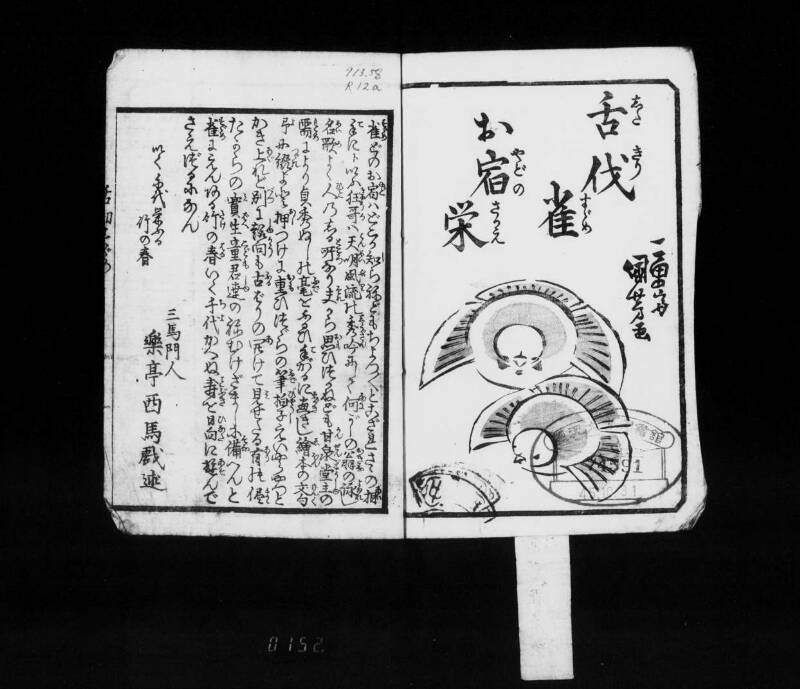
翻刻
舌伐(したきり)
雀(すずめ)
お宿(やどの)
栄(さかえ)
一勇斎
国芳
雀(すゞめ)どのお宿(やど)はどこか知(し)らねどもちよつ〳〵とこざれさゝの相(あい)
手(て)にといふ狂哥(きやうか)は天明風流(てんめいぶり)の秀吟(しうぎん)にして何(なに)がしの翁(おきな)の詠(よまれ)し
名歌(めいか)よく人(ひと)のしる所(ところ)なり夫(それ)から思(おも)ひつかねども甘泉(かんせん)堂主(どうしゆ)の
需(もとめ)により貞秀ぬしの毫(ふで)をふるひ手(て)がるに画(ゑが)きし絵本(ゑほん)のもんく
予(よ)に綴(つゞれ)よと押(おし)つけに重(おも)ひつゞらの筆拍子(ふでびやうし)えいやらやつと
かき上(あぐ)れど別(べつ)に趣向(しゆかう)も古(ふる)ばりの開(あ)けて見(み)せたる有(あり)の侭(まゝ)
たからの実生(みばへ)童君達(こどもしゆ)のねむけざましに備(そな)へんと
雀(すゞめ)にえんある竹(たけ)の春(はる)いく千代(ちよ)かへぬ寿(ことぶき)を日向(ひなた)に遊(あそ)んで
さえづるになん
いく千代栄ふる
竹の春
三馬門人
楽亭西馬戯述
現代語訳
**舌切り雀 お宿の栄**
(絵:一勇斎国芳)
「雀どのお宿はどこか知らねども、ちょいちょいとこざれ、笹の相手に」という狂歌は、天明期の風流な秀逸な句として、何某という翁が詠まれた名歌であり、広く人々に知られているところである。それからというもの、思いついたわけでもないが、甘泉堂の主人の求めにより、貞秀先生が筆を振るい、気軽に描いた絵本の文章を、私に綴れと押しつけられ、重いつづらを持つような気持ちで、筆の勢いに任せて「えいやら」とやっとかき上げた。格別に新しい趣向もなく、古びた箱を開けて見せるような、ありのままのものである。宝の芽生えのような子供たちの眠気覚ましにと備えるべく、雀にゆかりある竹の春のごとく、いく千代も変わらぬ寿ぎを、日向で遊びながら囀るばかりである。
いく千代栄える
竹の春
三馬門人
楽亭西馬 謹んで述ぶ
英語訳
**The Tongue-Cut Sparrow: The Prosperity of the Inn**
(Illustrated by Ichiyūsai Kuniyoshi)
The kyōka verse — "I know not where your inn may be, dear Mr. Sparrow, but please do come by now and again, to keep the bamboo company" — is celebrated as a masterpiece of the elegant Tenmei-era style, composed by a certain elderly gentleman, and is well known among many people. Though it did not exactly spring to mind from that poem alone, at the request of the proprietor of Kansentō, Mr. Teihide took up his brush and lightly sketched out an illustrated book, and I was pressed to provide the accompanying text. Feeling as though I were lifting a heavy treasure chest, I managed — with a great heave-ho — to finish the writing. There is nothing particularly novel in the approach; it is simply an opening of an old box to reveal things as they are. I offer this humbly as something to rouse children — those budding treasures — from their drowsiness, and like the spring of bamboo so associated with sparrows, I chirp away in the sunlight, celebrating prosperity through a thousand ages unchanging.
May prosperity flourish
for a thousand ages —
the spring of bamboo
Disciple of Sanba,
Rakutei Saima, written in jest