翻刻
大經藏
霊宝録曰經論聖教等を納る也本尊阿弥陀佛春日作也
此内に伏藏あり當寺三伏藏の一つなり
手水屋
霊宝録曰後嵯峨上皇臨幸の時御手水所也
藏王権現を安置す役行者の御作
三經院
霊宝録曰本尊阿弥陀佛行基作文殊弥勒四天王
毎年一夏九旬太子御遺願の三經講談あり今に絶ず
七種寶器あり釋尊より勝鬘夫人に授たまふ納袈裟梵綱經
太子御自筆外題に御手の皮を押給ふ真鈴子神代皇物也賢聖瓢
春秋瓢ともいふ孔子等の聖賢の像御足印太子御足の跡を踏残
し給ふ梓真弓六月鏑守屋大姓を御退治の時の軍器なり其外畫像
書軸かす〳〵あり
聖霊院
俗に太子堂といふ皇太子攝政束帯の遺像あり大兄王子
殖栗上子茨田王子惠慈法師已上鳥佛師の作の但其外かす〳〵あり
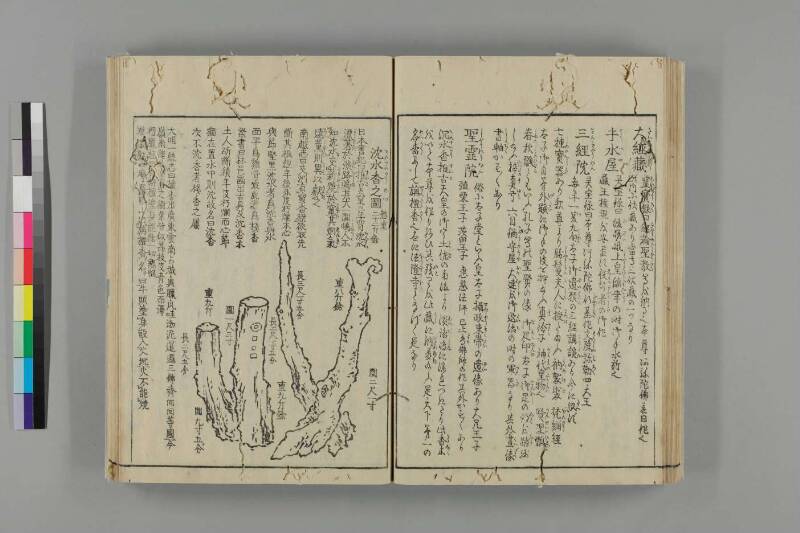
沈水香推古天皇の御宇土佐の南海より淡路嶋に流れつきたり此香木
を以て本尊を作り給ひ其残りを此般に納置給ふ是天下第一の
名香にして栴檀香也世に法隆寺となづく是なり
沈水香之図
惣重
二十二斤餘
日本書紀曰推古天皇三年四月沈水
漂着於淡路嶋其大一圍嶋人不
知沈水交薪焼於竃其烟気
遠薫則異以献獻之
南越志曰交州有宝香掛欲取先
断其根経年後外皮朽爛木心
與節堅黒沈水者為沈香興水
面平鳥鶏骨最麁者烏桟香
梁書曰林邑国出古具及沈香木
土人研断積年皮朽爛而心節
独在置水中則沈故名曰沈香
次不沈香者桟香之属
大明一統志曰檀香出廣東雲南占城眞臘瓜哇渤泥暹邏三佛齊囘囘等國今
嶺南諸地亦有之樹葉皆似茘枝皮青色而澤
楞嚴經曰包栴檀塗身能除一切熱悩
華嚴經摩羅耶山栴檀香名て曰牛頭塗身設入火■火不能焼
とし
圍二尺一寸
重八斤餘
長二尺一寸五分
重九斤余
長二尺一寸五分
圍一尺三寸
重九斤
圍九寸五分
長二尺五分
現代語訳
**大経蔵(だいきょうぞう)**
『霊宝録』によれば、経論・聖教などを納めている。本尊は阿弥陀仏で、春日仏師の作である。この内部に伏蔵(ふくぞう)があり、当寺三か所の伏蔵のうちの一つである。
---
**手水屋(ちょうずや)**
『霊宝録』によれば、後嵯峨上皇が行幸された際の御手水所である。蔵王権現を安置しており、役行者(えんのぎょうじゃ)の御作である。
---
**三経院(さんきょういん)**
『霊宝録』によれば、本尊は阿弥陀仏(行基の作)、文殊・弥勒・四天王を安置する。毎年、夏安居(げあんご)の九十日間、太子の御遺願による三経(さんきょう)の講談が行われており、今も絶えることなく続いている。七種の宝器がある。釈尊より勝鬘夫人(しょうまんぶにん)に授けられたという納袈裟、梵網経(ぼんもうきょう)(太子御自筆のもので、外題には御手の皮を押されている)、真鈴子(まりんす)(神代の皇物である)、賢聖瓢(けんせいひょう)(春秋瓢ともいう、孔子ら聖賢の像を描いたもの)、御足印(太子の御足の跡を踏み残されたもの)、梓真弓(あずさまゆみ)、六月鏑(むつきかぶら)(守屋大臣を御退治の際の軍器である)、その他画像・書軸など数々がある。
---
**聖霊院(しょうりょういん)**
俗に「太子堂」という。皇太子・摂政の束帯(そくたい)姿の御遺像があり、大兄王子・殖栗王子(えぐりおうじ)・茨田王子(まんだおうじ)・恵慈法師(えじほうし)などがあり、いずれも鳥仏師(とりぶっし)の作であるが、その他にも数々ある。
沈水香(じんすいこう)については、推古天皇の御代に、土佐の南海から淡路島に流れ着いた。この香木をもって本尊を作られ、その残りをこの厨子(ずし)に納め置かれた。これは天下第一の名香であって、栴檀香(せんだんこう)である。世に「法隆寺の香」と名付けるのはこれのことである。
---
**沈水香の図**
総重量 二十二斤余
---
『日本書紀』に曰く、推古天皇三年四月、沈水(じんすい)が淡路島に漂着した。その大きさは一囲(ひとかかえ)ほどであった。島人はそれが沈水香であることを知らず、薪に交ぜて竈(かまど)で焼いたところ、その煙の香りが遠くまで薫り、異なるものと気付いて献上した。
『南越志』に曰く、交州に宝香があり、これを採ろうとすれば、まず根を切り、数年後に外皮が朽ち爛れ、木の心と節が堅く黒くなる。水に沈むものを沈香といい、水面と平らになるものを鸚鵡(おうむ)・鶏骨と称し、最も粗いものを烏桟香(うざんこう)という。
『梁書』に曰く、林邑国(りんゆうこく)では古具(こぐ)および沈香木が産出する。土人はこれを切り、積年の後に皮が朽ち爛れ、心と節だけが残る。水の中に置けば沈むことから、沈香と名付けられた。次に水に沈まないものを桟香(さんこう)の類という。
---
『大明一統志』に曰く、檀香(だんこう)は広東・雲南・占城(チャンパ)・真臘(カンボジア)・瓜哇(ジャワ)・渤泥(ボルネオ)・暹羅(タイ)・三仏斉(シュリービジャヤ)・回回(イスラム諸国)などの国から産出する。今日では嶺南の諸地にもある。その樹と葉はいずれも茘枝(れいし)に似ており、皮は青色で潤いがある。
『楞厳経(りょうごんきょう)』に曰く、栴檀を身に塗れば、一切の熱悩を除くことができる。
『華厳経』に曰く、摩羅耶山(まらやさん)の栴檀香は「牛頭(ごず)」と名付けられており、身に塗れば、たとえ火に入っても火は焼くことができない。
---
(各部位の寸法・重量)
・囲 二尺一寸
・重 八斤余
・長 二尺一寸五分
・重 九斤余
・長 二尺一寸五分
・囲 一尺三寸
・重 九斤
・囲 九寸五分
・長 二尺五分
英語訳
**Daikyōzō (Great Sutra Repository)**
According to the *Reihōroku* (Record of Sacred Treasures), this building houses sutras, treatises, and sacred texts. The principal image is an Amida Buddha, crafted by a Kasuga sculptor. Within this repository there is a hidden underground cache (*fukuzō*), one of three such caches at this temple.
---
**Chōzuya (Water Ablution Pavilion)**
According to the *Reihōroku*, this was the hand-washing place used during the visit of Retired Emperor Gosaga. It enshrines a Zaō Gongen image, said to be the work of En no Gyōja (En the Ascetic).
---
**Sankyōin (Three Sutras Hall)**
According to the *Reihōroku*, the principal image is an Amida Buddha (the work of Gyōki), with Mañjuśrī, Maitreya, and the Four Heavenly Kings also enshrined. Every year, throughout the ninety days of the summer retreat (*ge'ango*), lectures on the Three Sutras are held in accordance with Prince Shōtoku's dying wish, a tradition that continues to this day without interruption.
Seven kinds of sacred treasures are kept here: a robe-pouch (*nōkesa*) said to have been bestowed by the Buddha upon Lady Śrīmālā; a copy of the *Brahmajāla Sūtra* written in Shōtoku Taishi's own hand, with an impression of the skin of his hand on the outer title; a *marinsu* (true bell vessel), an imperial artifact from the Age of the Gods; a *Kenseibyō* (also called *Shunjūbyō*), a gourd-shaped vessel depicting images of Confucius and other sages; a foot-print of Prince Shōtoku (*gosokin*), the impression of his very foot; an *azusamayumi* (catalpa bow); and a *mutsukikaburaya* (June-whistling arrow), a weapon used in the subjugation of Mononobe no Moriya — along with numerous other paintings and scrolls.
---
**Shōryōin (Sacred Spirit Hall)**
Commonly called the "Taishi-dō" (Prince's Hall). It houses a portrait of the Crown Prince and Regent in full court dress (*sokutai*), along with images of Prince Ōe, Prince Eguri, Prince Manda, and the priest Eji — all works of the sculptor Tori — as well as many others.
Regarding the *jinsuikō* (aloeswood/agarwood): during the reign of Empress Suiko, a piece of this wood drifted ashore on Awaji Island from the southern sea off Tosa Province. The principal image was carved from this fragrant wood, and the remainder was placed and stored in this cabinet. This is the finest aromatic wood in all the land, a sandalwood fragrance. What the world calls "Hōryūji's incense" refers to precisely this.
---
**Illustration of the Aloeswood**
Total weight: over 22 *kin* (approximately 13.2 kg)
---
The *Nihon Shoki* states: "In the third year of Empress Suiko's reign, in the fourth month, aloeswood drifted ashore on Awaji Island. It was about one arm's length in girth. The islanders, not knowing it was aloeswood, mixed it with firewood and burned it in their stoves. When its fragrance drifted far and wide, they realized it was something extraordinary and presented it [to the court]."
The *Nanyuezhi* (Record of Southern Yue) states: "In Jiaozhi (northern Vietnam) there is precious incense. To obtain it, one first cuts the roots, and after several years the outer bark rots away. The heartwood and nodes become hard and black. What sinks in water is called *chenxiang* (sinking fragrance / aloeswood); what floats level with the water surface is called 'parrot' or 'chicken bone' grade; and the coarsest variety is called *wuzanxiang* (black plank incense)."
The *Liangshu* (Book of Liang) states: "The kingdom of Linyi (Champa) produces *guju* and aloeswood. The local people cut it and leave it for many years until the outer bark rots away, leaving only the heartwood and nodes. Because it sinks when placed in water, it is called *chenxiang* (sinking fragrance). What does not sink is classified as *zanxiang* (plank fragrance) and its varieties."
---
The *Daming Yitongzhi* (Comprehensive Gazetteer of the Great Ming) states: "Sandalwood (*tanxiang*) is produced in Guangdong, Yunnan, Champa, Cambodia, Java, Borneo, Siam, Srivijaya, and the lands of the Hui (Islamic countries). Today it is also found throughout Lingnan. Its trees and leaves all resemble the lychee; its bark is green in color and lustrous."
The *Śūraṃgama Sūtra* states: "Applying powdered sandalwood to the body can remove all heat and afflictions."
The *Avataṃsaka Sūtra* states: "The sandalwood incense of Mount Māraya is called 'Ox-head' (*gōzu*). Applying it to the body, even if one enters fire, the fire cannot burn [one]."
---
(Measurements and weights of individual pieces of aloeswood:)
- Circumference: 2 *shaku* 1 *sun*
- Weight: over 8 *kin*
- Length: 2 *shaku* 1 *sun* 5 *bu*
- Weight: over 9 *kin*
- Length: 2 *shaku* 1 *sun* 5 *bu*
- Circumference: 1 *shaku* 3 *sun*
- Weight: 9 *kin*
- Circumference: 9 *sun* 5 *bu*
- Length: 2 *shaku* 5 *bu*