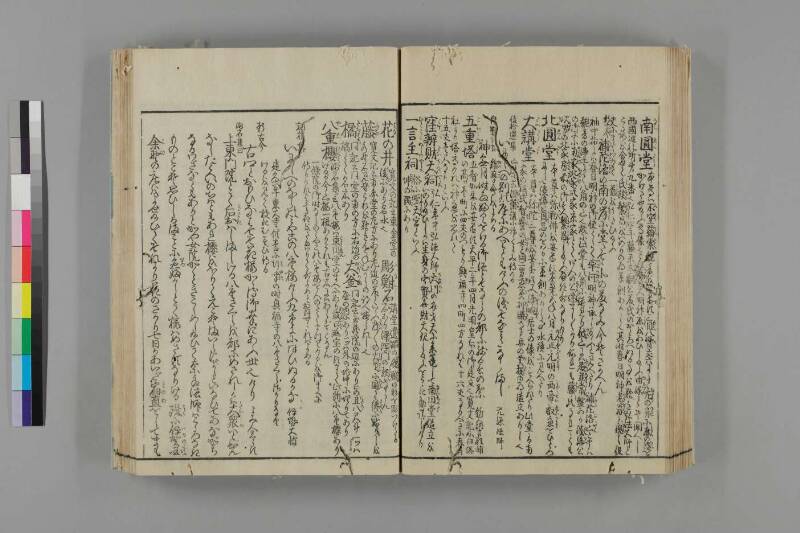
翻刻
南圓堂《割書:本尊は不空羂索観音を安置す三面八臂丈六にして左の肩に鹿の皮を|かけさせ給ふ尊像これ春日大明神鹿をあひし給ふ由縁とそ聞へし》
《割書:西国巡礼所第九番に弘仁四年藤原冬嗣は藤氏のおとろへぬる事を歎き弘法大師と|こゝろを合せて氏族繁昌をいのりの為草創ありし也其時春日明神老翁と現し役》
《割書:夫にまじはりて一首をうたひ給ふ》
新古今
補宅洛の南の岸に堂たてゝみ北の藤なみ今そさかへん
《割書:袖中抄には春日明神の御使として率河明神詠し給ふと見へたり補陀洛山と申すは|観音の浄土にて八角の山也故に此堂も八角に造れり彼山には藤並常盤あり淡海公》
《割書:の御子に南家北家式家京家とて四人の公達まし〳〵けり何れも藤氏なれとも|次男の北家房前の御すへ繁昌し給ふべき哥なりけり》
北圓堂《割書:本尊は弥勒佛を安置す養老五年八月元正元明の两帝叡慮をひとつ|にして淡海公周忌のをはりに草創ありし事水鏡に見へたり》
大講堂《割書:本尊は弥陀三尊を安置す又浄明居士の像をすへられたり此堂は南|家の祖氏智麿の女と同二恵恵美押勝など母の愛猫の菩提の為造工ありし也》
後拾遺集
山陵寺の涅槃講に詣てよみ侍ける
いにしへの別の庭にあへりともけふの涙そなみたなみたなりまし
光源法師
白川殿七百首
維摩會をよめる
神無月時雨ふりをける御法とてならの都に残るもの声に
新大納言顕輔
五重塔《割書:五智如来を安置す天平二年四月光明皇后の御建立也寛文記に曰塔|の髙さ壱町に四丈のつもり興福寺四町四方なれば十六丈なるべきに春日》
《割書:社より塔高けれは神慮を恐れて|十五丈壱尺なりといふ》
窪辨財天祠《割書:弘仁年中弘徳大師天川の弁天に参篭して南円堂造立を|いのり給ひしかは生身の宇賀弁財天現し給ふをこゝに勧請しけり》
一言主祠《割書:俗に聖天宮といふ|坤の隅にあり》
【左丁】
花の井 《割書:寛文の記云東金堂の後にあり|後にあり名水也》 彫鮒石《割書:講堂遺跡の礎鮒の形を彫つけたる|石あり澤潟門の類ならん》
藤 《割書:寛文記云南圓堂の左方にあり左近の藤といふ度〳〵の火災に遍て纔になりしを|水野石見守これを歎き近年むかしの跡へ植られし也》
橘 《割書:同記云同堂の方に右近の|橋とて名木あり》 大釜《割書:同記云玉蔵院の辺にあり口の且八尺斗一つは|屋の内にあり一つは外の地中に埋りてあり》
八重櫻 《割書:沙石集三八重桜は東円堂のまへにあり或曰延宝の頃にて此所に八重桜あり|けるが今山桜一株ありこれも古木にはあらずとなん》
《割書:一条院の御時ならのみやこの八重桜を人のたてまつりけるを御まへに|侍りければ其花をたまはりて哥よめとおほせらればよめる》
詞花集
いにしへのならのみやこの八重桜けふ九重にほひぬるかな
伊勢大輔
《割書:建久六年東大寺供養に行幸の時興福寺の八重さくらさかりなりなり|けるを見て枝にむすび侍る》
新古今
古郷とおもひなはてそ花桜かゝる御幸にあふ世也けり
よみ人しらす
沙石集曰
上東門院とて后おはしましける八重さくらを都にめされしかは大衆いとびん
なしたとへいのちはともあれ櫻をほりてえこそまいらすよしといなひてあながち
なるわざなともありとかや女院かくときこしめし給ひて奈良法師はこゝろなき
ものとこそ思ひしかまことに色ふかしとて橘はめさずなりける殊に伊賀國
余野の庄をよせ給ひてそれより花のさかり七日かあいだ宿直をしてまも
現代語訳
## 南円堂
本尊として不空羂索観音を安置する。三面八臂で、像の高さは丈六(約4.8メートル)であり、左の肩に鹿の皮をかけておられる。この尊像こそ、春日大明神が鹿をお愛しになる由縁と伝えられている。
西国巡礼の第九番札所であり、弘仁四年(813年)に藤原冬嗣が藤氏の衰退を嘆き、弘法大師と心を合わせて氏族の繁昌を祈るために草創した。その時、春日明神が老翁の姿を現して工夫たちに交じり、一首をお詠みになった。
【新古今和歌集】
補陀洛の南の岸に堂たてて み北の藤波 今ぞ栄えん
袖中抄には、春日明神の御使として率河明神がお詠みになったと記されている。補陀洛山とは観音の浄土であり八角の山である。ゆえにこの堂も八角形に造られた。彼の山には常緑樹が茂り、淡海公(藤原不比等)の御子には南家・北家・式家・京家の四公達がいらっしゃった。いずれも藤氏であるが、次男の北家・房前の御末が繁昌なさるべき歌であった。
---
## 北円堂
本尊として弥勒仏を安置する。養老五年(721年)八月、元正・元明の両帝が御心をひとつにして、淡海公(藤原不比等)の一周忌に際して草創されたことが『水鏡』に記されている。
---
## 大講堂
本尊として阿弥陀三尊を安置する。また浄明居士の像も置かれている。この堂は、南家の祖である氏智麿の女と、恵美押勝(藤原仲麻呂)等の母の愛猫の菩提のために造られた。
【後拾遺集】 山陵寺の涅槃講に詣でて詠みはべれる
いにしへの別れの庭に逢へりともけふの涙ぞ波波なりまし
光源法師
白鳳書をよめる 維摩会をよめる
神無月時雨降りおける御法とて奈良の都に残るもの声に
新大納言顕輔
---
## 五重塔
五智如来を安置する。天平二年(730年)四月、光明皇后の御建立である。寛文記に曰く、塔の高さは一町に四丈のつもりで、興福寺は四町四方であれば十六丈になるはずだが、春日社より塔が高くなると神慮が憚られるため、十五丈一尺とされたという。
---
## 窪弁財天祠
弘仁年中(810〜824年)、弘徳大師(弘法大師)が天川の弁天に参篭して南円堂の造立を祈ったところ、生身の宇賀弁財天がお現れになったので、ここに勧請した。
---
## 一言主祠
俗に聖天宮という。境内の坤(南西)の隅にある。
---
## 花の井
寛文の記に云う、東金堂の後ろにある名水である。
---
## 彫鮒石
講堂遺跡の礎石に、鮒の形を彫り付けた石がある。澤潟門(南大門)と同様の類のものであろう。
---
## 藤
寛文記に云う、南円堂の左方にあり、「左近の藤」という。度重なる火災で枯れかけてわずかになったのを、水野石見守が嘆き、昔の跡に植え直したものである。
---
## 橘
同じ記に云う、同堂の右方に「右近の橘」という名木がある。
---
## 大釜
同記に云う、玉蔵院の辺りにあり、口の径が八尺ほどで、一つは建物の内にあり、もう一つは外の地中に埋まっている。
---
## 八重桜
沙石集・三 八重桜は東円堂の前にある。ある説によれば延宝の頃(1673〜1681年)にはこの所に八重桜があったが、今は山桜一株があるのみで、これも古木ではないという。
一条院の御時、奈良の都の八重桜を人が献上したのを、御前に侍っていた折に、その花を賜り、歌を詠めと仰せられたので詠んだ。
【詞花集】
いにしへの奈良の都の八重桜 けふ九重に匂いぬるかな 伊勢大輔
建久六年(1195年)東大寺供養に行幸の時、興福寺の八重桜が盛りであったのを見て、枝に結び付けて詠んだ。
【新古今和歌集】
古郷と思ひなはてそ花桜 かかる御幸に逢ふ世なりけり 詠み人知らず
---
【沙石集】に曰く、
上東門院という后がいらっしゃり、八重桜を都に召されようとしたところ、(興福寺の)大衆はとても残念に思い、「たとえ命はどうなろうとも、桜を掘って差し上げることはできません」と断り、無理強いするような振る舞いもあったとか。女院がそのように聞き召されて、「奈良の法師たちは心ない者だと思っていたが、まことに(桜への)情が深い」とおっしゃり、橘はお召しにならなかった。特に伊賀国余野の庄を寄進なさって、それより花の盛りの七日の間、宿直をして守ら(以下次頁へ続く)
英語訳
## Nan'endō (South Circular Hall)
The principal image enshrined here is the Fukūkensaku Kannon (Amoghapāśa Avalokiteśvara). The image has three faces and eight arms, stands approximately 4.8 meters tall (jōroku), and has a deer skin draped over the left shoulder. This image is said to be the reason why the Great Deity of Kasuga holds deer in such reverence.
This is the ninth temple on the Saikoku Pilgrimage circuit. It was founded in the fourth year of Kōnin (813 CE) when Fujiwara no Fuyutsugu, lamenting the decline of the Fujiwara clan, joined forces with Kōbō Daishi (Kūkai) and established this hall to pray for the prosperity of the clan. At that time, the Kasuga Deity appeared in the form of an elderly man, mingled among the laborers, and composed a poem:
**[New Kokinshū]**
*On the southern shore of Potalaka, we have built this hall—*
*May the wisteria waves of the north now flourish.*
The Shūchūshō records that this poem was composed by the Ikuta deity as a messenger of the Kasuga Deity. Potalaka (Fudaraku-san) is the Pure Land of Kannon, an eight-sided mountain. Therefore, this hall too was built in an octagonal shape. That mountain is covered with evergreen trees. The children of Lord Ōmi (Fujiwara no Fuhito) comprised four noble houses: the Southern House, the Northern House, the Shiki House, and the Kyō House. Though all were of Fujiwara lineage, this poem foretold the flourishing of the Northern House descended from Fusasaki, the second son.
---
## Hokuen'dō (North Circular Hall)
The principal image enshrined here is Maitreya (Miroku Butsu). According to the Mizu Kagami, this hall was founded in the eighth month of the fifth year of Yōrō (721 CE), when Emperors Genshō and Genmei united their intentions to commemorate the first anniversary of the death of Lord Ōmi (Fujiwara no Fuhito).
---
## Great Lecture Hall (Daikōdō)
The principal images enshrined here are the Amida Triad. The image of Jōmyō koji (Vimalakīrti) is also placed here. This hall was built to pray for the repose of the soul of a beloved cat belonging to the mother of Ujimaro's daughter of the Southern House and Emi no Oshikatsu (Fujiwara no Nakamaro), among others.
**[Goshūi Wakashū]** — Composed upon visiting the Nirvana Lecture at Sanryōji Temple:
*Even if we were to meet again in that garden of ancient parting,*
*how the tears of today would overflow and overflow.*
— Kōgen Hōshi
**[Composed on the Vimalakirti Assembly]:**
*In the tenth month, with winter rains falling—*
*this teaching lingers in the old capital of Nara, in the sound of chanting voices.*
— New Grand Counselor Akisuke
---
## Five-Storied Pagoda
The Five Wisdom Buddhas (Gochi Nyorai) are enshrined here. It was built by Empress Kōmyō in the fourth month of the second year of Tenpyō (730 CE). According to the Kanmon Record, the height of the pagoda was originally planned at one chō and four jō, and since Kōfukuji occupies four chō on each side, the pagoda would have stood sixteen jō tall. However, since this would have made it taller than Kasuga Shrine, out of reverence for the divine will, it was reduced to fifteen jō and one shaku.
---
## Kubo Benzaiten Shrine
During the Kōnin era (810–824 CE), the Great Virtuous Master (Kōbō Daishi) secluded himself in prayer at the Benzaiten of Tenkawa, praying for the construction of Nan'endō. The living body of Uga Benzaiten appeared to him, and was subsequently enshrined here.
---
## Hitokoto-nushi Shrine
Commonly called the Shōten-gū (Shrine of the Sacred Elephant Deity). Located in the southwestern corner of the temple grounds.
---
## Hana no I (Flower Well)
According to the Kanmon Record, it is located behind the East Golden Hall and is a famous spring of pure water.
---
## Carved Crucian Carp Stone
Among the foundation stones of the former Lecture Hall, there is a stone with a crucian carp carved upon it. This is probably of the same type as the water plantain (澤潟) carving on the South Great Gate.
---
## Wisteria
According to the Kanmon Record, it is located to the left of Nan'endō and is called the "Left Wisteria" (Sakon no fuji). Repeated fires left it nearly destroyed, and Mizuno Iwami no Kami lamented this, having it replanted in its original location.
---
## Mandarin Orange Tree
The same record states that to the right of the same hall stands a famous tree called the "Right Orange" (Ukon no tachibana).
---
## Great Cauldron
The same record states that it is located near the Gyokuzō-in. The opening is approximately eight shaku in diameter. One is inside a building; the other is buried in the ground outside.
---
## Double Cherry Blossoms (Yaezakura)
According to the Shasekishū (Volume Three), the double cherry blossoms are in front of the East Circular Hall. Some say that during the Enpō era (1673–1681), there were double cherry blossoms at this spot, but now there is only a single wild cherry tree, which is not an ancient tree.
During the reign of Emperor Ichijō, someone presented double cherry blossoms from the old capital of Nara to the court. As the poet was in attendance at the Imperial presence, she was given the flowers and commanded to compose a poem:
**[Shikashū]**
*The double-petaled cherries of the ancient capital of Nara—*
*today they bloom in eightfold glory at the ninefold imperial court.*
— Ise no Taiyū
In the sixth year of Kenkyū (1195 CE), during the imperial procession for the dedication ceremony of Tōdaiji, when the double cherry blossoms of Kōfukuji were at their peak, (a poem was tied to a branch):
**[New Kokinshū]**
*Do not think of this as merely an old, familiar place—*
*cherry blossoms: this is a world that witnesses such an imperial visit.*
— Anonymous
---
The Shasekishū states:
There was an Empress known as Jōtōmon'in who wished to have the double cherry blossoms brought to the capital. However, the monks of Kōfukuji found this most disagreeable, and declared, "Even if it should cost us our lives, we cannot dig up these cherry trees and offer them." There were apparently instances of rather forceful resistance. When the Empress heard of this, she said, "I had thought the monks of Nara to be heartless, but truly their feelings for these blossoms run deep," and she did not request the orange tree. She even donated the Manor of Yono in Iga Province, and from then on, during the seven-day peak of the blossoms, night watch was kept to guard them... *(continues on next page)*