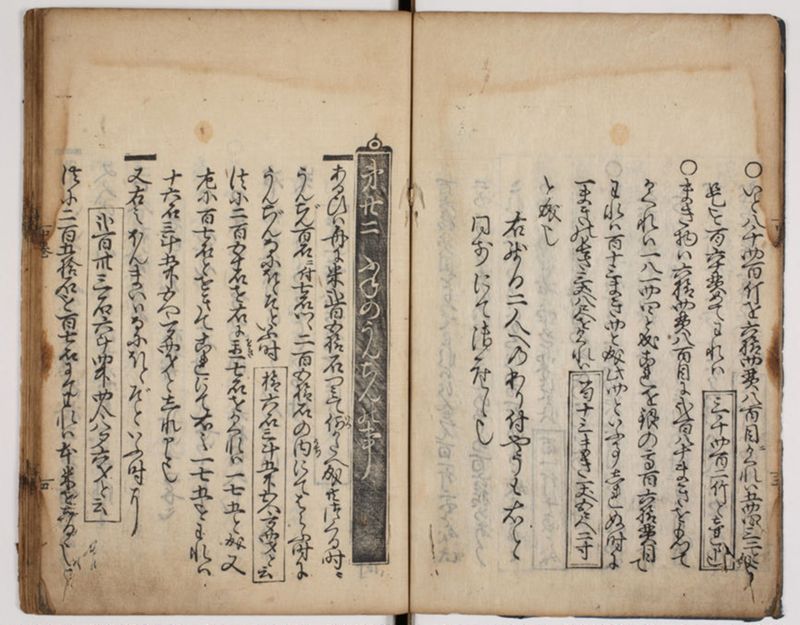
翻刻
【中巻三丁裏】
○いと八千四百斤を六拾四貫八首目 ̄ニかくれは五四四三二と成
是を百六十貫めてわれは [三千四百二斤としれ申也]
○まき物は六拾四貫八百目に弐百八十まきをもつて
かくれは一八一四四と成これを銀の高百六拾貫目て
われは百十三まき四と成此四といふ事しれぬ時に
一まきの長さ三丈八尺をかくれは [百十三まき一丈五尺二寸]
と成也
右残る二人へのわり付やうも右と
同前にて御座候也
【中巻四丁表】
《題:第廿二 ふねのうんちんの事》
┃あるひは舟に米弐百五拾石つみて何(いつ)かたへ成共御くる時 ̄ニ
うんぢん百石 ̄ニ付七石つつ二百五拾石の内(うち)にてはらふ時に
うんぢんなにほとそといふ時 [拾六石三斗五升五合一勺四才と云]
法に二百五十石を右に置(をき)七石をかくれは一七五と成又
左に百七石とをきてこれにて右の一七五をわれは
十六石三斗五升五合一勺四才としれ申也
┃又右のほんまいはなにほとぞといふ時に
[弐百卅三石六斗四升四合八勺六才と云]
法に二百五拾石を百七石にてわれは本米をしる也
現代語訳
【中巻・三丁裏】
○糸八千四百斤を六十四貫八百目にかければ五四四三二(=54,432)となる。これを百六十貫目で割れば〔三千四百二斤と知れ申すなり〕。
○巻物は六十四貫八百目に二百八十巻をかければ一八一四四(=18,144)となる。これを銀の総高百六十貫目で割れば、百十三巻と端数四となる。この「四」という意味がわからない時は、一巻の長さ三丈八尺をかければ〔百十三巻一丈五尺二寸〕となる。
右の残る二人(堺・大坂の商人)への割り付け方も、
右(京の商人の場合)と同じやり方で御座候なり。
---
【中巻・四丁表】
《第二十二 船の運賃のこと》
ある船に米二百五十石を積んで、どこへなりとも運ぶ時に、運賃を百石につき七石ずつ、二百五十石の内から払うとする。その時、運賃はいかほどかといえば、〔十六石三斗五升五合一勺四才という〕。
法:二百五十石を右に置き、七石をかければ一七五(=175)となる。また左に百七石を置き、これで右の一七五を割れば、十六石三斗五升五合一勺四才と知れ申すなり。
またこの時、本米(荷主に残る米)はいかほどかといえば、〔二百三十三石六斗四升四合八勺六才という〕。
法:二百五十石を百七石で割れば、本米を知ることができる。
英語訳
【Middle Volume, Third Folio, Verso】
○ Multiply 8,400 kin of silk thread by 64 kan 800 me, and one obtains 54,432. Dividing this by 160 kan-me gives [3,402 kin, as can be determined].
○ For rolls of cloth: multiply 64 kan 800 me by 280 rolls, and one obtains 18,144. Dividing this by the total silver of 160 kan-me gives 113 rolls with a remainder of 0.4. When the meaning of this "0.4" is unclear, multiply by the length of one roll — 3 jō 8 shaku — and one obtains [113 rolls, 1 jō 5 shaku 2 sun].
The method of apportionment for the remaining two merchants
(Sakai and Osaka) is the same as described above.
---
【Middle Volume, Fourth Folio, Recto】
《Problem 22: On the freight charges of a boat》
Suppose a boat is loaded with 250 koku of rice and is to transport it to any given destination. The freight charge is set at 7 koku per 100 koku, to be paid out of the 250 koku loaded. How much is the freight charge? [The answer is: 16 koku, 3 to, 5 shō, 5 gō, 1 shaku, 4 sai.]
Method: Place 250 koku on the right and multiply by 7 koku, giving 175. Then place 107 koku on the left, and divide the 175 on the right by it, giving 16 koku, 3 to, 5 shō, 5 gō, 1 shaku, 4 sai, as can be determined.
Furthermore, how much is the principal rice (the rice remaining for the cargo owner)?
[The answer is: 233 koku, 6 to, 4 shō, 4 gō, 8 shaku, 6 sai.]
Method: Dividing 250 koku by 107 koku gives the principal rice.