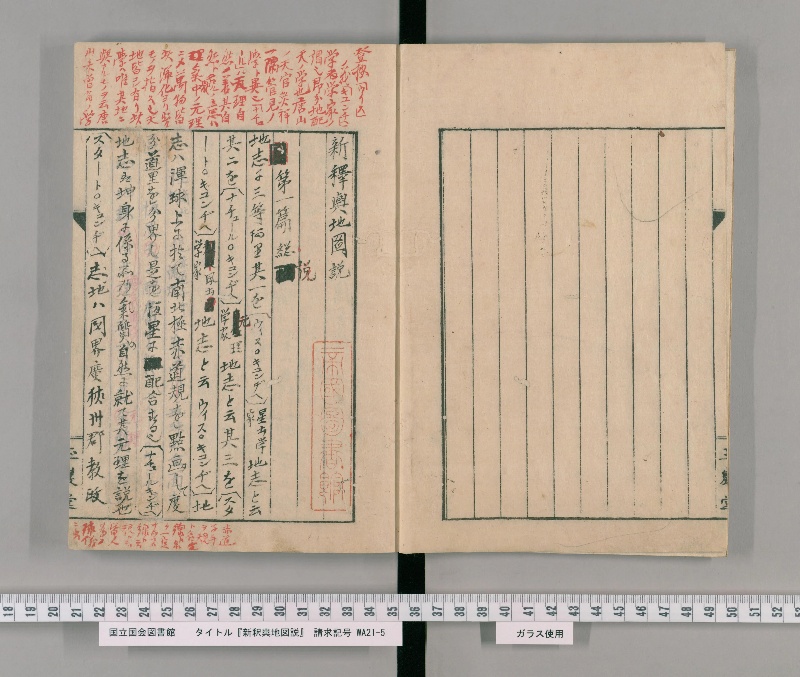
翻刻
新釈輿地図説
第一篇総説
地志に三等あり其一を(ウィス・キユンヂヘ)《割書:星土学|家》地志と云
其二を(ナチュール・キユンヂヘ)《割書:元理|学家》地志と云其三を(スタ
ート・キユンヂヘ)《割書:風土|学家》地志と云 ウィス・キユンヂヘ)地
志は渾球上に於て南北極赤道規を点画して度
分道里を分界し是を恒星に配合する也(ナチュールキュンヂヘ)
地志は坤身に係る所の気質の自然に就て其元理を説也
(スタート・キュンヂヘ)志地は国界広狭州郡教政
【上・朱書】
登按「ウイス」
ノ義「キユンチヘ」
学者学家ノ
謂也即分地配
天ノ学也唐山
ノ天宮災祥
一隅管見ノ
学ト異也「ナチュ
ール」ハ天理自
然ノ義其自
然ト名ルノ意ハ
理気教中ノ元理
ニシテ万物皆
此渾化ヨリ出ル
モノヲ指ス也天
地皆コレ有リ此
学ハ唯其地ニ
与フルモノヲ云唐
山未曽有ノ学
【下・朱書】
赤道
子午
ヲ規
ト名ケ
線ト名
ケ一定
ナラス
線ト云
規ト云
皆人
為ノ
球儀
ニ出
現代語訳
新釈輿地図説
第一篇 総説
地理学には三つの種類がある。その一つを「ウィス・キユンヂヘ」(数理地理学者の)地理学といい、その二つ目を「ナチュール・キユンヂヘ」(自然地理学者の)地理学といい、その三つ目を「スタート・キユンヂヘ」(国政地理学者の)地理学という。「ウィス・キユンヂヘ」地理学は、地球上において南北極と赤道の基準線を描いて経緯度や距離を区分し、これを恒星に対応させるものである。「ナチュール・キュンヂヘ」地理学は、地球に関わる物質の自然的性質について、その根本原理を説明するものである。「スタート・キュンヂヘ」地理学は、国境の広さ狭さ、州や郡の行政区分、宗教や政治について(論じるものである)。
【上部・朱書による注釈】
私(崋山)の考察:「ウィス」の意味、「キユンヂヘ」とは学者・学家という意味である。すなわち天地を配分する学問である。中国の天官災祥学のような一面的な見解とは異なる。「ナチュール」とは天理自然という意味で、それを自然と名づける意味は、理気哲学における根本原理であって、万物はすべてこの混然とした変化から生じるものを指している。天地にすべてこれがある。この学問は、ただその土地に関するもののみを論じる。中国にはかつてなかった学問である。
【下部・朱書による注釈】
赤道、子午線を「規」と名づけ、「線」と名づけるが、一定ではない。線といい、規というが、すべて人工的な球儀に表したものである。
英語訳
New Interpretation of World Geography
Chapter 1: General Overview
There are three types of geography. The first is called "Wis-Kyundehe" (mathematical geographers') geography, the second is called "Natuur-Kyundehe" (natural geographers') geography, and the third is called "Staat-Kyundehe" (political geographers') geography. "Wis-Kyundehe" geography involves drawing the North and South poles and equatorial reference lines on the globe to demarcate degrees, minutes, and distances, correlating these with fixed stars. "Natuur-Kyundehe" geography explains the fundamental principles regarding the natural properties of matter related to the earth. "Staat-Kyundehe" geography deals with national boundaries both extensive and narrow, administrative divisions of states and counties, religion and politics.
[Upper annotation in red ink]
My (Kazan's) analysis: The meaning of "Wis" and "Kyundehe" refers to scholars or academics. This is the study of distributing heaven and earth. It differs from the limited perspective of Chinese astronomical disaster divination. "Natuur" means natural heavenly principle, and the reason it is called "natural" refers to the fundamental principle in natural philosophy, indicating that all things emerge from this primordial transformation. Heaven and earth both possess this. This study discusses only what pertains to the land. This is a discipline that never existed in China.
[Lower annotation in red ink]
The equator and meridian are called "ki" (規) and also called "sen" (線), but this is not consistent. Whether called lines or circles, they are all artificial representations on globes.