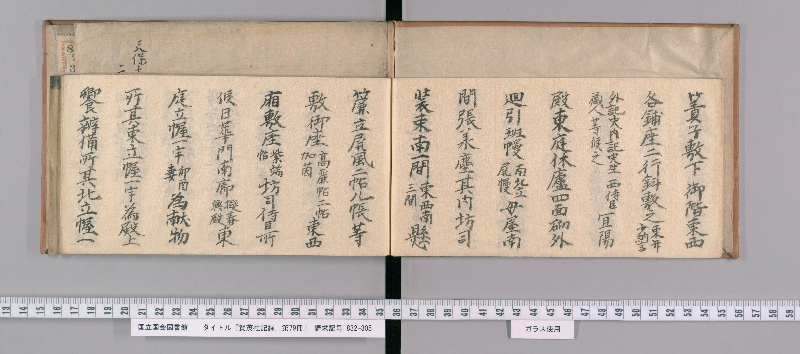
翻刻
簀子敷下御階東西
各鋪座二行斜敷之《割書:東弁|少納言》
《割書:外記央内記央生 西侍臣|蔵人等候之》冝陽
殿東庭休處四面砌外
廻引班幔《割書:南北立|屏幔》母屋南
間張承塵其内坊司
装束南一間《割書:東西南|三間》懸
簾立屏風二帖元帳等
敷御座《割書:高簾帖二帖|加茵》東西
廂敷座《割書:紫端|帖》坊司侍臣所
候日華門南廊《割書:擬春|興殿》東
庭立幄一字《割書:卯酉|妻》為献物
所其束立幄一字為殿上
饗弁備所其北立幄一
現代語訳
簀子敷の御階の東西それぞれに座を二行、斜めに敷く。(東には弁・少納言、外記・内記が控え、西には侍臣・蔵人等が候ずる。)
宜陽殿の東庭の休処は、四面の砌の外に廻らして引き班幔を張る。(南北には屏幔を立てる。)母屋の南の間に承塵を張り、その内側を坊司が装束する。南の一間(東西南の三間)に簾を懸け、屏風二帖を立て、元帳等を敷き、御座を設ける。(高簾・帖二帖・茵を加える。)東西の廂に座を敷く。(紫端の帖。)坊司・侍臣の候する所は日華門南廊とする。(春興殿に擬える。)
東庭に幄一字を立てる。(卯酉の妻。)献物所とする。その東に幄一字を立て、殿上饗弁備所とする。その北に幄一を立てる〔…〕
英語訳
On the east and west sides of the imperial steps (mi-hashigo) of the slatted-floor corridor (sunoko-shiki), two rows of seats are spread diagonally. (On the east side, the Counselors [ben] and Minor Counselors [shōnagon], as well as the Outer Recorders [geki] and Inner Recorders [naiki], wait in attendance; on the west side, the Imperial Attendants [jishō/shinjin] and Chamberlains [kurōdo] and others attend.)
Around the resting area (kyūsho) in the eastern courtyard of Giyōden, curtain-screens with a striped pattern (hiki-han-maku) are hung around the outside of the stone pavement (mizugiri) on all four sides. (Curtain-screens [heimaku] are erected on the north and south sides.) A dust-curtain (jōjin/shōjin) is stretched across the southern bay of the main building (moya), and inside this space the Bōshi arranges the furnishings. In the southern bay (three bays: east, west, and south), blinds (sudare) are hung, two folding screens are erected, and the main imperial mat/bedding (genchō) and other items are spread out to form the imperial seat (go-za). (A tall blind [takasudare] and two layers of mats [jō] with a cushion [in] are added.) Seats are spread in the eastern and western side chambers (hisashi). (Mats with purple borders [murasaki-buchi no jō].) The location where the Bōshi and imperial attendants wait in attendance is the south corridor of the Nikka Gate (Nikkamon). (Modeled after Shunkōden.)
In the eastern courtyard, a single tent canopy (aku) is erected in a straight line (ichiji). (With east-west gable ends [u-tori no tsuma].) This serves as the place for presenting offerings (kenmono-jo). To the east of this, another single tent canopy is erected to serve as the preparation area for the banquet for courtiers of the senior council (tenjō-kyō-benbisho). To the north of this, one canopy is erected [...].