翻刻
【下巻継丁裏】
子卅人有内十五人は先腹残る十五人は当腹也右のことく
立ならへて十にあたるをのけて又廿にあたるをのけ廿九人
まてのけて残る一人にあとをゆつり可申といふ時まま母かくの
ことくたてたる也さてかそへ候へは先腹の子十四人まてのき
申候時いま一たひかそへれは先腹の子みなのき申候ゆへに
一人残りたるまま子のいふやうはあまりかた一双にのき申候間
ここよりはわれよりかそへられ候へといへはせひにをよはすして一人
残りたる先腹の子よりかそへ候へは当腹の子皆のき先腹一人残る也
【下巻一丁表】
《題:第卅三》
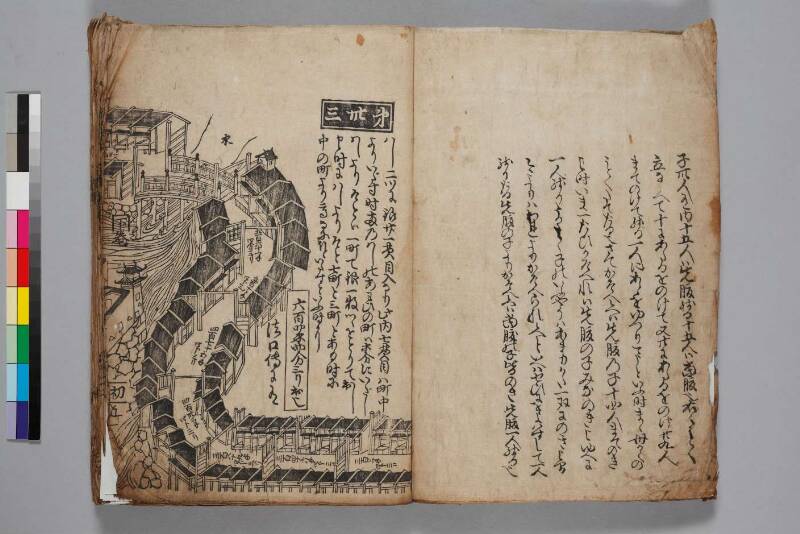
はし二つに銀廿一貫目入なり此内七貫目は町中
よりいだす時両はしのあわひの町は等分にいだし
はしよりそとは一町て銀一枚つつをとりて出し
申候時にはしよりそと七町と三町とある時に
中の町より高なにほといたすといふ時に
六百四匁四分三り出也
法口伝に有
[図]
現代語訳
【下巻・継子立て丁・裏面】
子供が三十人いて、そのうち十五人は先妻の子、残る十五人は後妻の子である。右に示したように(円形に)並べて、十番目に当たる者を除き、また二十番目に当たる者を除き、二十九人まで除いて、最後に残った一人に(家の)跡を譲るべしと言う時、継母がこのように(子供たちを)並べた。さて数えてみると、先妻の子が十四人まで除かれた時、もう一度数えると先妻の子がすべて除かれてしまうので、最後に残った継子(先妻の子)が言うには、「あまりにも一方に偏って除かれておりますゆえ、ここからは私のほうから数えていただきたい」と言ったので、どうにもならず(継母は)最後に残った先妻の子から数えると、今度は後妻の子がすべて除かれ、先妻の子が一人残ることになった。
【下巻・第一丁・表面】
《第三十三問》
橋が二つあり、(その間の)銀の負担は合計二十一貫目である。このうち七貫目は町全体から出す。両橋の間の町は等分に出し、橋より外側は一町ごとに銀一枚ずつを余分に出すものとする。橋の外側にそれぞれ七町と三町ある時、中の町(両橋の間の町)はそれぞれいくら出すか、という問題において、
答:六百四匁四分三厘が出ることになる。
解法は口伝にあり。
〔図〕
英語訳
[Volume 2, Mamako-date Folio, Reverse Side]
There are thirty children in total: fifteen are children of the first wife, and the remaining fifteen are children of the current wife. Arranged in a circle as shown, every tenth person is removed — first the tenth, then the twentieth, continuing until twenty-nine have been removed — with the last remaining child to inherit the household. The stepmother arranged them (in a circle designed to eliminate the first wife's children). However, as the counting proceeded, when fourteen of the first wife's children had been eliminated, one more count would have eliminated all remaining children of the first wife. At that moment, the last surviving stepchild (the first wife's child) said: "The eliminations have fallen far too heavily on one side; from this point, please begin counting from my position." Left with no choice, (the stepmother) began counting from the last remaining child of the first wife — and as a result, all of the current wife's children were eliminated, leaving one child of the first wife as the survivor.
[Volume 2, Folio 1, Front Side]
《Chapter 33》
There are two bridges, and the total silver contribution for them amounts to 21 *kanme*. Of this, 7 *kanme* is to be contributed by the town as a whole. The towns situated between the two bridges contribute equally, while the towns outside the bridges contribute an additional one silver coin per *chō* of distance from the bridge. When there are 7 *chō* on the outer side of one bridge and 3 *chō* on the outer side of the other, how much does each of the middle towns (between the two bridges) contribute?
Answer: 604 *monme* 4 *bu* 3 *rin* each.
The method of calculation is given by oral tradition.
〔Figure〕