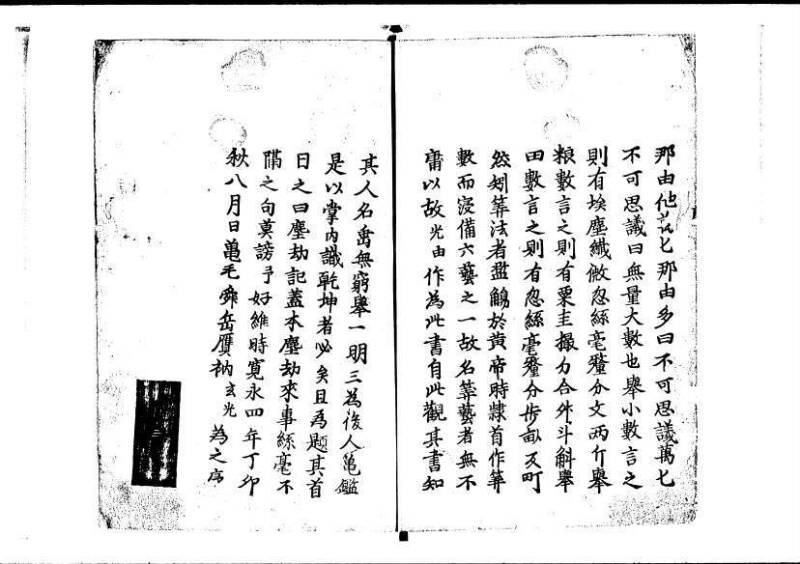
翻刻
【巻上二丁裏】
那由他萬匕那由多曰不可思議萬匕
不可思議曰無量大數也舉小數言之
則有埃塵繊微忽絲毫厘分文両斤舉
粮數言之則有栗圭撮勺合升斗斛舉
田數言之則有忽絲毫厘分歩畝反町
然矧筭法者濫觴於黄帝時隷首作筭
數而寖備六藝之一故名算藝者無不
庸以故光由作為此書自此観其書知
【巻上三丁表】
其人名禹無窮舉一明三為後人亀鑑
是以掌内識乾坤者必矣且為題其首
日之曰塵劫記蓋本塵劫来事絲毫不
隔之句莫謗予好維時寛永四年丁卯
秋八月日亀毛舜岳贋納玄光為之序
【左下に5文字分の黒塗り長方形.中央に「二」または「三」に見える白い線】
現代語訳
那由他(なゆた)の万倍を不可思議といい、不可思議の万倍を無量大数という。小さい数を挙げていえば、埃(あい)・塵(じん)・繊(せん)・微(び)・忽(こつ)・絲(し)・毫(ごう)・厘(りん)・分(ぶ)・文(もん)・両(りょう)・斤(きん)がある。量(かさ)の単位を挙げていえば、栗(りつ)・圭(けい)・撮(さつ)・勺(しゃく)・合(ごう)・升(しょう)・斗(と)・斛(こく)がある。田地の面積の単位を挙げていえば、忽(こつ)・絲(し)・毫(ごう)・厘(りん)・分(ぶ)・歩(ぶ)・畝(せ)・反(たん)・町(ちょう)がある。
そもそも算法というものは、黄帝の時代に隷首が算数を作ったことに端を発し、次第に整備されて六藝の一つとなった。ゆえに算藝と称するものは欠かすことのできないものである。このような理由から、光由はこの書を著したのである。この書を見れば、その人(光由)の名が禹のごとく無窮に伝わり、一を挙げて三を明らかにし、後世の人々の亀鑑(手本・鑑)となるであろうことは必定である。また、その首題として「塵劫記」と題するのは、思うに「塵劫来事、絲毫も隔てず(塵劫よりこのかたの事、わずかも隔てることなく)」という句に基づくものである。どうか私(序文の筆者)を好事家と謗ることなかれ。時に寛永四年丁卯(ひのとう)秋八月吉日、亀毛舜岳贋納玄光、序を為す。
【左下に、五文字分の黒塗り長方形あり(印または署名が墨消しされているものと思われる)】
英語訳
"Nayuta" multiplied ten-thousandfold is called "fukashigi" (inconceivable), and "fukashigi" multiplied ten-thousandfold is called "muryōtaisū" (immeasurably great number). To enumerate small units of measurement: there are *ai*, *jin*, *sen*, *bi*, *kotsu*, *shi*, *gō*, *rin*, *bu*, *mon*, *ryō*, and *kin*. To enumerate units of volume: there are *ritsu*, *kei*, *satsu*, *shaku*, *gō*, *shō*, *to*, and *koku*. To enumerate units of land area: there are *kotsu*, *shi*, *gō*, *rin*, *bu*, *bu* (step), *se*, *tan*, and *chō*.
Now, the art of arithmetic traces its origins to Reishu [a legendary figure], who created arithmetic during the time of the Yellow Emperor, and it gradually became fully developed as one of the Six Arts. Thus, that which is called the art of arithmetic is indispensable. For this reason, Kōyū [Yoshida Mitsuyoshi] composed this book. From reading this book, one will certainly understand that his name, like that of [the Great] Yu, will be handed down without end, and that by "raising one to illuminate three," it shall serve as a model and mirror for later generations. Furthermore, the title given at its head, *Jinkōki*, is based on the phrase "from time immemorial, not a thread's breadth is hidden [between past and present]." Please do not reproach me for my fondness [in writing this preface]. Written in the autumn, eighth month of Kan'ei 4, the year Hinoto-U (1627), by Kibō Shungaku Ganno Genkō, as a preface.
[At the lower left, there is a black-painted rectangle covering approximately five characters, presumably redacting a seal or signature.]