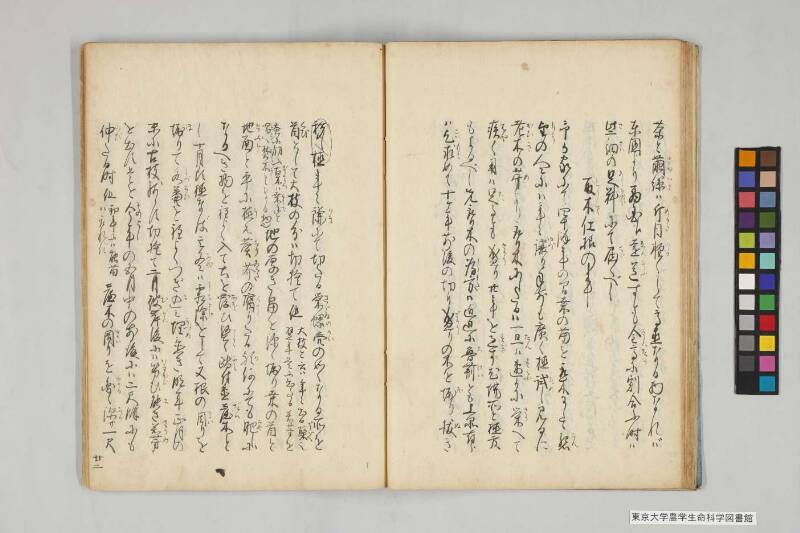
翻刻
茶と/繭絲(まゆいと)は/斤目軽(めかたかる)くして高直なる物なれば
東國より西國江/遠送(ゑんそふ)すとも/金高(きんたか)尓割合ふ時は
/些細(ささい)の/足料(あしりやう)尓て/届(とゞ)くべし
/取木(とりき)仕様の事
予か家尓て四十餘年の間桑の苗を取木尓して/懇(こん)
/望(もう)の人々尓は年々/譲(ゆづ)り手前も廣く植/試(ため)し見るに
/老木(おひき)の/芽(め)より取り木尓したるは一/旦(たん)は/速(春みや)か尓/栄(さか)へて
/疾(はや)く用は/足(た)るとも/盛(さかり)り廿年を/過(春ぎ)ず尤場所と植方に
もよるべし先取り木の/為方(しかた)は近辺尓/魯荊(ろけい)とも上品有ら
は/乞求(こいもと)めて十ヶ年前後の切り/盛(ざかり)りの木を/掘(不)り/抜(ぬ)き
移し植年々/鎌(かま)尓て切たる/栄螺買(さゞゐのかい)の如くなる所を
/首(くび)として大枝の分は切捨て但 《割書:大枝と云は年々出る/蘖(ずばへ)也|翌年是尓出たる若芽を》
《割書:蚕尓飼ふ/古木(ずわへ)は/桑手(くわで)と|/唱(とな)へ/焚木(たきぎ)となる物也》地の厚き畠を深く堀り桑の首と
/地面(ぢづら)と平尓/植(う)え/塵芥(ちりあくた)の/腐(くさり)りたる/歟(か)何尓ても/肥(こや)し尓
なるへき物を程よく入て土を/覆(おを)ひ/堅(かた)く/踏(ふみ)付置/臺(だい)木と
し十月頃植なば其/冬(ふゆ)は/霜除(しもよけ)をして又根の/周(まは)りを
/堀(ほ)りて/水糞(みづごひ)を程よくつぎ/込(こ)み/埋(うづめ)置き明年正月の
末尓古枝残ら須切捨て二月/彼岸(ひがん)後尓は/勢(いき不ひ)ひ/能(よ)き/若芽(わかめ)
を出須是を/今年(そのとし)の五月中の前後尓は二尺餘尓も
/伸(のび)たる時但《割書:初年尓は能苗|は取れず》臺木の/周(まは)りを/圓(まる)く/深(ふか)サ一尺
現代語訳
茶と繭糸は重量が軽くして高価な物なれば、東国より西国へ遠方に送るとも、金額に対する割合で見る時は、些細な運送料で届くべし。
取木仕様の事
予が家にて四十余年の間、桑の苗を取木にして懇望の人々には年々譲り、手前も広く植え試し見るに、老木の芽より取り木にしたるは一旦は速やかに栄えて早く用は足るとも、盛りは二十年を過ぎず。尤も場所と植え方にもよるべし。先ず取り木の仕方は、近辺に魯桑・荊桑とも上品有らば乞い求めて、十ヶ年前後の切り盛りの木を掘り抜き、
移し植え、年々鎌にて切たる栄螺貝の如くなる所を首として、大枝の分は切り捨てる。但し《割書:大枝と云うは年々出る蘖也|翌年これに出たる若芽を》《割書:蚕に飼う|古木は桑手と|唱え焚き木となる物也》地の厚き畑を深く掘り、桑の首と地面と平に植え、塵芥の腐りたる物か何にても肥やしになるべき物を程よく入れて土を覆い、堅く踏み付け置き台木とし、十月頃植えなば其の冬は霜除けをして、また根の周りを掘りて水糞を程よく注ぎ込み埋め置き、明年正月の末に古枝残らず切り捨てて、二月彼岸後には勢いひ良き若芽を出す。これをその年の五月中の前後には二尺余りにも伸びたる時、但し《割書:初年には良い苗|は取れず》台木の周りを円く深さ一尺
英語訳
Tea and cocoon silk are lightweight yet valuable commodities, so even when shipping them long distances from the eastern provinces to the western provinces, when calculated as a proportion of their monetary value, they can be delivered for minimal transport costs.
On the Method of Taking Cuttings
In my household, for over forty years I have been propagating mulberry saplings through cuttings, giving them annually to those who earnestly request them, and also planting them widely myself for experimentation. I have observed that while cuttings taken from shoots of old trees initially flourish rapidly and quickly serve their purpose, their prime period does not exceed twenty years. This naturally depends on the location and planting method. First, regarding the method of taking cuttings: if there are superior varieties of Lu mulberry or thorny mulberry in the vicinity, one should seek them out and dig up trees that are at their cutting prime, around ten years old.
After transplanting, the part that resembles a turban shell where it has been cut annually with a sickle becomes the "head," and the large branch portions are cut away. Note: {{Large branches refer to the annual shoots | The young buds that emerge from these the following year}} {{are fed to silkworms | Old wood is called "mulberry hands" and | becomes firewood}} Dig deeply in thick-soiled fields, plant the mulberry head level with the ground surface, add an appropriate amount of rotted refuse or whatever can serve as fertilizer, cover with soil, and tamp down firmly to serve as the stock tree. If planted around October, protect from frost during that winter, also dig around the roots and pour in an appropriate amount of liquid manure and bury it. At the end of January of the following year, cut away all the old branches without exception, and after the spring equinox in February, vigorous young shoots will emerge. By around May of that same year, these will have grown to over two feet in length. However, {{good saplings cannot be obtained in the first year}} Around the stock tree in a circle, to a depth of one foot