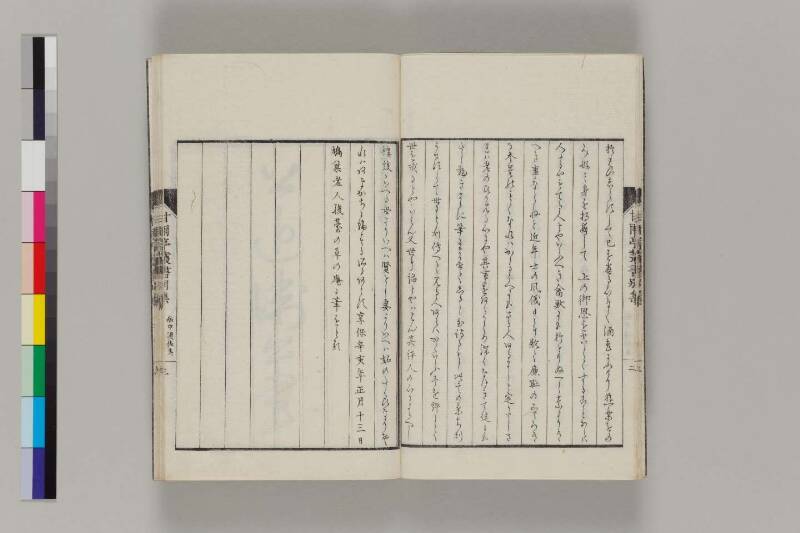
翻刻
おもひしらすして己を省る心なく酒色にふけり遊楽をの
み好み身を持崩して 上の御恩を空しくすることあらは
人たる心もてる人とやいふへき禽獣にもおとりぬへし素より有
へき事ならねど近年士の風儀日々に散【敗?】て廉恥のこゝろ有
る参星のことくなれはかゝるうへにもさる人あるましと定かたしさ
れは老のひかめる心にや其事をあらかしめ深くなけきて徒にも
たし難きまゝに筆にまかせてしるし置伝るもし此言の葉ちり
うせすして世にとり伝へて見る人あらはかくいふ予を評して
世を戒るとやいはん又世に論【謟?】とやいはん其評人の心によるへし
楼後【緩?】かいへる母よりいへは賢とし妻よりいへは妬のたくひなりそ
れはあなかちに論する所にあらす享保辛亥年正月十三日
鳩巣老人駿臺の草の庵に筆をとる
現代語訳
思い知らずして自分を省みる心もなく、酒色にふけり遊楽のみを好み、身を持ち崩して上の御恩を空しくすることがあれば、人たる心を持てる人と言うべきであろうか。禽獣にも劣るであろう。もとよりあるべきことではないが、近年武士の風儀が日々に乱れて、廉恥の心ある者は参星のようになったので、このような上にもそのような人があるまいと断定し難い。それゆえ老いの僻んだ心であろうか、その事を予め深く嘆いて、黙っていることも耐え難いままに、筆に任せて記し置いて伝える。もしこの言葉が散り失せずに世に語り伝えられて見る人があれば、このように言う私を評して、世を戒めるとも言うであろうし、また世に阿るとも言うであろう。その評価は人の心によるであろう。婁敬が言った「母より言えば賢とし、妻より言えば妬の類なり」というのがそれである。それはことさらに論ずるところではない。享保辛亥年正月十三日、鳩巣老人、駿台の草の庵に筆を取る。
英語訳
—if they fail to recognize this and have no heart for self-reflection, indulging in wine and sensual pleasures, favoring only amusement, ruining themselves and rendering their lord's grace meaningless, could such people be called persons with human hearts? They would be inferior even to birds and beasts. Though this should not naturally occur, in recent years the conduct of samurai has deteriorated daily, and those with a sense of honor and shame have become as rare as the three stars of Orion. Therefore, it is difficult to say with certainty that there are no such people even in these circumstances. Perhaps it is the prejudiced heart of old age, but I deeply lament this matter in advance, and finding it unbearable to remain silent, I let my brush run free and record this for posterity. If these words do not scatter and disappear but are transmitted in the world for others to read, those who evaluate me for speaking thus may call it admonishing the world, or they may call it flattering the world. Such evaluation will depend on the evaluator's heart. As Lou Jing said, "Spoken by a mother, it would be called wise; spoken by a wife, it would be called jealous." That is not something to argue about particularly. On the thirteenth day of the first month of Kyōhō Kanotoi year [1731], the old man Kyūsō takes up his brush in his humble grass hut at Sundai.