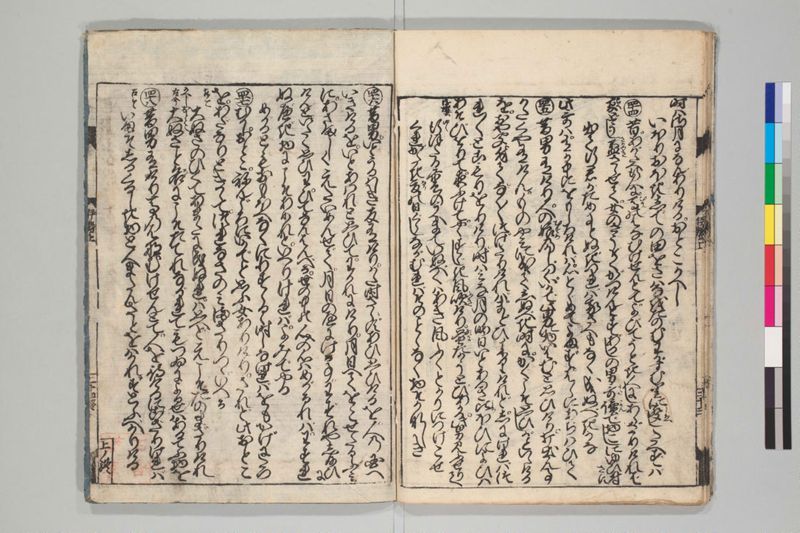
翻刻
【右丁】
時はさ月になんありける。おとこかへし
いほりおほきしでの田をさはなをたのむわがすむ里に声(こゑ)したへずば
「四十四」昔。あがたへ行人に。馬(むま)のはなむけせんとて。よびてうとき人にしあらざりければ
家(いへ)どうじ#2盃(さかつき)さゝせて。女のさうぞくがつけん#1とす。あるしの男 哥(うた)読(よん)で物こしにゆひ付さす
出て行君がためにとぬぎつれば我さへもなく成ぬべきかな
此哥は。有か中にをもしろければ。心とゞめてよまず。はらにあぢはひて
「四十五」昔男有けり。人の娘(むすめ)のかしづく。いかで此男に物いはむと思ひけり。打出ん事
かたくや有けん。ものやみに成てしぬべき時に。かくこそ思ひしがといゝける
を。おや聞付て。なく〳〵つげたりければ。まどひ来りけれど。しにければつ
れ〳〵とこもりをりけり。時はみな月の晦日いとあつき比(ころ)ほひによひは
あそびをりて。夜ふけて。やゝすゞしき風 吹(ふき)けり。蛍(ほたる)たかうとびあかる。此男見ふせりて
《送り仮名:後撰》行(ゆく)ほたる雲のうへまていぬべくはあき風ふくとかりにつげこせ
くれかたき夏(なつ)の日ぐらしながむればそのことゝなく物ぞかなしき
【左丁】
「四十六」昔男。いとうるはしき友有けり。かた時さらずあひ思ひけるを。人の国へ
いきけるを。いとあはれと思ひて。わかれにけり。月日へてをこせたるふみ
に。あさましくえたいめんせで。月日のへにける事。わず#3れやし給ひ
けんと。いたく思ひわ。#4ひてなんはんべる。世の中の人の心はめがるれば。わすれ
ぬべぎ物にこそあめれと。いへりければ。よみでやる
めがるともおもほへなくにわすらるゝ時しなければをもかげにたつ
「四十七」むかし。おとこ。ねんごろにいかでと思ふ女ありけり。されど此おとこ
を。あだなりときゝて。つれなさのみまさりつゝ。いへる
《送り仮名:古今》大ぬさのひくてあまたに成ぬれば思へどえこそたのまざりけれ
《割書:古今(かへしおとこ)》大ぬさと名(な)にこそたてれながれてもつゐによるせはあるてふ物を
「四十八」昔男有けり馬のはなむけせんとて。人を待けるに。こざりければ
《送り仮名:古今》いまそしるくるしき物と人またんさとをはかれずとふべかりける
上ノ終
現代語訳
【右丁】
(第四十三段・続き)
時は五月(さつき)であった。男の返し(歌)、
いほりおほき しでの田長は なをたのむ わがすむ里に 声(こゑ)したへずば
(庵(いほり)が多いと(噂される)しでの田長(ほととぎす)よ、それでも頼みにしてほしい——私の住む里に、(これからも)声を絶やさずにいておくれ)
---
【第四十四段】
昔、(遠方の)地方へ行く人に、餞別(はなむけ)をしようとして、(その人を)呼んだのだが、(招いた相手は)疎遠な人というわけでもなかったので、家の童(わらわ)に盃(さかずき)を持たせて、女の装束(そうぞく)を(贈り物として)付けようとした。主人(あるじ)の男が歌を詠んで、(それを)物越しに結びつけさせた。
出て行く君がために とぬぎつれば 我さへもなく 成ぬべきかな
(旅に出るあなたのためにと(この衣を)脱ぎ与えてしまえば、私まで(魂が抜けたように)なきがごとくなってしまいそうです)
この歌は、あるべき(名歌の)中でもすぐれて趣深いので、心をとめてよく読まず(ざっと読み流してはいけない)、腹に(じっくりと)味わうべきである。
---
【第四十五段】
昔、男がいた。(ある)人の娘で、大切に育てられた(かしづく)(女が)、なんとかこの男に物を言いたい(思いを打ち明けたい)と思っていた。(気持ちを)打ち明けることがかなわなかったのだろうか、(女は)もの(病)やみになって死にそうになった時に、「こんなにも(あなたを)思っていた」と言ったのを、(女の)親が聞きつけて、泣く泣く(男に)告げたので、(男は)あわてふためいて(女のもとへ)来たけれど、(すでに)死んでしまったので、所在なく(女の家に)こもって(籠もって)いた。時は六月(みなづき)の晦日(みそか)で、たいそう暑い頃に、宵(よい)の間は(管弦などで)遊んでいたが、夜が更けて、ようやく涼しい風が吹いた。蛍が高く飛び上がって明るく光った。この男は(それを)見ながら臥せっていて、
《後撰より》
行く蛍 雲のうへまで いぬべくは 秋風ふくと かりにつげこせ
(飛んでいく蛍よ、雲の上まで飛んでいけるならば、秋風が吹いているよと、(あの人に)仮(かり)にでも知らせてきておくれ)
暮れがたき 夏の日ぐらし ながむれば そのこととなく 物ぞかなしき
(暮れることもなかなかない夏の長い日を、ひたすら眺めていると、これといった理由もなく、ただ物悲しい)
---
【左丁】
【第四十六段】
昔、男に、たいそう親しい友人がいた。片時も離れずに互いに思い合っていたのに、(その友が)他国へ行くことになったので、たいそうしみじみとした思いで別れた。月日が経って、(友が)送ってきた手紙に、「(こちらに来てから)驚くほど(あなたに)直接お会いすることもできずに、月日が経ってしまったことを、(あなたは私のことを)お忘れになってしまったでしょうか——と、たいそう思い煩っております。世の中の人の心は(時とともに)移り変わるものであるから、(私のことも)忘れてしまうのが道理というものでしょうか」と言ってきたので、(男が)歌を詠んで送った。
め離(か)るとも おもほへなくに わすらるゝ 時しなければ おもかげにたつ
((遠く)目が離れてしまったとも思われないくらいに、(あなたは)忘れられることがないので、いつも(心の中の)面影に立っています)
---
【第四十七段】
昔、男に、ねんごろに(なんとか思いを届けたいと)思う女がいた。しかしこの男のことを(女は)浮気者だと聞いて、(女の)つれなさはますます募るばかりで、(女が)言った。
《古今より》
大幣(おおぬさ)の ひくてあまたに 成ぬれば 思へどえこそ たのまざりけれ
(大幣(おおぬさ)のように、引く手(求める人)があまりに多くなってしまったので、(あなたのことを)思いながらも、頼りにすることができないのです)
《割書:古今(返し・男)》
大幣と 名にこそたてれ ながれても つゐによるせは あるてふ物を
(大幣(おおぬさ)という名(評判)こそ立っているが、(川に)流れてもとどのつまりは寄る瀬(寄りどころ)はあるというものですよ)
---
【第四十八段】
昔、男がいた。餞別(はなむけ)をしようとして、人を待っていたのに、(その人が)来なかったので、
《古今より》
いまぞ知る くるしき物と 人またん さとをは離(か)れず とふべかりける
(今こそわかった。つらいものだと——人を待つのであれば、(その人の)里(家)を離れずに訪ねていくべきだったのだなあ)
---
上ノ終(上巻 終わり)
英語訳
【Right Page】
(Section 43, continued)
The time was the fifth month (early summer). The man's reply poem:
*Iori ōki / shide no taosa wa / nao tanomu / waga sumu sato ni / koe shi taezuba*
(O hototogisu, rumored to have many lodgings — still, I pray you will rely on me: do not let your voice fall silent in the village where I dwell.)
---
【Section 44】
Long ago, a man intended to give a farewell gift (hanamuke) to someone setting off for a distant province. He invited the traveler over — and as it was not a particularly distant acquaintance — he had his young house servant carry out a sake cup, and prepared to attach a woman's robe as a gift. The host composed a poem and had it tied to the gift, passed over through an intervening object (mono-goshi):
*Idete yuku / kimi ga tame ni to / nugi tsureba / ware sae mo naku / nari nu beki kana*
(Since I have stripped off and given away this robe for you, who must now depart — I fear even I shall become as if emptied, as if I no longer exist.)
This poem stands out among all fine poems for its remarkable depth of feeling; one should not read it with only half an eye, but savor it fully in one's heart.
---
【Section 45】
Long ago, there was a man. A daughter of a certain household, raised with great care, longed to speak her feelings to this man. Perhaps she found it impossible to bring herself to speak them openly — she fell gravely ill, seemingly unto death, and at that moment she said, "This is how deeply I have thought of you." Her parents, hearing this, tearfully informed the man. He rushed to her side in a panic, but she had already died; so he remained there, grief-stricken, secluding himself at her home with nothing to do.
The time was the last day of the sixth month (Minazuki), in the height of terrible summer heat. He had spent the early evening in amusement, but as the night deepened, at last a somewhat cool breeze began to blow. Fireflies flew high and glowed brightly. The man lay watching them, and (recited):
《From the Gosenshū》
*Yuku hotaru / kumo no ue made / inu beku wa / akikaze fuku to / kari ni tsuge kosei*
(Departing firefly — if you could fly as high as the clouds, bring word, even in passing, that the autumn wind is blowing (i.e., that the season has changed and my grief persists).)
*Kuregata ki / natsu no higurashi / nagamureba / sono koto to naku / mono zo kanashiki*
(As I gaze through the long, slow summer day that refuses to darken into evening, I feel, for no reason I can name, an overwhelming sadness.)
---
【Left Page】
【Section 46】
Long ago, a man had a very dear friend. The two had been inseparable, each holding the other close in heart, but when the friend departed for another province, they parted with deep and sorrowful feelings. After months and years had passed, a letter arrived from the friend, which said: "It is astonishing that I have been unable to meet you in person, and I wonder — have you forgotten me, now that so much time has passed? I am deeply troubled by this thought. The hearts of people in this world are apt to drift apart, and I suppose forgetting is only natural." In reply, the man composed and sent:
*Me karuru to mo / omohoe naku ni / wasuraru / toki shi nakereba / omokage ni tatsu*
(It does not even seem as if our eyes have grown distant from one another — for there is not a moment when you are forgotten; you always stand before me as a living image in my heart.)
---
【Section 47】
Long ago, there was a man who longed earnestly for a certain woman. But the woman had heard that this man was fickle, and her coldness toward him only grew and grew. She said to him:
《From the Kokinshū》
*Ōnusa no / hikite amata ni / nari nureba / omoedomo e koso / tanoma zarikere*
(Like the great purification wand (ōnusa), which is grasped by so many hands, you have become so sought-after that, though I long for you, I simply cannot bring myself to rely on you.)
《Interlinear note: Kokinshū — the man's reply》
*Ōnusa to / na ni koso tatere / nagarete mo / tsui ni yoru se wa / aru to iu mono wo*
(The name of "great wand" may well be my reputation — but even something adrift in the current will at last find a shore to rest upon, they say. (= Even a wanderer like me will eventually find one true resting place.))
---
【Section 48】
Long ago, there was a man. He had been waiting for someone in order to hold a farewell gathering (hanamuke), but the person did not come. And so he composed:
《From the Kokinshū》
*Ima zo shiru / kurushiki mono to / hito matan / sato wo wa karezu / tofu beka ri keru*
(Now I understand — how painful it is to wait for someone! I should not have left their village and waited here; I ought to have gone to call on them without ever leaving their side.)
---
*End of Volume One*