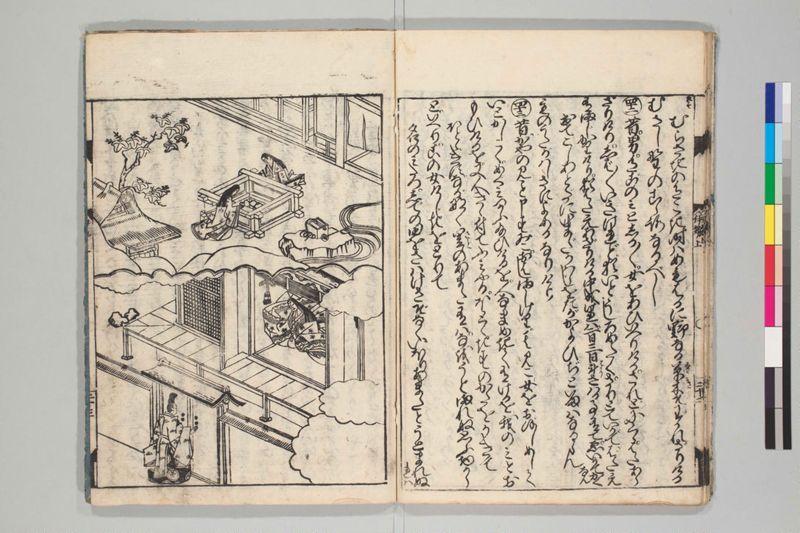
翻刻
【右丁】
《送り仮名:古今》むらさきの色こき時はめもはるに野なる草木(くさき)ぞわかれざりける
むさし野のこゝろなるべし
「四十二」昔。男。色ごのみとしる〳〵。女をあひいへりける。されどにくゝ。はたあら
ざりけり。しば〳〵いきけれど。猶いとうしろめたく。さりとていかで。はたえ
有まじかりけり。猶はたえあらざりける中成けれは。二日三日 計(はかり)さはる事有て。ゑいかてかくなん
出てこしあとだにいまだかはらじをたがかよひぢといまはなるらん
ものうたがはしさによめるなりけり
「四十三」昔。かやのみこと申すみこ。おはしましけり。其みこ。女をおぼしめして
いとかしこく。めぐみつかふ給ひけるを。人なまめきて有けるを。我のみてお
もひけるを。又人きゝ付てふみやる。ほとゝぎすのかたをかきて
ほとゝぎす。ながなく里(さと)のあまた有は。なをうとまれぬ思ふ物から
と。いへり。この女けしきをとりて
名のみたつ。しでの田をさはけさぞなくいほりあまたとうとまれぬれは
【左丁】
【挿絵】
現代語訳
【右丁】
(第四十一段・続き)
《古今より》
紫の 色こき時は めもはるに 野なる草木ぞ わかれざりける
(紫草が濃く色づいている時は、目も晴れ晴れとして、野の草木はみな(それと)見分けがつかないものだよ)
(これは)武蔵野の心(趣旨)であるのだろう(=武蔵野の紫草にちなんだ歌の趣旨で贈ったのであろう)。
---
【第四十二段】
昔、男が、(相手の女が自分のことを)色好みだと知りながら、女と交際していた。しかし(女は男を)憎くも、またそうでもなかった。男は度々(女のもとへ)通ったけれど、やはりたいそう心もとなく(女を案じる気持ちがあり)、そうかといってどうしても(関係が)終わることもできなかった。やはりまた(関係が)絶えることもなかった仲であったので、二日三日ほどさしつかえることがあって、(男が)行けずにいるうちにこう詠んだ、
出てこし あとだにいまだ かはらじを たがかよひぢと いまはなるらん
((私が)出てきたあとでさえ、まだ(道は)変わっていないだろうに、誰が通う道と、今はなってしまうのだろうか)
(女への)疑わしさ(=他の男が通っているのではないかという不安)から詠んだのであった。
---
【第四十三段】
昔、賀陽の宮(かやのみこ)と申し上げる宮がいらっしゃった。その宮が、ある女をお思いになって、たいそう懇ろに(ていねいに)おつきあいされていたところ、(その女に)色めかしく(他にも男が)いたのだったが、(宮は)自分だけが(この女を)思っていると(お思いに)なっていた。ところが、また別の男(=宮のこと)が(それに)気づいて(女に)文を送った。ほととぎすの絵(形)を描いて、
ほととぎす 長く鳴く里の あまた有は なおうとまれぬ 思ふものから
(ほととぎすが長く鳴く里が(他に)たくさんあるならば、(この里の声も)やはり疎んじられてしまうのだろう——そう思いながらも(あなたのことが気になってしまう))
と言ってきた。この女は(男の)気配(意図)を察して、
名のみたつ しでの田長は けさぞ鳴く いほりあまたと うとまれぬれは
(名だけが立つ(名高い)「しでの田長(ほととぎす)」は今朝ぞ鳴く——(私の)庵(ほとり)が(他に)たくさんあると(思われて)疎まれてしまったので(今朝初めて鳴きはじめました)=あなたに疎まれたくないから、今こそお返事します)
【左丁】
【挿絵】
英語訳
【Right Page】
(Section 41, continued)
《From the Kokinshū》
*Murasaki no / iro koki toki wa / me mo haru ni / no naru kusaki zo / wazare zarikeru*
(When the purple grasses are deeply colored, the eye is gladdened, and all the plants and grasses of the field are indistinguishable from one another.)
This must be in the spirit of the Musashino (poems about the purple grasses of Musashino).
---
【Section 42】
Long ago, a man carried on a relationship with a woman, even knowing full well that she considered him a philanderer. Yet she did not find him entirely disagreeable either. He visited her frequently, yet still felt very uneasy in his heart (about her fidelity), and yet he could not bring himself to end things. It was indeed a relationship that could not be severed; so when two or three days passed during which some matter prevented him from going to her, he composed:
*Idete koshi / ato dani ima da / kawaraji wo / ta ga kayoiji to / ima wa naru ran*
(The path by which I left surely cannot have changed so soon — yet whose visiting path might it have now become?)
This was composed out of his suspicion and anxiety (that another man might be visiting her).
---
【Section 43】
Long ago, there was a prince known as Prince Kaya. This prince was deeply fond of a certain woman and treated her with remarkable care and tenderness. There was a man who was behaving flirtatiously toward (the same woman), though the prince believed he was the only one who held feelings for her. Then another man (the prince himself?) noticed this and sent a letter to the woman. He drew a picture of a hototogisu (cuckoo) and wrote:
*Hototogisu / nagaku naku sato no / amata areba / nao utomarenu / omou mono kara*
(If there are many villages where the hototogisu cries out at length, then even this village's song must eventually grow distant — and yet I cannot help but think of you.)
The woman, perceiving the intent behind his words, replied:
*Na nomi tatsu / shide no taosa wa / kesa zo naku / iori amata to / utomarenureba*
(The famed "shide no taosa" (the hototogisu) cries out only this morning — because it feared that, being thought to have many lodgings, it would be forsaken. (= Only now do I reply to you, for fear of being thought to have many suitors.))
【Left Page】
【Illustration】