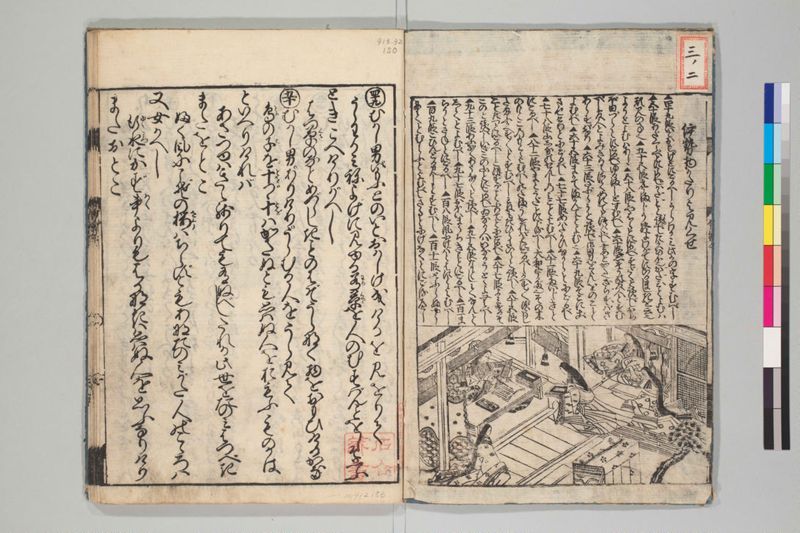
翻刻
【右丁】
【上欄外ラベル 三ノ二】
【上段】
伊勢物かたりよみくせ
▲四十九段いとおかしげとにごるへしうらわかみ此かの字すむべし
▲五十段あだくらべとにこるへ し(ヽ)#1か(ヽ)た(Ι)み(Ι)と読(よむ)べしたかいの心也 か(Ι)た(Ι)み(ヽ)とよむは
形見の事也#2▲五十五段えうまじう終にわがてにいるましきを云也
ようとよむはあしゝ▲五十八段みやはらとにごるべしすだくと読べしおち
ぼ田づらとにこるべしゆかましとすむべし▲六十段しそうの官人とすむ
べし官人とよみきりてさてめにてとつゝくべし妻とかく也 さ(ヽ)ら(Ι)す(ヽ)ばさ
あらすばなり▲六十三段さぶらうと読べし御男をゝんをのこと
よむべし▲六十五段まかてまかんてとよむ也▲六十九段そこにご
させけりとにごるべし▲七十七段めはたかひなからとにごるべし
▲七十八段山しなのせんしのみことよむべし▲八十一段たいじきと
にこるべし▲八十二段やまとうだとにごるへし大和うだ也その木
のもとこのもとゝよむべしのたまうければとにごるべしかへ〳〵ずうじ
たまふかへす〳〵とすむべしみねもたひらたいらと読へし▲八十五段
ことだつとにこるべしこほすがごとふりてとにごるべし▲八十七段よみけるそ
このと読べしいざこの山にこるべしゐなかひ人はいなかうとゝよむべし
▲九十三段あふな〳〵あうな〳〵と読べし▲九十五段なとしてなんと
してとよむべし▲九十七段おほいまうちきみとにごるへし▲百一#3ま
らうとさねとにごるべし▲百八段風ふけばとはにとよむべし
▲百九段こひんとか見しとすむべし▲百十一段とふらふやう
にてとむらふとよむべしさるとにげなくとにごるへし
【挿絵】
【左丁】
「四十九」むかし男。いもふとのいとおかしけ成けるを見をりて
うらわかみねよげに見ゆる若草(わかくさ)を人のむすばんことをしそ思ふ
ときこへけり。かへし
はつ草(くさ)のなとめづらしきことのはぞうらなく物をおもひけるかな
「五十」むかし男。ありけり。うらむる人をうらみて
鳥(とり)の子(こ)を十(とを)づゝ十(とを)はかさぬとも思はぬ人をおもふものかは
といへりければ
あさつゆはきえ残りても有ぬべしたれか此世をたのみはつべき
またをとこ
ふく風にこぞの桜(さくら)はちらずともあなたのみがた人のこゝろは
又女かへし
行(ゆく)水(みつ)にかず書(かく)よりもはかなきは思はぬ人を思ふなりけり
またおとこ
現代語訳
【右丁】
【上欄外ラベル 三ノ二】
**伊勢物語 読み方の注意(よみくせ)**
▲第四十九段:「いとおかしげ」は濁って読むべし。「うらわかみ」の「か」の字は清音で読むべし。
▲第五十段:「あだくらべ」は濁って読むべし。「かたみ」は〔「か」を長く・「た」を長く・「み」を濁って〕読むべし。「互いに」の意味である。「かたみ」と〔「み」を清音で〕読むのは「形見」のことである。
▲第五十五段:「えうまじう」——結局、自分の手に入らないことを言うのである。「よう」と読むのはよくない。
▲第五十八段:「みやはら」は濁って読むべし。「すだく」と読むべし。「おちぼ田づら」は濁って読むべし。「ゆかまし」は清音で読むべし。
▲第六十段:「しそうの官人」は清音で読むべし。「官人」と読み切って、「さてめにて」と続けるべし。「妻」と書くのである。「さらずば」は「さあらずば」である。
▲第六十三段:「さぶらう」と読むべし。「御男」は「おんをのこ」と読むべし。
▲第六十五段:「まかて」は「まかんて」と読むのである。
▲第六十九段:「そこにごさせけり」は濁って読むべし。
▲第七十七段:「めはたかひながら」は濁って読むべし。
▲第七十八段:「山しなのせんし」の「のみこと」と読むべし。
▲第八十一段:「たいじき」は濁って読むべし。
▲第八十二段:「やまとうだ」は濁って読むべし。「大和宇陀」のことである。「その木のもと」は「このもと」と読むべし。「のたまうければ」は濁って読むべし。「かへかへずうじたまふ」——「かへすかへす」は清音で読むべし。「みねもたひら」は「たいら」と読むべし。
▲第八十五段:「ことだつ」は濁って読むべし。「こほすがごとふりて」は濁って読むべし。
▲第八十七段:「よみけるそのこと」と読むべし。「いざこの山」は濁って読むべし。「ゐなかひ人は」は「いなかうと」と読むべし。
▲第九十三段:「あふなあふな」は「あうなあうな」と読むべし。
▲第九十五段:「なとして」は「なんとして」と読むべし。
▲第九十七段:「おほいまうちきみ」は濁って読むべし。
▲第百一段:「まらうとさね」は濁って読むべし。
▲第百八段:「風ふけばとは」は「に」と読むべし。
▲第百九段:「こひんとか見し」は清音で読むべし。
▲第百十一段:「とふらふやうにて」は「とむらふ」と読むべし。「さるとにげなく」は濁って読むべし。
【挿絵】
---
【左丁】
**「第四十九段」**
むかし、ある男が、妹のたいそう愛らしい様子のものを見て、
若々しく、よく育ちそうに見える若草を、誰かが手折って自分のものにしてしまうことを、つい思ってしまうことだ
と申し上げた。その返し、
初草のように、なんと珍しいことばでしょう。あどけなく物思いをしていたのですね
---
**「第五十段」**
むかし、ある男がいた。恨んでいる人を逆に恨んで、
鳥の卵を十ずつ十重に重ねるとも(それほどひどくしても)、思いをかけていない人を慕うものだろうか(いや、そんなことはない)
と言ったので、(女が)
朝露はたとえ消え残っていることもあるだろうが、いったい誰がこの世を頼みにすることができようか
また男が、
吹く風に去年の桜は散らなくても、ああ、あなた一人の心だけが頼みにしにくいのです
また女の返し、
流れる水に数を書くよりもはかないのは、思いを寄せていない人を思うことだよ
また男が(続く)
英語訳
【Right Page】
【Margin Label: 3-2】
**Notes on Reading the Ise Monogatari (Yomikuse)**
▲Section 49: "ito okashige" should be read with voiced consonants. The character "ka" in "urawakemi" should be read with an unvoiced consonant.
▲Section 50: "adakurabe" should be read with voiced consonants. "Katami" should be read [with "ka" and "ta" lengthened, and "mi" voiced]—this means "mutually/reciprocally." Reading "katami" with an unvoiced "mi" refers to "keepsake/memento."
▲Section 55: "Eumajiu"—this means that something ultimately will not come into one's possession. Reading it as "yō" is incorrect.
▲Section 58: "Miyahara" should be read with voiced consonants. Read as "sudaku." "Ochiho tazura" should be read voiced. "Yukamashi" should be read with unvoiced consonants.
▲Section 60: "Shisō no kannin" should be read with unvoiced consonants. Read "kannin" as a complete unit, then continue with "sate me nite." The word written is "妻" (wife/spouse). "Sarazuba" means "sa arazuba" (if it were not so).
▲Section 63: Should be read as "saburau." "御男" should be read as "on'wonoko."
▲Section 65: "Makate" should be read as "makante."
▲Section 69: "Sokonigosasakeri" should be read with voiced consonants.
▲Section 77: "Mehatakai nagara" should be read with voiced consonants.
▲Section 78: Should be read as "Yamashina no Senshi no Mikoto."
▲Section 81: "Taijiki" should be read with voiced consonants.
▲Section 82: "Yamato uda" should be read voiced—it refers to Yamato Uda (a place name). "Sono ki no moto" should be read as "kono moto." "Notamaukereba" should be read voiced. "Kahekahe zuji tamau"—"kahesukahesu" should be read unvoiced. "Mine mo tahira" should be read as "taira."
▲Section 85: "Kotodatsu" should be read voiced. "Kohosu ga goto furite" should be read voiced.
▲Section 87: Should be read as "yomikeru sono koto." "Iza kono yama" should be read voiced. "I naka hito wa" should be read as "inakabito."
▲Section 93: "Auna auna" should be read as "auna auna."
▲Section 95: "Nani shite" should be read as "nan to shite."
▲Section 97: "Ōi mōchigimi" should be read voiced.
▲Section 101: "Marauto sane" should be read voiced.
▲Section 108: "Kaze fukeba towa" should be read as "ni."
▲Section 109: "Kohin to ka mishi" should be read with unvoiced consonants.
▲Section 111: "Torafu yō ni te" should be read as "tomurau." "Saru to nigenaku" should be read voiced.
【Illustration】
---
【Left Page】
**"Section 49"**
Long ago, a man, gazing upon his sister who was remarkably charming in appearance, composed:
*Young grass that appears to be growing up beautifully and well—I cannot help but think of someone plucking and binding it for themselves.*
He presented this poem to her. In reply:
*Like new young shoots of grass, what a surprising verse this is—you have been thinking such innocent, guileless thoughts.*
---
**"Section 50"**
Long ago, there was a man. Resenting someone who resented him:
*Even if you were to stack bird's eggs ten by ten in ten layers (treating me so harshly), would I ever yearn for someone who does not care for me? Never.*
When he said this, (she replied):
*Morning dew may linger and remain awhile, but who in this world can truly place their hope in another?*
Again the man:
*Even if last year's cherry blossoms did not scatter in the blowing wind—ah, yours alone is a heart so difficult to rely upon.*
Again the woman's reply:
*More fleeting than writing numbers on flowing water is the act of longing for one who does not long for you.*
Again the man (continues)