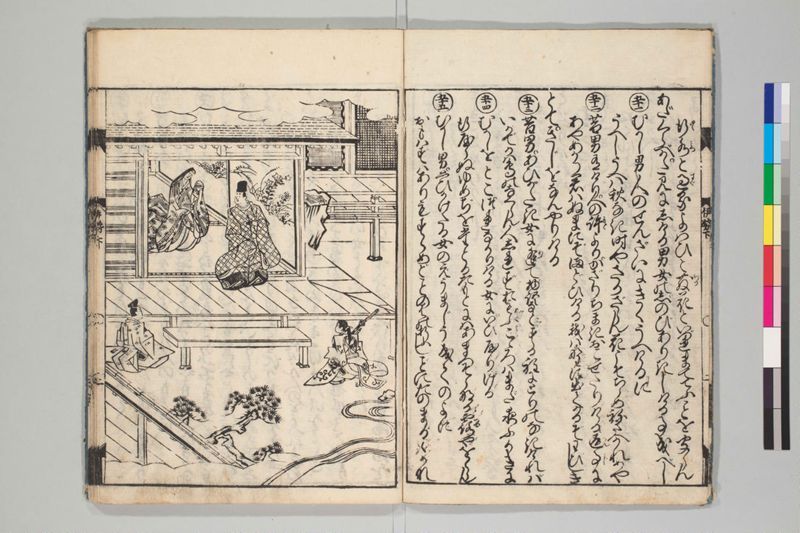
翻刻
【右丁】
行(ゆく)水(みつ)と過(すぐ)るよはひと散(ちる)花といづれまててふことを聞らん
あだくらべ。かたみにしける男女の。しのびありきしける事成べし
「五十一」むかし男人のせんざいにきくうへけるに
うへしうへは秋なき時やさかざらん花こそちらめねさへかれめや
「五十二」昔男有けり。人の許(もと)より。かざりちまきおこせたりける。返事(へんじ)に
あやめかり君はぬまにぞまどひける我は野に出てかるぞわびしき
とて。きじわなんやりける
「五十三」昔男。あひがたき女に逢(あふ)て。物語なとする程にとりのなきければ
いかでかは鳥のなくらん人しれずおもふこゝろはまだ夜ふかきに
「五十四」むかしをとこ。つれなかりける女に。いひやりける
行やらぬゆめぢをたとるたもとにはあまつそらなる露(つゆ)やをくらん
「五十五」むかし男。思ひかけたる女の。えうまじう成てのよに
おもはずはありもすらめどことのはの折ふしごとにたのまるゝかな
【左丁】
【挿絵】
現代語訳
【右丁】
流れる水と、過ぎ去る齢と、散る花と——いずれを「まつ(待つ・松)」というものだと聞いているのだろうか
(この段は)互いに張り合う(あだくらべ)——共に忍んで逢瀬を重ねていた男女の事柄であろう。
---
**「第五十一段」**
むかし、ある男が、人の庭園に菊を植えたところ、
植えた(うえし)甲斐もなく、秋のない時には咲かないのだろうか。花は散りもしようが、根まで枯れることがあろうか(いや、決して枯れはすまい)
---
**「第五十二段」**
むかし、ある男がいた。ある人のもとから、飾りちまきを贈ってきた。その返事に、
菖蒲を刈るあなたは、沼の中で迷っているのですね。私は野に出て(菖蒲を)刈るので、それがわびしいことですよ
と言って、雉の子を贈ったのであった。
---
**「第五十三段」**
むかし、ある男が、なかなか逢えない女と逢って、物語などしているうちに、鶏が鳴いたので、
どうして鳥が鳴くのだろうか。人知れず(あなたを)思う心は、まだ夜が深いというのに
---
**「第五十四段」**
むかし、ある男が、冷淡であった女に、言い送った、
行きつけない夢路をたどる袂には、天空にある露でも置くのだろうか(涙で袂が濡れている)
---
**「第五十五段」**
むかし、ある男が、思いをかけていた女と、(逢うことが)かなわなくなった後の世に、
(あなたのことを)思わずにいられもしようけれど、言葉の折々ごとに、頼みにされてしまうことだよ
---
【左丁】
【挿絵】
英語訳
【Right Page】
*Flowing water, the years that pass, and scattering blossoms—which of these, I wonder, has one heard can be "waited upon" (matsu / pine tree)?*
(This section concerns) a mutual rivalry in fickleness (adakurabe)—it must be the tale of a man and woman who had been meeting in secret.
---
**"Section 51"**
Long ago, a man planted chrysanthemums in someone's garden, and composed:
*Could it be that what I planted will not bloom when there is no autumn to come? The flowers may scatter, but surely even the roots will not wither away.*
---
**"Section 52"**
Long ago, there was a man. Someone sent him a decorative chimaki (a festive rice dumpling). In reply,
*You who cut the sweet flag (ayame) seem to have lost your way in the marsh. As for me, I go out to the fields to cut it—and that is a lonely, wretched thing.*
Saying this, he sent back a pheasant chick.
---
**"Section 53"**
Long ago, a man met with a woman who was difficult to see, and while they were conversing, a cock crowed, so he composed:
*How can the bird be crowing already? The heart that secretly longs for you still feels the deep of night.*
---
**"Section 54"**
Long ago, a man sent this poem to a woman who had been cold and indifferent to him:
*On the sleeve that gropes along the dream-path I cannot complete—does the dew that hangs in the far heavens come to rest there?*
(My sleeve is wet with tears shed while wandering a dream I cannot reach.)
---
**"Section 55"**
Long ago, a man composed this after the woman he had set his heart upon had become impossible to meet:
*I might be able to cease thinking of you—and yet, at every turn of phrase and season, I find myself made to place my hope in you once more.*
---
【Left Page】
【Illustration】