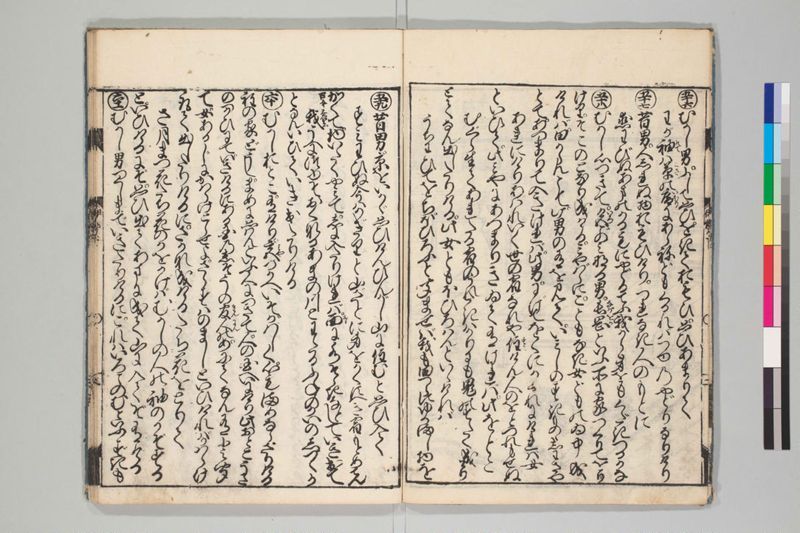
翻刻
【右丁】
「五十六」むかし男。ふして思ひ。をきておもひ。思ひあまりて
わが袖(そて)は草(くさ)の庵(いほり)にあらねどもくるればつゆのやどりなりけり
「五十七」昔男。人しれぬ物おもひけり。つれなき人のもとに
恋わびぬあまのかるもにやどるてふ我から身をもくだきつるかな
「五十八」むかし心つきて。色(いろ)ごのみなる男。長岡(ながをか)といふ所に家つくりてをり
けり。そこのとなり成ける。みやばらに。こともなき女どものゐ中成
ければ。田からんとて。此男の有を見て。いみしのすきものゝしはわさや
とて。あつまりて入きければ。此男。にげてをくにかくれにければ女
あれにけりあはれいく世の宿なれや住(すみ)けん人のをとつれもせぬ
といひて。此みやにあつまりきゐて有ければ。此をとこ
むぐら生てあれたる宿のうれたきはかりにも鬼のすたく成けり
とてなん出したりける。此女ともほひろはんといゝければ
うちわひてをちぼひろふと聞ませば我も田つらにゆかまし物を
【左丁】
「五十九」昔男。京をいかゞ思ひけんひんがし山に住むと思ひ入て
すみわひぬ今はかぎりと山ざとに身をかくすへき宿もとめてん
かくて。物いたくやみて。しに入たりければ。《振り仮名:面|おも》に水そゝきなとしていき出て
《送り仮名:古今無作者》我うへにつゆそおくなるあまの川とわたるふねのかいのしづくか
となんいひていき出たりける
「六十」むかしおとこ。有けり。宮(みや)づかへいそがはしくて。心もまめならざりける
程のいえ家どうし#1。まめに思はんといふ人につきて。人の国へいにけり此おとこうさ
のつかひにて。いきけるに。ある国のしそうの官人(くわんにん)の。めにてなん有と聞
て。女あるじにかはらけとらせよ。さらすはのましといひければかはらけ
取て出したりけるに。さかな成けるたち花をとりて
さ月まつ花たち花のかをかげばむかしの人の袖かぞする
と。いひけるにぞ。思ひ出てあまに成て山に入てぞ有ける
「六十一」むかし男つくしまでいきたりけるに。これはいろこのむといふず#2きも
現代語訳
【右丁】
**「第五十六段」**
むかし、ある男が、横になっても思い、起きていても思い、思いあまって(詠んだ)、
私の袖は、草の庵ではないけれども、夜になると露の宿となることだよ
(涙が袖に宿る)
---
**「第五十七段」**
むかし、ある男が、人知れず物思いをしていた。冷淡な女のもとに(詠み送った)、
恋に侘びてしまった——海人が刈る藻に宿るという「我から(ワレカラ)」ではないが、わが身をも砕いてしまったことよ
(自分から招いた苦しみで身が砕けるようだ)
---
**「第五十八段」**
むかし、風流心があって、色好みである男が、長岡という所に家を建てて住んでいた。そこの隣にある神社の原に、たいしたこともない、田舎者の女たちがいたので、稲を刈ろうとして、この男がいるのを見て、「まあ、なんと素晴らしい色好みの人の、何ということでしょう」と言って、集まって入ってきたので、この男は逃げて、奥に隠れてしまった。すると女たちが、
荒れてしまったことよ——ああ、いく世の宿なのだろうか。住んでいた人は訪ねても来ない
と言って、この神社に集まり座っていたので、この男が(詠んだ)、
葎が生い茂って荒れ果てた宿の、うとましいことよ——かりにも鬼が騒ぐことになってしまった
と詠んで(女たちに)出してやったのであった。この女たちが「落ち穂を拾いましょう」と言ったので(男が詠んだ)、
わびしい思いをしながら落ち穂を拾うと聞かせてくださっていたならば、私も田のほとりへ行ったことでしょうに
---
【左丁】
**「第五十九段」**
むかし、ある男が、京をどのように思っていたのだろうか、東山に住もうと思い定めて、
(京に)住み侘びてしまった——今はもう限りと、山里に身を隠すべき宿を求めよう
こうして、ひどく病んで、死にそうになったので、顔に水をそそいだりなどして息を吹き返した時に、(詠んだ。)
《詞書:古今集・作者不詳》
私の上に露を置いているのだろうか——天の川を渡る舟の、櫂のしずくなのだろうか
(顔の上の水が、天の川の舟の櫂のしずくのように感じられる)
と詠んで、息を吹き返したのであった。
---
**「第六十段」**
むかし、ある男がいた。宮仕えに忙しく、心もまじめでなかった頃に、近所の(家)同士で、「まじめに(あなたのことを)思いましょう」と言う人に従って、他国へ行ってしまった(女がいた)。この男が、勅使の使いとして(その国へ)行ったところ、ある国の受領の官人の妻となっているのだと聞いて、「女主人に盃を取らせよ。さもなくばのまない」と言ったので、盃を取って出てきたところに、肴として添えてあった橘を取って、
五月を待つ花橘の香りをかぐと、昔の人の袖の香りがする
と詠んだところ、(女は昔のことを)思い出して、尼になって山に入ってしまったのであった。
---
**「第六十一段」**
むかし、ある男が筑紫(九州)まで行ったところ、(次段につづく)これは色を好むとは言わず……
英語訳
【Right Page】
**"Section 56"**
Long ago, a man lay thinking, rose thinking, and overcome with longing, composed:
*My sleeve is not a grass-thatched hermitage, and yet—each time night falls, it becomes a lodging for the dew.*
(His sleeve is drenched with tears every night.)
---
**"Section 57"**
Long ago, a man was pining in secret. He sent this to a cold and indifferent woman:
*I have grown weary of love—like the weed-crab (ware kara) said to dwell in the seaweed the fisher-folk harvest, it is none but myself who has broken my own body to pieces.*
(Playing on *ware kara*, meaning both a type of crustacean and "from myself / of my own doing.")
---
**"Section 58"**
Long ago, there was a man with refined sensibility and an amorous nature, who had built a house and was living in a place called Nagaoka. In the grove of a shrine neighboring that place, some unremarkable country women happened to be present. Coming to cut rice, and catching sight of this man, they exclaimed, "My, what a splendid connoisseur of love—what a thing to behold!" and gathered and came inside. The man fled and hid himself in the back of the house. The women then said:
*How desolate it has become—ah, how many ages has this dwelling stood? The one who lived here sends not even a visit.*
And so they gathered and sat in the shrine. The man then sent out this poem:
*The wretched thing about this dwelling, overgrown with mugwort and fallen to ruin, is that even in passing, demons have come to make their noise here.*
The women said they wished to gather fallen ears of grain, and the man replied:
*Had you let me know that you were gathering fallen ears in your sorrow, I too would have gone out to the edge of the paddies.*
---
【Left Page】
**"Section 59"**
Long ago, a man—whatever he may have thought of the capital—resolved to live in the Eastern Hills (Higashiyama), thinking:
*I have grown weary of living here—now, at last, I shall seek a dwelling in the mountain village where I may hide myself away.*
And so it was that he fell gravely ill and seemed near death. They poured water over his face and did what they could, and when he revived, he composed:
*(Note: attributed in the Kokinshū to an anonymous poet)*
*Is it dew being laid upon me? Or is it the dripping of the oar of a boat crossing the Milky Way?*
(The water on his face felt to him like dew from the heavens, or the spray from a celestial vessel.)
And having recited this, he came back to life.
---
**"Section 60"**
Long ago, there was a man. During a time when he was busy with court service and his heart was not devoted, a woman from the neighborhood, saying she would be loved faithfully, went off with someone to a distant province. This man, traveling to that province as an imperial envoy, heard that she had become the wife of a provincial official there. He declared, "Have the lady of the house take up the cup—otherwise I shall not drink," and so she came out holding the cup. He took a mandarin orange (*tachibana*) that had been set out as an accompaniment, and composed:
*When I catch the scent of the orange blossoms awaiting the fifth month, it is as though I smell the sleeve of a person from long ago.*
At this, the woman was overcome with memories, became a nun, and retreated into the mountains.
---
**"Section 61"**
Long ago, a man traveled all the way to Tsukushi (Kyushu). This is not said to be the act of one who pursues love, but rather… *(continues)*