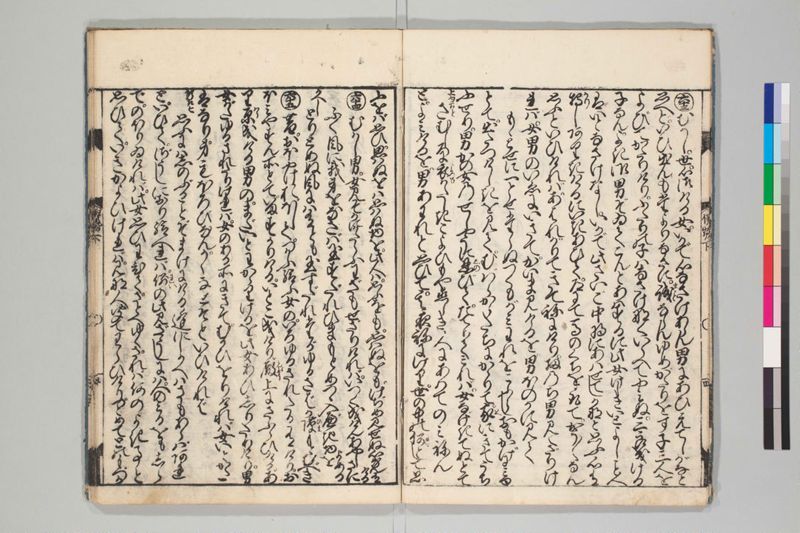
翻刻
【右丁】
「六十三」むかし。世。心つける女。いかで心なさけあらん男にあひえてしがなと
思へど。いひ出んもたよりなさに。誠(まこと)ならんゆめがたりをす子三人を
よびてかたりけり。ふたりの子はなさけなくいらへてやみぬ。三郎成ける
子なん。よき御男ぞゐてこんとあはするに此女けしきいとよしこと人
はいとなさけなし。いかで此さいご中将にあはせてしかなと思ふ心有
狩(かり)しありきけるにいきあひて。道にて馬のくちを取て。かう〳〵なん
思ふといひければ。あはれがりてきてねにけり。扨のち男見えざりけ
れば。女男のいゑにいきて。かいま見けるを。男ほのかに見て
もゝとせに一とせたらぬつくもがみわれをこふらしおもかげにみゆ
とて。出たつけしきを見て。むばらからたちにかゝりて。家(いへ)にきてうち
ふせり。男かの女のせしやうに忍(しの)びて。たてりてみれば。女なげきてぬとて
《送り仮名:上勺古今》さむしろに衣(ころも)かたしきこよひもや恋しき人にあはてのみねん
と。よみけるを。男あはれと思ひて。其夜ねにけり。世の中の例(れい)として思
【左丁】
ふをば思ひ。思はぬをは思はぬ物を。此人は。思ふをも。思はぬをも。けぢめ見せぬ心なん有ける
「六十四」むかし男。女みそかにかたらふわざもせざりければ。いつく成けんあやしさによめる
ふく風に我身をなさば玉すだれひまもとめつゝ入べき物を
《送り仮名:かへし》とりとめぬ風には有とも玉すだれたがゆるさばか隙(ひま)もとむべき
「六十五」昔。おほやけおぼして。つかふ給ふ女の。いろゆるされたる有けり。お
ほみやすん所とて。いますかりける。いとこ成けり。殿上(てんじやう)にさふらひける。あ
り原(はら)成ける男の。まだいとわかゝりけるを此女あひしりたりけり。男
女がたゆるされたりければ。女のある所にきて。むかひをりければ女いとかた
はなり。身もほろびなん。かくなせそといひければ
《送り仮名:新古今》思ふにはしのぶることぞまけにける逢にしかへはさもあらばあれ
と。いひて。ざうしにおり給へれば。例(れい)の此みざうしには。人のみるをもしら
で。のほりゐければ。此女思ひわひて。さとへゆく。されば何のよき事と
思ひて。いきかよひければ。みな人聞てわらひけり。つとめてとのもづか
現代語訳
【右丁】
**第六十三段**
昔、世慣れた、思慮深い女がいた。どうにかして情愛のある男に巡り会いたいものだと思っていたが、自分からそれを言い出す縁もなく、本当らしい夢の話として、三人の子どもたちを呼んで語り聞かせた。二人の子どもは情感もなく答えてそれきりになってしまった。三郎という子が、「よい殿方をお連れしましょう」と言って引き合わせてみると、この女の様子はたいそう好ましく、他の人はまったく情趣がない。なんとかしてこの在五中将に引き合わせたいものだと思う気持ちがあった。(男が)狩りに出かけていたところに出くわして、道で馬の口取りをして、「こういう事情でこのように思っております」と言ったところ、男は心を動かされてやって来て、共に寝た。
その後、男が姿を見せなくなったので、女は男の家に行って垣間見をしていたところ、男はかすかにそれを見て、
百年に一年足りぬ九十九髪(つくもがみ)、わたしを恋しく思っているらしい、面影に見える
と詠んで、出かけようとする様子を見て、(女は)茨やからたちに引っかかりながらも家に帰って、伏し沈んでいた。男は、あの女がしたように、こっそりと立って覗いてみると、女は嘆いて寝ながら、
さむしろに衣を片敷いて、今夜もまた恋しい人に逢えないまま独り寝するのだろうか
と詠んだ。男はしみじみと心を動かされて、その夜は共に寝た。世の常として、思う相手を思い、思わない相手は思わないものだが、この人(男)は、思う場合も思わない場合も、その区別をつけない心があったのだった。
**第六十四段**
昔、男が、女にひそかに言い寄ることもしなかったので、どこにいるのだろうという不思議な気持ちで詠んだ。
吹く風に我が身をなしたならば、玉すだれの隙を探しながら入ることができるものを
(返し)
引き留めることのできない風であっても、玉すだれの隙を誰が許してくれるというのか、その隙を求めることができようか
**第六十五段**
昔、帝がお気に入りになって、お仕えさせていらっしゃる女で、五位以上の色の衣を許された人がいた。「大御息所(おおみやすんどころ)」として在られた方の従姉妹であった。殿上に伺候していた在原氏の男で、まだたいそう若かった者を、この女は知り合いとしていた。男は女の部屋に入ることを許されていたので、女のいる所にやって来て、向かい合っていたところ、女は「たいそう体裁が悪い。身も滅びてしまうでしょう。このようなことをしないでください」と言ったところ、
思う気持ちには、堪え忍ぶことが負けてしまった。逢えたことの代わりとして、どうなろうとも構わない
と言って、(男は)小座敷に下りてお入りになったので、いつものようにこの小座敷には、人が見ているのも知らずに上がって座っていたので、この女は思い悩んで、実家へ帰ってしまった。それならばどんな良いことがあるかと思って、(男が)通い続けたところ、皆が聞いて笑った。翌朝、宮の雑仕(とのもづか…)
【左丁】
(思う人を思い、思わない人は思わないものだが、この人は、思う場合も思わない場合も、けじめを見せない心があったのだった。)
英語訳
**Section 63**
Once upon a time, there was a worldly-wise and thoughtful woman. She longed to meet a man of true feeling and compassion, but having no means to express this openly, she gathered her three children and told them what seemed like a believable dream she had had. Two of the children responded without feeling and the matter ended there. The third child, a boy, said, "I will bring you a fine gentleman," and arranged a meeting. This woman's manner was exceedingly charming, while others seemed entirely lacking in sensitivity. The child felt strongly that he must somehow bring her together with this Zaigo-no-Chūjō (the man of Ariwara).
When the man happened to be out hunting, the child encountered him, took hold of his horse's bridle on the road, and explained the circumstances. Moved with compassion, the man came and spent the night with her.
After that, the man ceased to appear, so the woman went to his house and peeped in. The man caught a faint glimpse of her and composed a poem:
*Of a hundred years, lacking but one — such is the white-haired one (tsukumogami). She seems to long for me; I can see it in her face.*
Seeing him prepare to leave, the woman caught herself on brambles and thorns as she made her way home and lay prostrate with grief. The man, in the same manner that the woman had done, stealthily stood and peered in. The woman lay sighing and lamenting, composing:
*Spreading my robe alone on a narrow mat, must I again tonight sleep without meeting the one I love?*
The man was deeply moved and spent that night with her. As is the way of the world, one loves those one loves, and does not love those one does not love — yet this man had a heart that made no such distinction.
**Section 64**
Once upon a time, a man did not even attempt to court a woman in secret, so in wonder at where she might be, he composed:
*If only I could make myself into the blowing wind — I would seek out the gaps in the jeweled bamboo blinds and slip inside.*
(Reply)
*Even if you were a wind that cannot be restrained, who would permit the gap in the jeweled blinds? How could you seek that opening?*
**Section 65**
Once upon a time, there was a woman whom the Emperor favored and kept in service, one who had been granted permission to wear robes of the higher court colors. She was the cousin of the one known as the "Great Imperial Consort" (Ōmiyasundokoro). A young man of the Ariwara clan, still very much in his youth, who attended at the imperial court (tenjō), was acquainted with this woman. Since the man had been granted access to the women's quarters, he came to where the woman was and sat facing her. The woman said, "This is most improper. It will be my ruin. Please do not do this," to which he replied:
*In the face of love, endurance and restraint have lost. In exchange for having met you — let come what may.*
He descended into the small inner chamber, and just as he always did in this small chamber, not knowing that people could see him, he climbed up and sat there. The woman, overcome with distress, withdrew to her family home. Thinking what good could come of this, the man continued to visit her, and everyone who heard of it laughed. The following morning, the palace attendants (tonomodzu...)
*(The page continues on the next leaf.)*