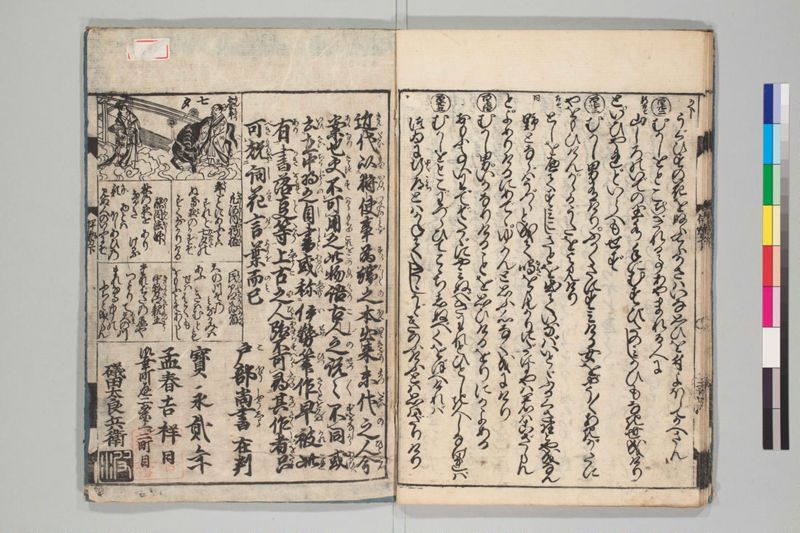
翻刻
【右丁】
《送り仮名:かへし》うぐひすの花をぬふてふかさはいな思ひを付よほしてかへさん
「百廿二」むかしをとこ。ちぎれる事あやまれる人に
《送り仮名:新古今》山しろのいでの玉水手にむすびたのみしかひもなき世成けり
と。いひやれどいらへもせず
「百廿三」むかし男有けり。ふかくさにすみける女をやう〳〵あきがたに
やをもひけん。かゝるうたをよみけり
《送り仮名:古今》としをへてすみこしさとを出ていなばいとゞふかくさ野とや成なん
《送り仮名:同 》野とならばうづらと成て鳴(なき)をらんかりにだにに【衍】やは君はこざらん
と。よめりけるにめでゝ。ゆかんと思ふ心なく成にけり
「百廿四」むかし男。いかなりけることを思ひけるをりにかよめる
おもふ事いわでぞたゞにやみぬべきわれとひとしき人しなければ
「百廿五」むかしをとこ。わづらひてこゝちしぬべくをぼへければ
つゐに行(ゆく)道(みち)とはかねてきゝしかどきのふけふとは思はざりけり
【左丁】
近(きん)-代(だい)以(もつて)_二狩(かりの)-使(つかいの)事(ことを)_一為(する)_レ端(はしと)之(の)本(ほん)出(いて)-来(きたり)末代(まつだい)之(の)人(ひと)今(こん)
案(あん)也(なり)更(さらに)不(す)_レ可(へから)_レ用(もちゆ)_レ之(これを)此(この)物語(ものかたり)古(こ)-人(しん)之(の)説(せつ)々(〳〵)不(ず)_レ同(をなしから)或(あるひは)
云(いひ)_二在中将(さいちうじやう)之(の)自書(じしよと)_一或(あるひは)称(しやうし)_二伊勢(いせが)筆作(ひつさくと)_一早(をかんぬ)被(かれ)此(これ)
有(あり)_二書(かき)落(をとす)亊(こと)等(たう)_一 上古(しやうこ)之(の)人(ひと)強(あなかち)不(す)【レ点脱】可(べから)_レ尋(たづね)_二其(その)作者(さくしやを)【一点脱】只(たゝ)
可(べき)_レ競(もてあそふ)_二詞花(しくわ)言葉(げんようを)【一点脱】而(の)巳(み)
戸部(こほう)尚書(しやうしよ) 在判
宝永弐年
孟春吉祥日 【赤角印】
御幸町通二条上ル二町目
礒田太郎兵衛 【落款】
【上段挿絵】
牽(けん)牛(きう)
七
夕
【中段和歌】
凡河内躬恒(おふしかうちのみつね)
年(とし)ごとにあふとは
すれど七夕(たなはた)の
ぬる夜(よ)のかずぞ
すくなかりける
能因法師(のうゐんほうし)
秋の夜を あり
ながき ける
物とは
影(かげ) ほしあひの
見ぬ人のいふにぞ
【下段和歌】
民部卿為藤(みんぶきやうためふち)
天の川その
みなかみは
あふ きはむとも
せははても
をもふとそあらし
中務卿親王(なかつかさきやうしんわう)
たなばたの恋や
つもりて天(あま)の川
まれなる中の
ふちと成らん
現代語訳
【右丁】
**【返し(第百二十一段・返歌)】**
鶯の 花を縫うてふ 笠はいな 思いを付けよ 干して返さん
(鶯が花を縫うという笠など、いりません。(濡れた衣を)干しながら、そこに(あなたへの)思いを付けてお返ししましょう。)
---
**【第百二十二段】**
昔、男が、約束を破った人(女)に(歌を送った)。
山城の 井出の玉水 手に結び 頼みしかひも なき世なりけり
(山城の井出の玉のような清水を、手で掬って頼みにしたように、(あなたを)頼りにしていたのに、そのかいもない世の中であったことよ。)
と言い送ったけれど、返事もしなかった。
---
**【第百二十三段】**
昔、男がいた。深草に住んでいた女を、次第に飽きが(きたのであろう)か、(あるいは)もう(他の女を)思っていたのであろうか、このような歌を詠んだ。
年を経て 住み来し里を 出でていなば いとど深草 野とやなりなん
(長年住み慣れたこの里を出て行ってしまったなら、ますます深草(の野)は荒れ果てた野原となってしまうことだろう。)
(女が返した歌)
野とならば 鶉と成りて 鳴きおらん かりにだにやは 君は来ざらん
((深草が)野となるなら、私は鶉となって鳴いておりましょう。(せめて)狩りのためだけにでも、あなたは来てくださらないのですか。)
と詠んだので、(その歌に)心を動かされて、(男は)去ろうと思っていた心がなくなってしまった。
---
**【第百二十四段】**
昔、男が、どのようなことを思っていた折に詠んだのか、
思ふ事 いはでぞただに やみぬべき われと等しき 人しなければ
(思うことを言わずに、そのまま(胸に秘めて)終わってしまうであろう。私と同じ(気持ちをわかってくれる)ような人がいないのだから。)
---
**【第百二十五段】**
昔、男が、病を患って、このまま死んでしまいそうに思われたので(詠んだ)。
ついに行く 道とはかねて 聞きしかど 昨日今日とは 思はざりけり
(いつかは誰もが行く(死への)道だとは、かねてより聞いていたけれど、(まさか)昨日今日のこととは思っていなかった。)
【左丁】
**【奥書・跋文】**
近代になって、(これを)狩りの使いの話を書いたものの起源(端緒)として(解釈することが)出てきたが、それは末代の人の今の考えであって、さらに用いるべきではない。この物語については、昔の人の説がそれぞれ異なっており、ある人は「在中将(在原業平)自身の書いたもの」と言い、ある人は「伊勢(伊勢の御)の筆作(筆によるもの)」と称している。(そのように)書き落とされていることなどがあるが、上古(大昔)の人について、むやみにその作者を尋ねるべきではない。ただ(この書の)美しい詞花・言葉を愛でるだけにすべきであろう。
戸部尚書 (花押あり)
宝永二年(1705年)
孟春吉祥日 【赤角印】
御幸町通二条上ル二町目
礒田太郎兵衛 【落款】
---
**【上段挿絵・題】**
牽牛・七夕
---
**【中段和歌】**
凡河内躬恒(おおしこうちのみつね)
年ごとに 逢うとはすれど 七夕の 寝る夜の数ぞ 少なかりける
(毎年(七夕には)逢うとはいっても、(実際に)七夕(の二星)が共に寝る夜の数の、なんと少ないことよ。)
能因法師(のういんほうし)
秋の夜を ありながら 長きものとは 影ほし逢いの 見ぬ人のいふにぞ
(秋の夜は長いものだという(世間の)言葉があるが、(七夕の)星逢いを見たことのない人が言うことだよ。(会えずにいる者には、夜はあっという間に明けてしまうのだから。))
---
**【下段和歌】**
民部卿為藤(みんぶきょうためふじ)
天の川 そのみなかみは 逢うせばても 思ふとぞあらし
(天の川、その水源(上流)はどこまでも(尽きることがあろうとも)、(二人が)逢いたいと思う気持ちは尽きることがないだろう。)
中務卿親王(なかつかさきょうしんのう)
たなばたの恋やつもりて 天の川 まれなる中の 淵となりぬらん
(七夕の(かなわぬ)恋がつもり積もって、天の川の(その流れの中で)まれな、深い淵となってしまっただろうか。)
英語訳
【Right Folio】
**Return poem (Episode 121, reply verse)**
*Uguisu no / hana wo nu fu chō / kasa wa ina* / *omoi wo tsuke yo / hoshite kaesan*
(A hat woven of the blossoms the warbler is said to stitch — no, I have no need of that. I shall dry (my soaked robe) and send it back to you, with all my feelings attached to it.)
---
**Episode 122**
Long ago, a man (sent a poem) to a person who had broken a promise:
*Yamashiro no / Ide no tamamizu / te ni musubi* / *tanomishi kai mo / naki yo nari keri*
(Like the jewelled waters of Ide in Yamashiro, which I cupped in my hands and trusted — I put my faith in you, yet this world has proved to be one in which such trust goes unrewarded.)
He sent this, yet received no reply.
---
**Episode 123**
Long ago, there was a man. He had begun to grow weary of a woman with whom he had lived in Fukakusa — or perhaps he had set his heart upon someone else — and he composed this poem:
*Toshi wo hete / sumikoshi sato wo / idete inaba* / *itodo Fukakusa / no to ya nari nan*
(If I were to leave and go away from this village where I have lived these many years, would not Fukakusa become, more than ever, nothing but a desolate moor?)
The woman replied:
*No to naraba / uzura to nari te / naki oran* / *kari ni dani ya wa / kimi wa kozaran*
(If it is to become a moor, then I shall become a quail and cry out within it — would you not come, if only to hunt?)
Moved by this poem, his resolve to leave dissolved entirely.
---
**Episode 124**
Long ago, a man composed the following — it is unclear what circumstances prompted it:
*Omou koto / iwade zo tada ni / yami nu beki* / *ware to hitoshiki / hito shi nakereba*
(All that I think and feel must simply pass away, left unspoken — for there is no one in this world who is the equal of myself [who could truly understand me].)
---
**Episode 125**
Long ago, a man fell gravely ill and felt that he was likely to die, and so he composed:
*Tsui ni yuku / michi to wa kanete / kikishi kado* / *kinō kyō to wa / omowazari keri*
(That there is in the end a road we all must travel — this I had long heard tell. Yet I had not thought that road would come for me as soon as yesterday or today.)
【Left Folio】
**Colophon / Postscript**
In recent times it has come about that this work is taken to be the origin of the tradition of the *kari no tsukai* (hunting envoy); however, this is merely a notion held by people of later generations and should by no means be adopted. As for this tale, the explanations of scholars of old differ from one another: some say it was written in the hand of the Zaichūjō (Ariwara no Narihira himself), while others claim it was composed by the brush of Ise (Lady Ise). Given that there are things which have been written down and then lost, one should not rashly seek to determine its author — for such a person belongs to high antiquity. One need only take pleasure in the beauty of its *shikka* (flowers of language) and its words.
*Kobō Shōsho* [Minister of the Board of Works] — *with cipher*
Hōei 2nd Year (1705)
An auspicious day of the first spring month 【Red seal】
Gokōmachi-dōri, Nijō-agaru, Second Block
Isoda Tarōbei 【Colophon seal】
---
**[Illustration header]**
Kengyū (the Cowherd Star) · Tanabata (the Star Festival / the Weaver Star)
---
**[Middle section: waka poems]**
*Ōshikōchi no Mitsune*
*Toshi goto ni / au to wa suredo / Tanabata no* / *nuru yo no kazu zo / sukunakari keru*
(Though every year they say the two stars meet at Tanabata — how very few are the nights they actually sleep together.)
*Nōin Hōshi* (The Priest Nōin)
*Aki no yo wo / ari nagara / nagaki mono to wa* / *kage hoshi-ai no / minu hito no iu ni zo*
(People say the autumn night is long — but that is what those who have never seen the meeting of the shadow-stars say. [For those who wait, the night passes all too swiftly.])
---
**[Lower section: waka poems]**
*Minbu-kyō Tamefuji* (Minister of Popular Affairs, Tamefuji)
*Ama no kawa / sono minagami wa / au seba / hate mo / omou to zo arashi*
(Even if the headwaters of the Milky Way were to run dry — the longing to meet, the desire, could never be exhausted.)
*Nakatsukasa-kyō Shinnō* (Prince of the Ministry of Central Affairs)
*Tanabata no / koi ya tsumorite / Ama no Kawa* / *mare naru naka no / fuchi to nari ran*
(Has the love of Tanabata, piling up and accumulating, become a deep pool — rare and profound — in the midst of the Milky Way?)