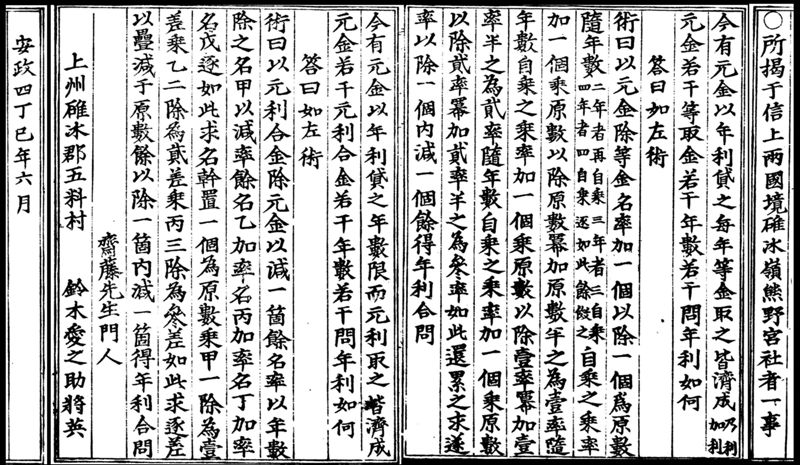
翻刻
○所揭于《場所:信上兩國境碓冰嶺》熊野宮社者一事
今有元金以年利貸之每年等金取之皆濟成《割書:乃利|加利》
元金𠰥干等取金𠰥干年𢿙𠰥干問年利如何
答曰如左術
術曰以元金除等金名率加一個以除一個爲原𢿙
隨年𢿙《割書:二年者再自乘三年者三自乘|四年者四自乘逐󠄁如此餘傚之》自乘之乘率
加一個乘原𢿙以除原𢿙冪加原𢿙半󠄁之為壹率隨
年𢿙自乘之乘率加一個乘原𢿙以除壹率冪加壹
率半之為貳率隨年𢿙自乘之乘率加一個乘原𢿙
以除貳率冪加貳率半之為參率如此還󠄁累之求遂󠄂
率以除一個内減一個餘得年利合問
今有元金以年利貸之年𢿙限而元利取之皆濟成
元金𠰥干元利合金𠰥干年𢿙𠰥干問年利如何
答曰如左術
術曰以元利合金除元金以減一箇餘名率以年𢿙
除之名甲以減率餘名乙加率名丙加率名丁加率
名戊逐󠄁如此求名幹置一個為原𢿙乘甲一除為壹
差乘乙二除為貳差乗丙三除為參差如此求逐󠄁差
以疊減于原𢿙餘以除一箇内減一箇得年利合問
《人物*先生:齋藤先生》門人
《場所:上州碓冰郡五料村》 《人物*奉納者:鈴木愛之助將英》
《日時:安政四丁巳年六月》
現代語訳
## 【掲示場所:信州・上州両国境、碓氷嶺】熊野宮社に掲げた事柄について
**〔問題一〕**
今、元金があり、年利をもって貸し付け、毎年等額の金を取り立て、すべて返済し終わるものとする(すなわち利息に利息がつく複利)。
元金○○干、等取金(毎年の均等返済額)○○干、年数○○干、年利を求めよ。
答え:以下の術の通り。
**術(解法):**
元金を等取金で割り、その商を「率」と名づけ、一を加えたものを「一個加えた率」とし、一を「一個」とする。これを「原数」と名づける。
年数に従い(二年なら二回自乗、三年なら三回自乗、四年なら四回自乗、以下同様)自乗したものに率を掛け、一を加えて原数を掛け、原数の冪(二乗)を除き、原数の半を加えたものを「壱率」とする。
年数に従い自乗したものに率を掛け、一を加えて原数を掛け、壱率の冪(二乗)を壱率で除し、壱率の半を加えたものを「弐率」とする。
年数に従い自乗したものに率を掛け、一を加えて原数を掛け、弐率の冪(二乗)を弐率で除し、弐率の半を加えたものを「参率」とする。
このようにして次々と累算し、最終的な率(遂率)を求め、一を除してから一を減ずれば、年利が得られる。問いに合う。
---
**〔問題二〕**
今、元金があり、年利をもって貸し付け、年数を限って元利合計を取り立て、すべて返済し終わるものとする。
元金○○干、元利合計金○○干、年数○○干、年利を求めよ。
答え:以下の術の通り。
**術(解法):**
元利合計金を元金で割り、一を減じた余りを「率」と名づける。これを年数で割り「甲」と名づける。率から甲を減じた余りを「乙」、乙に率を加えたものを「丙」、丙に率を加えたものを「丁」、丁に率を加えたものを「戊」とし、以下同様に続けて「幹」に至る名を求める。一を「原数」として置き、甲を掛け一で割って「壱差」、乙を掛け二で割って「弐差」、丙を掛け三で割って「参差」とし、以下同様に各差を求める。これらを順次原数から重ねて減じ、余りで一を除した後、一を減ずれば年利が得られる。問いに合う。
---
齋藤先生 門人
【上州碓氷郡五料村】 鈴木愛之助將英
【安政四丁巳年六月】
英語訳
## A Matter Displayed at Kumano Shrine, on Usui Pass at the Border of Shinano and Kōzuke Provinces
**[Problem 1]**
Suppose there is a principal sum lent out at annual interest, from which equal annual payments are collected until the debt is fully repaid (that is, with compound interest accruing on interest).
Given: principal = ○○ *kan*, equal annual payment = ○○ *kan*, number of years = ○○ *kan*. Find the annual interest rate.
Answer: As given by the method below.
**Method:**
Divide the principal by the equal annual payment; call this quotient the "rate" (*ritsu*). Add one to it. Call one the "original number" (*gensū*).
According to the number of years (for 2 years, square twice; for 3 years, cube; for 4 years, raise to the 4th power; and so forth), multiply the self-multiplied result by the rate, add one, multiply by the original number, divide by the square of the original number, and add half the original number; call this "First Rate" (*ichi-ritsu*).
According to the number of years, perform the same self-multiplication, multiply by the rate, add one, multiply by the original number, divide the square of the First Rate by the First Rate, and add half the First Rate; call this "Second Rate" (*ni-ritsu*).
Perform the same operation using the Second Rate to obtain the "Third Rate" (*san-ritsu*).
Continue accumulating in this manner to find the final rate (*sui-ritsu*). Divide one by it and subtract one; the remainder is the annual interest rate. This satisfies the problem.
---
**[Problem 2]**
Suppose there is a principal sum lent out at annual interest, with the full principal-plus-interest total collected at the end of a fixed number of years, at which point the debt is fully settled.
Given: principal = ○○ *kan*, total of principal and interest = ○○ *kan*, number of years = ○○ *kan*. Find the annual interest rate.
Answer: As given by the method below.
**Method:**
Divide the total principal-plus-interest by the principal, subtract one, and call the remainder the "rate" (*ritsu*). Divide this by the number of years and call it *kō* (甲). Subtract *kō* from the rate; call the remainder *otsu* (乙). Add the rate to *otsu*; call it *hei* (丙). Add the rate to *hei*; call it *tei* (丁). Add the rate to *tei*; call it *bo* (戊). Continue in this manner up to the term called *kan* (幹).
Set one as the "original number" (*gensū*). Multiply by *kō* and divide by one to obtain "First Difference" (*ichi-sa*). Multiply by *otsu* and divide by two to obtain "Second Difference" (*ni-sa*). Multiply by *hei* and divide by three to obtain "Third Difference" (*san-sa*). Continue finding each successive difference. Subtract these differences cumulatively from the original number. Divide one by the remainder and subtract one; the result is the annual interest rate. This satisfies the problem.
---
Disciple of Teacher Saitō
[Goryō Village, Usui District, Kōzuke Province] Suzuki Ainosuke Masahide
[Sixth month, Ansei 4, Year of the Snake (1857)]