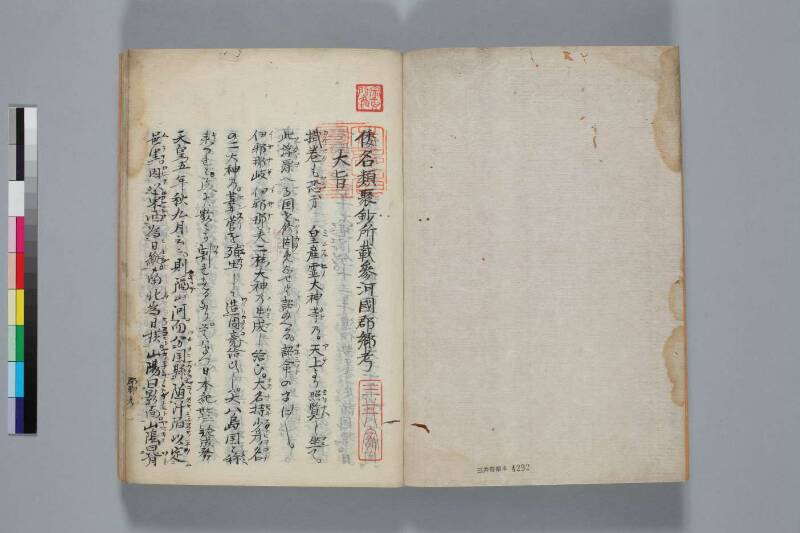
翻刻
倭名類聚鈔所載参河國郡郷考 三井家
大旨
/掛巻(カケマク)も/恐(カシコ)き /皇産霊(ミムスヒノ)大神 等(タチ)の。天上(アメ)より/照覧(ミソナハ)し/坐(マシ)て。
此 ̄ノ/浮漂(タダヨ)へる国を/修固(ツクリカタ)めなせと/詔(ノリ)給へる。/詔命(オホミコト)のまに〳〵。
/伊邪那岐(イサナギ)/伊邪那美(イサナミ)二柱 ̄ノ大神/乃(ノ)/生成(ウミナ)し給ひ。/大名持少彦(オオナモチスクナヒコ)/名(コナ)
の二大神の。/葦(アシ)/菅(スゲ)を/殖生(ウエオフ)して/造固(ツクリカタメ)/竟(ヲヘ)給ひしは。大八島国と称(タヽヘ)
来(キ)つれど。後には数々に割(ワカ)れたるなり。そはまづ日本紀《割書:七之巻|廿六ノヒラ》成務
天皇 ̄ノ五年秋九月云々。則 隔(カギリテ)_二山河 ̄ヲ_一而 分(ワケ)_二国県(クニアガタ) ̄ヲ_一。随(マニ〳〵)_二阡(タヽサノミチ) 陌(ヨコサノミチ) ̄ノ_一以定 ̄ム_二
邑里(ムラ) ̄ヲ_一。因(カレ) ̄ヲ以_二東西(ヒカシニシ) ̄ヲ_一為_二日縦(ヒタヽシ) ̄ト_一。南北 ̄ヲ為_二【訓点の脱落】日横(ヒノヨコシ) ̄ト_一。山陽(ヤマノミナミ) ̄ヲ曰(イヒ)_二影面(カゲトモ) ̄ト_一。山陰(ヤマキタ)曰_二背(ソト)
郡郷考 一
現代語訳
『倭名類聚抄』所載の参河国郡郷考 三井家
大旨
恐れ多くも皇産霊大神等が、天上より照覧されて、この漂っている国土を修理し固めよとお命じになった。その詔命のままに、伊邪那岐・伊邪那美の二柱の大神がお生みになり、大名持・少彦名の二大神が、葦や菅を植え育てて造り固め終えられたのが、大八島国と称されてきたが、後には数多くに分割されたのである。
それはまず『日本書紀』(巻七、二十六ページ)に、成務天皇五年秋九月に「山河を境として国県を分け、縦横の道に従って村里を定めた。そこで東西を縦とし、南北を横とした。山の南側を陽面といい、山の北側を陰側という」とある。
郡郷考 一
英語訳
A Study of the Districts and Villages of Mikawa Province as Listed in the Wamyō Ruijushō by the Mitsui Family
General Overview
The most revered Mimusubi no Ōkami and other deities, observing from heaven above, commanded that this floating land be repaired and solidified. In accordance with that imperial command, the two great deities Izanagi and Izanami gave birth to the land, and the two great deities Ōnamochi and Sukunahikona planted reeds and sedges to create and solidify it, completing what came to be called the Great Eight Islands. However, later it was divided into many parts.
This is first recorded in the Nihon Shoki (Volume 7, page 26), where in the fifth year of Emperor Seimu's reign, in the ninth month of autumn, it states: "Using mountains and rivers as boundaries, the provinces and districts were divided, and villages were established according to the north-south and east-west roads. Thus, east-west was designated as 'vertical' and north-south as 'horizontal.' The southern side of mountains was called the 'sunny side,' and the northern side of mountains was called the 'shady side.'"
Study of Districts and Villages, Volume 1