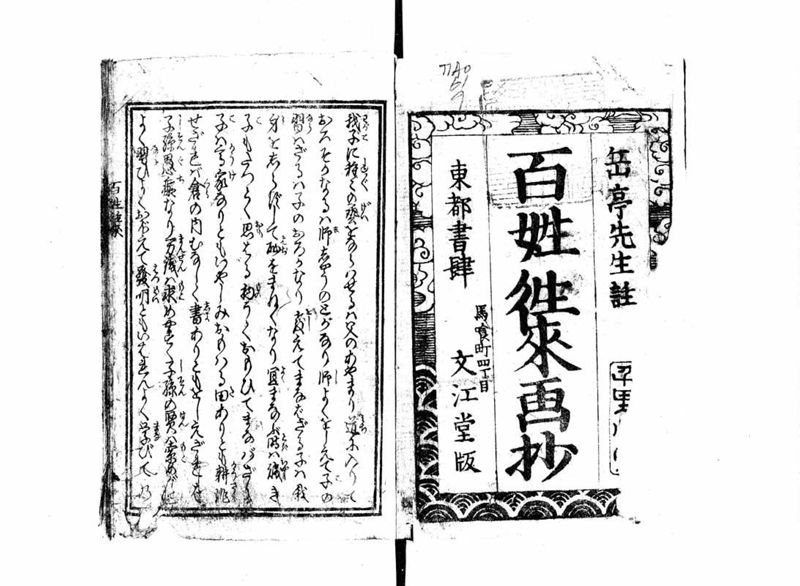
翻刻
【見返し】
岳亭先生註 □□□□
《題:百姓往来画抄》
《割書:馬喰町四丁目》
東都書肆 文江堂版
【左丁】
我子(わがこ)に種々(しゆ〴〵)の芸(げい)をならはせるは父のあやまり道(みち)に入りて
おろそかなるは師(し)しやうのとがなり師(し)よくをしえて子(こ)の
習(なら)はざるは子のおろかなり教(をし)えてまなばざる子は我
身(み)をしらずして恥(はぢ)をまねくなり宜(よく)まなぶ時(とき)は賤(いやし)き
子(こ)もたつとく思(おも)はる物(もの)うくおもひてまなばざる
子(こ)は高家(かうけ)なりともいやしみおもはる田(た)ありとも耕作(かうさく)
せざれば倉(くら)の内むなしく書(しよ)ありともをしえざれば
子孫(しそん)愚痴(ぐち)なり万銭(まんせん)は求(もと)めやすく子孫(しそん)の賢(けん)は索(もと)めがたし
よく習(なら)ひよくおぼえて発明(はつめい)ともいはれんよく学(まな)びての
現代語訳
【見返し】
岳亭先生註 □□□□
《題:百姓往来画抄》
《割書:馬喰町四丁目》
東都書肆 文江堂版
【左丁】
我が子に様々な芸事を習わせるのは父の過ちであり、道に入っても
おろそかになるのは師匠の咎である。師がよく教えて子が
習わないのは子の愚かさである。教えても学ばない子は自分の
身分をわきまえず恥を招くものである。よく学ぶときは身分の低い
子も尊く思われる。物憂く思って学ばない
子は高貴な家柄であっても卑しく思われる。田があっても耕作
しなければ倉の中は空しく、書があっても教えなければ
子孫は愚かになる。大金は求めやすいが、子孫の賢さは求めがたい。
よく習いよく覚えて発明とも言われるように、よく学んでの
英語訳
【Title Page】
Annotated by Master Gakutei □□□□
《Title: Hyakushō Ōrai Eshō (Illustrated Farmers' Correspondence Manual)》
《Side note: Bakurōchō 4-chōme》
Tōto Shoshi Bunkōdō Edition
【Left Page】
Having one's child learn various arts is the father's mistake, and
being negligent after entering the path is the teacher's fault. When a teacher teaches well but the child
does not learn, it is the child's foolishness. A child who does not study despite being taught does not know his own
station and invites shame. When one studies well, even a child of low
birth is thought noble. A child who finds it tedious and does not study
will be thought base even if from a noble house. Even if one has fields, without cultivation
the storehouse remains empty; even if one has books, without teaching them
the descendants become foolish. Great wealth is easy to seek, but the wisdom of descendants is hard to obtain.
Study well, memorize well, and be called inventive; through diligent learning...