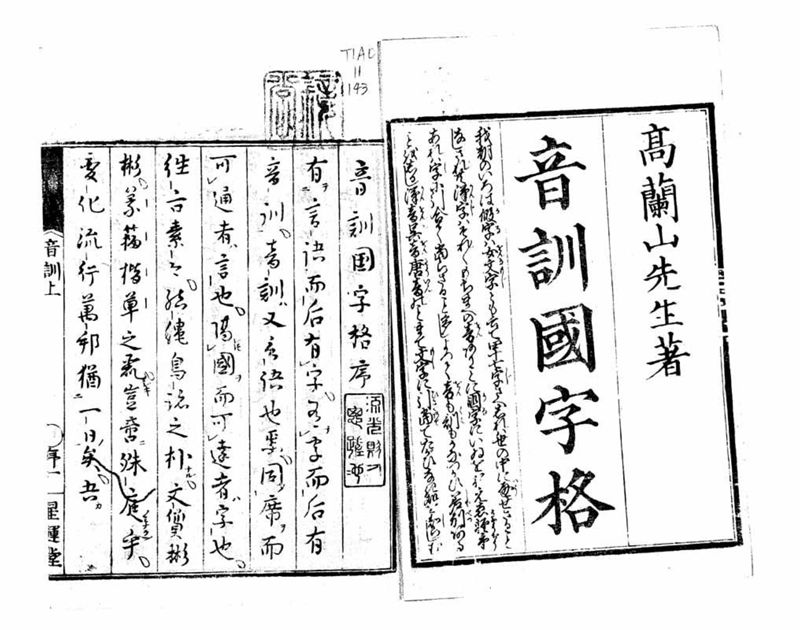
翻刻
【右丁】
高蘭山先生著
《題:音訓国字格》
我朝のいろは仮字(かな)は女文字(をんなもじ)とも云て四十七 字(じ)さへしれは世の中に通(つう)せさること
なしされ共 漢字(かんじ)はそれ〳〵もちまへの音(をん)ありことに国字(かな)にいゐをおえゑ軽重(きやうぢう)
あれは字(し)に引合て当らさること多しよつて音(をん)も訓(くん)もかなつかひ差別(しやべつ)ある
ことをしるし漢音(かんをん)呉音(ごをん)唐音(たういん)のことまて文字(もし)に引当(ひきあて)てたがひなき処を知らしむ
【左丁】
音訓国字格序 【角印】#2
有 ̄テ_二言-語_一而-后有_レ字。有 ̄テ_レ字而-后有#1
音-訓_一。音-訓 ̄ハ又言-語也焉。同 ̄シテ-席 ̄ヲ而
可_レ通者 ̄ハ言-也。隔 ̄レトモ_レ国 ̄ヲ而可_レ達者 ̄ハ字-也。
往-古素-々。結-縄鳥-跡之朴 ̄ナル。文-質彬
彬。《圏点:篆籀楷草|━》之麗 ̄シキ。豈啻 ̄ニ殊-庭 ̄ノミナラン乎。
変-化流-行萬-邦猶_二 一-日 ̄ノ_一矣。吾 ̄カ
【文の切れ目が記されておりここでは「。」で翻刻する】
現代語訳
【右丁(右ページ)】
高蘭山先生著
《題:音訓国字格》
わが国のいろは仮名は「女文字」とも言い、四十七字さえ知れば世の中に通じないことはない。しかしながら、漢字にはそれぞれ固有の音(おん)があり、特に国字(仮名)においては「い・ゐ」「を・お」「え・ゑ」のように軽重(音の重さの違い)があるため、文字に照らし合わせると合致しないことが多い。そこで、音読み・訓読みにおける仮名遣いの区別があることを記し、漢音・呉音・唐音のことまで文字に当てはめて、誤りのないところを知らしめるものである。
---
【左丁(左ページ)】
**音訓国字格 序** 【角印】
言語があって、その後に文字が生まれた。文字があって、その後に音訓が生まれた。音訓もまた言語である。同じ席(その場)にいれば通じるのが「言(ことば)」であり、国を隔てても伝わるのが「字(文字)」である。
遠い昔、縄を結んで記録したり、鳥の足跡のような素朴な文字があった頃から、文と質が調和した(篆書・籀書・楷書・草書などの)麗しい書体に至るまで、どうして単に異なる庭(場所)にとどまるだけであろうか(いや、そうではない)。変化し流行して、万邦(あらゆる国)においてもなお一日のうちに(広まるほどである)。わが(国においても)……
英語訳
**[Right Page]**
*Composed by Master Takei Ranzan*
**Title: Onkun Kanazukai (A Guide to the On and Kun Readings and National Characters)**
The Japanese *iroha* syllabary is also called "women's writing" (*onnaji*), and if one knows even its forty-seven characters, there is nothing in the world one cannot communicate. However, Chinese characters each have their own inherent readings, and in particular, among the national syllabic characters (*kana*), there are distinctions of weight and lightness—such as between *i* and *wi* (い・ゐ), *o* and *wo* (を・お), and *e* and *ye* (え・ゑ)—and so there are many cases where matching them to characters does not align correctly. Therefore, this work records the distinctions in *kana* usage for both *on* (Chinese-derived) and *kun* (native Japanese) readings, and, extending even to matters of *kan-on*, *go-on*, and *tō-on*, it aims to make known the correct correspondences between sounds and characters, free of error.
---
**[Left Page]**
**Preface to Onkun Kanazukai** [Square seal]
First there was spoken language, and thereafter writing was born. First there was writing, and thereafter *on* and *kun* readings were born. *On* and *kun* are, in turn, also a form of language. What conveys meaning to those sharing the same room is speech; what reaches across the distance of nations is the written character.
In the remote past, from the rustic simplicity of knotted cords and bird-track-like markings, through the refined elegance of the various script styles—seal, great seal, standard, and cursive (篆・籀・楷・草)—could it be that these things remained confined to a single court alone? Surely not. Through change and circulation, even ten thousand nations were as if united in a single day. And in our own [country...]