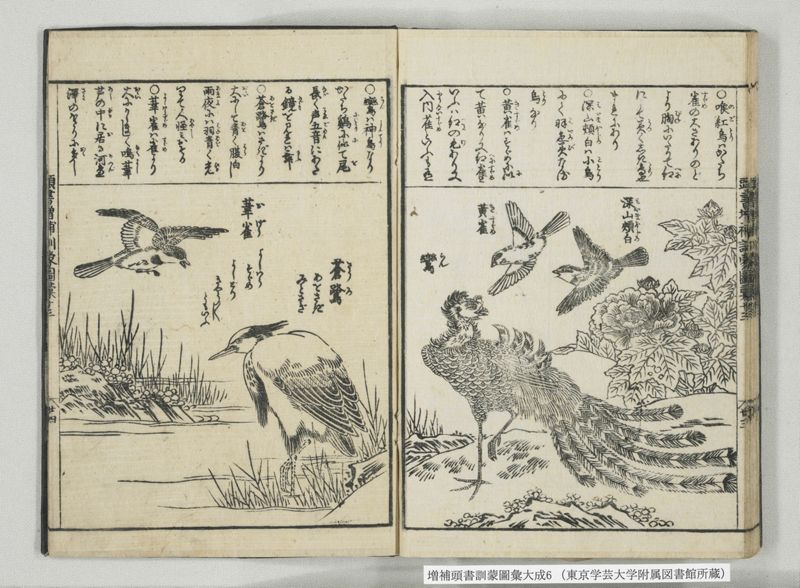
翻刻
【上段】
○喉紅鳥(のごとり)はかたち
雀(すゞめ)の大さありのど
より胸(むね)にいたりて紅(へに)
にして美(うつ)くしき鳥(とり)也
まれにあり
○深山頬白(みやまほじろ)は小鳥(ことり)
にて羽色(はいろ)美(び)なる
鳥(とり)なり
○黄雀(きすゞめ)はすゞめに似(に)
て黄なり又 紅雀(へにすゞめ)と
いふは紅(へに)の毛(け)あり又
入内雀(にうないすゞめ)といふも有
○鸞(らん)は神鳥(しんてう)なり
かたち鶏(にはとり)に似(に)て尾(を)
長(なが)く声(こゑ)五音(ごゐん)にあた
る鏡(かゞみ)を見れは舞(まふ)
○蒼鷺(あをさぎ)はさぎより
大(おゝい)にして青(あを)く腹(はら)白し
雨夜(あまよ)には羽青(はねあを)く光(ひか)
りて人 怪(あやし)みおそる
○葦雀(よしはらすゞめ)は雀(すゞめ)より
大(おゝい)にかしましく鳴(なく)葦(よし)
芦(あし)の中(なか)に居(お)る河辺(かへん)
沢(さわ)のほとりに多(おゝ)し
【下段】
深山頬白(みやまほじろ)
黄雀(きすゞめ)
鸞(らん)
蒼鷺(さうろ)
あをさぎ
みとさぎ
葦雀(おげら)
よしはらすゞめ
よしとり
きやう〳〵し
ともいふ
現代語訳
【上段】
○喉紅鳥(ノゴドリ)は形がスズメほどの大きさで、のどから胸にかけて紅色をしており、美しい鳥である。めったにいない。
○深山頬白(ミヤマホオジロ)は小鳥で、羽の色が美しい鳥である。
○黄雀(キスズメ)はスズメに似ていて黄色である。また紅雀(ベニスズメ)というものは紅色の毛がある。また入内雀(ニュウナイスズメ)というものもある。
○鸞(ラン)は神鳥である。形はニワトリに似ていて尾が長く、声は五音に当たる。鏡を見ると舞う。
○蒼鷺(アオサギ)はサギより大きくて青く、腹は白い。雨夜には羽が青く光って、人が怪しんで恐れる。
○葦雀(ヨシハラスズメ)はスズメより大きく、やかましく鳴く。葦の中にいて、河辺や沢のほとりに多い。
【下段】
深山頬白(ミヤマホオジロ)
黄雀(キスズメ)
鸞(ラン)
蒼鷺(サウロ)
あおさぎ
みとさぎ
葦雀(オゲラ)
よしはらすずめ
よしとり
きょうきょうし
ともいう
英語訳
[Upper section]
○The Nogodori (throat-red bird) is about the size of a sparrow, with red coloring from throat to chest, making it a beautiful bird. It is rarely found.
○The Miyama-hōjiro (chestnut-eared bunting) is a small bird with beautiful wing colors.
○The Ki-suzume (yellow sparrow) resembles a sparrow but is yellow. There is also the Beni-suzume (red sparrow) which has red feathers, and the Nyūnai-suzume (rustic bunting) also exists.
○The Ran (phoenix) is a divine bird. Its shape resembles a chicken with a long tail, and its voice corresponds to the five musical notes. It dances when it sees a mirror.
○The Ao-sagi (grey heron) is larger than regular herons and is blue with a white belly. On rainy nights, its feathers glow blue, causing people to find it mysterious and fearsome.
○The Yoshi-hara-suzume (reed sparrow) is larger than sparrows and makes noisy calls. It dwells among reeds and is abundant near riverbanks and marshes.
[Lower section]
Miyama-hōjiro (Chestnut-eared bunting)
Ki-suzume (Yellow sparrow)
Ran (Phoenix)
Saurō (Grey heron)
aosagi
mitosagi
Ashisuzume (Ogera)
yoshiharasuzume
yoshitori
kyōkyōshi
are also called