翻刻
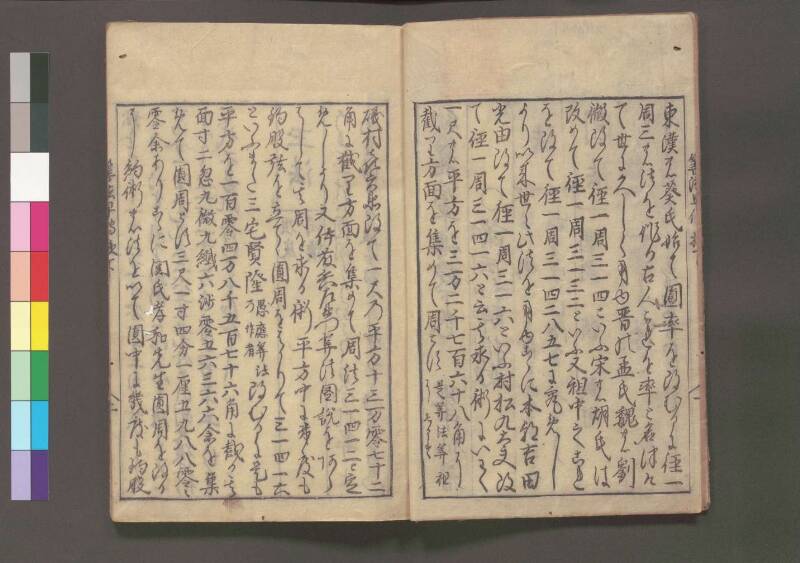
東漢の葵氏始て円率を改むるに径一
周三の法を作る古人これを率と名つけ
て世に久しく用ゆ晋の孟氏魏の劉
徽改て径一周三一四といふ宋の胡氏は
改めて径一周三一三二といふ又祖中之これ
を改て径一周三一四二八五七に究めし
より以来世々此法を用ゆこゝに本朝吉田
光由改て種一周三一六といふ村松九太夫改
て径一周三一四一六と云其求る術にいわく
一尺の平方を三万二千七百六十八角に
截り方面を集めて周とす《割書:是算法算祖|にしるす》
磯村喜兵衛改て一尺の平方十三万零七十二
角に截り方面を集めて周法三一四一二に定
めしより又伊藤兵左衛門算法図説をあら
はして其周を求る術平方中に幾度も
鈎股弦を立てゝ円周をはかりて三一四一六
といふまた三宅賢隆《割書:愚應筭法|乃作者》改むるに是も
平方を一百零四万八千五百七十六角に截る其
面寸二忽九徹九繊六沙零五六三六六余を集
めて円周とす三尺一寸四分一厘五九八八零々
零余ありこゝに関氏孝和先生円周を得る
に術の鈎法の法を以て円中に幾度も鈎股
現代語訳
東漢の葵氏が初めて円周率を改めるにあたり、直径1に対して円周3とする方法を作った。古人はこれを「率」と名付けて、世に長く用いた。晋の孟氏、魏の劉徽はこれを改めて直径1に対して円周3.14とした。宋の胡氏はさらに改めて直径1に対して円周3.132とした。また祖沖之がこれを改めて直径1に対して円周3.1428571と究めて以来、代々この法が用いられた。ここにおいて、わが国の吉田光由は改めて直径1に対して円周3.16とした。村松茂清(九太夫)は改めて直径1に対して円周3.1416とした。その求める方法に曰く、一尺の正方形を三万二千七百六十八角形に切り、その辺の面を集めて円周とする。(これは「算法算祖」に記されている。)
磯村吉徳(喜兵衛)は改めて、一尺の正方形を十三万零七十二角形に切り、辺の面を集めて円周の値を3.14152と定めた。さらに伊藤重孝(兵左衛門)は「算法図説」を著して、円周を求める方法として、正方形の中に何度も鉤・股・弦(直角三角形)を立てて円周を測り、3.14159とした。また三宅賢隆(「愚應算法」の著者)が改めるにあたり、これも正方形を百四万八千五百七十六角形に切り、その面(辺の長さ)一寸二忽九徹九繊六沙零五六三六六余を集めて円周とし、三尺一寸四分一厘五毛九糸八忽零々零余があった。ここに関孝和先生は円周を得るにあたり、鉤股の法(直角三角形の性質)を用いて、円の中に何度も鉤・股・
英語訳
The Kui clan of the Eastern Han dynasty first revised the method for calculating the circular ratio (pi), establishing the rule that for a diameter of 1, the circumference is 3. The ancients named this the "ratio" and it was used in the world for a long time. Meng of Jin and Liu Hui of Wei revised this to give a circumference of 3.14 for a diameter of 1. Hu of the Song dynasty further revised it to 3.132. Then, when Zu Chongzhi refined it to 3.1428571 for a diameter of 1, this method was used for generations thereafter. Here in our country, Yoshida Mitsuyoshi revised it to 3.16 for a diameter of 1. Muramatsu Shigekiyo (Kudayū) revised it to 3.1416, and his method for obtaining this states: divide a one-shaku square into a polygon of 32,768 sides, collect the lengths of the sides, and treat this as the circumference. (This is recorded in the "Sanpō Sansō.")
Isomura Yoshinori (Kihei) revised it by cutting a one-shaku square into a polygon of 130,072 sides, collecting the side lengths as the circumference, and fixed the value at 3.14152. Furthermore, Itō Shigetaka (Hyōzaemon) published the "Sanpō Zusetsu" and used a method of repeatedly constructing right triangles (base, altitude, hypotenuse) within a square to measure the circumference, arriving at 3.14159. Also, Miyake Kenryū (author of "Guō Sanpō"), when revising, similarly cut a square into a polygon of 1,048,576 sides, collected the face measurements of 1 sun 2 bu 9 rin 9 mō 6 shi zero 5 6 3 6 6 remainder, and used these as the circumference, obtaining 3 shaku 1 sun 4 bu 1 rin 5 mō 9 shi 8 kō zero zero zero with remainder. Here, Master Seki Takakazu (Kōwa), in obtaining the circumference, used the method of right triangles (the gōkoygen method) to repeatedly construct base, altitude, and hypotenuse within a circle...