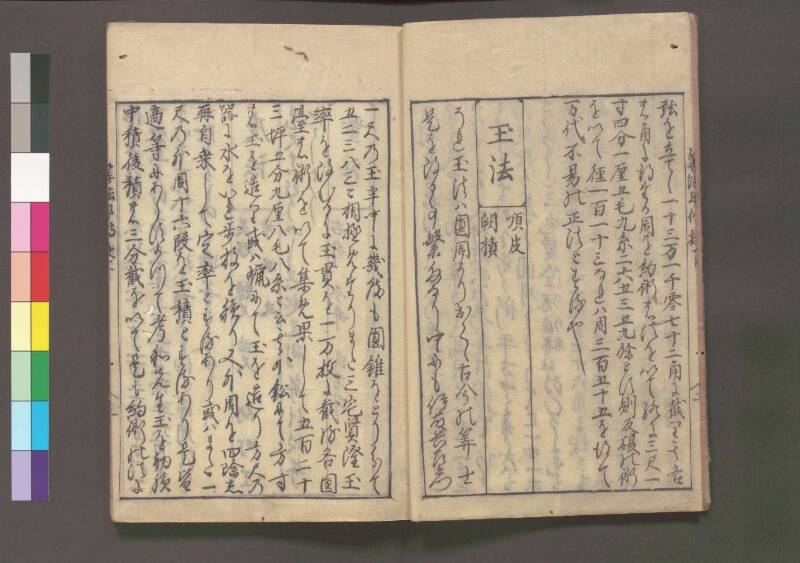
翻刻
弦を立て一十三万一千零七十二角に截り其各
の角に得たる周を鈎術の法を以て終に三尺一
寸四分一厘五毛九糸二六五三五九余とす則反復の術
を以て径一百一十三なれは周三百五十五を得て
万代不易の正法とする也
《題:玉法《割書:順皮|闕積》》
それ玉法は円周より出てゝ古今の算士
是を得る事繁多なり中にも伊藤兵左衛門
一尺の玉半中に幾度も円錐をとり分て
五二三八三に相極めたりまた三宅賢隆玉
率を得むるに玉貫を一万枚に截る各円
臺の術を以て集め果して五百二十
三坪五分九厘八毛八糸と云其外鈆にて方寸
の玉を造り或は蝋にて玉を造り方尺の
器に水をいれ歩数を積り又外周を四除し
再自乗して定率とするあり或はまた一
尺の外周十六段を玉積とするあり是皆
適等にあらすよつて孝和先生玉を初積
中積後積の三分截を以て是も約術の法に
現代語訳
弦を立て、十三万一千零七十二角形に切り、各角から得た円周を鉤術の法によって計算し、最終的に三尺一寸四分一厘五毛九糸二六五三五九余とした。すなわち、反復の術(逐次近似法)を用いて、直径百十三に対して円周三百五十五を得て、これを万代不易の正法(永遠に変わることのない正確な方法)とした。
【球の体積の計り方(玉法:順皮・闕積)】
そもそも玉法(球の体積を求める方法)は円周率から導き出されるものであり、古今の算士たちがこれを求めることは数多くあった。中でも伊藤兵左衛門は、一尺の球の中に何度も円錐を取り分けて、(球の体積率を)五二三八三と極めた。また三宅賢隆は球の体積率を求めるにあたり、球を一万枚に切り、各々の円台(円錐台)の術を用いて集計し、結果として五百二十三坪五分九厘八毛八糸と算出した。そのほかに、鉛で一寸四方の球を作り、あるいは蝋で球を作って一尺四方の器に水を入れ、体積の数を積算する方法や、外周を4で割り再び二乗して定率とする方法があった。または、一尺の外周の十六乗を球積とする方法もあった。しかしこれらはいずれも正確ではない。よって孝和先生(関孝和)は、球を初積・中積・後積の三分截(三分割)の方法を用いて、これもまた約術(逐次近似)の法によって
英語訳
...constructed base, altitude, and hypotenuse, cutting into a polygon of 131,072 sides, and using the right-triangle method to calculate the circumference obtained from each angle, ultimately arriving at 3 shaku 1 sun 4 bu 1 rin 5 mō 9 shi 2653590 with remainder. That is, using the method of repeated iteration (successive approximation), for a diameter of 113, a circumference of 355 was obtained, and this was established as the correct method unchanging for ten thousand generations.
【Method for the Volume of a Sphere (Tamahō: Junpi / Kessheki)】
The method for calculating the volume of a sphere (tamahō) is derived from the value of pi, and countless mathematicians throughout history have endeavored to obtain it. Among them, Itō Hyōzaemon repeatedly extracted cones from within a sphere of one shaku, ultimately determining the volumetric ratio to be 0.52383. Also, Miyake Kenryū, in seeking the spherical volume ratio, cut the sphere into 10,000 slices, collected them using the method of circular frustums (circular truncated cones), and concluded that the result was 523 tsubo 5 bu 9 rin 8 mō 8 shi. Beyond these, there were methods such as making a one-sun-square sphere from lead, or making a sphere from wax, filling a one-shaku-square vessel with water, and accumulating the number of steps (volume units); or dividing the outer circumference by 4 and squaring the result to establish a fixed ratio. There was also a method using the 16th power of the outer circumference of a one-shaku sphere as the spherical volume. However, none of these are accurate. Therefore, Master Kōwa (Seki Takakazu), using the method of dividing a sphere into three sections—the initial accumulation, middle accumulation, and final accumulation (shoseki, chūseki, kōseki)—and employing the method of successive approximation (yakujutsu)...