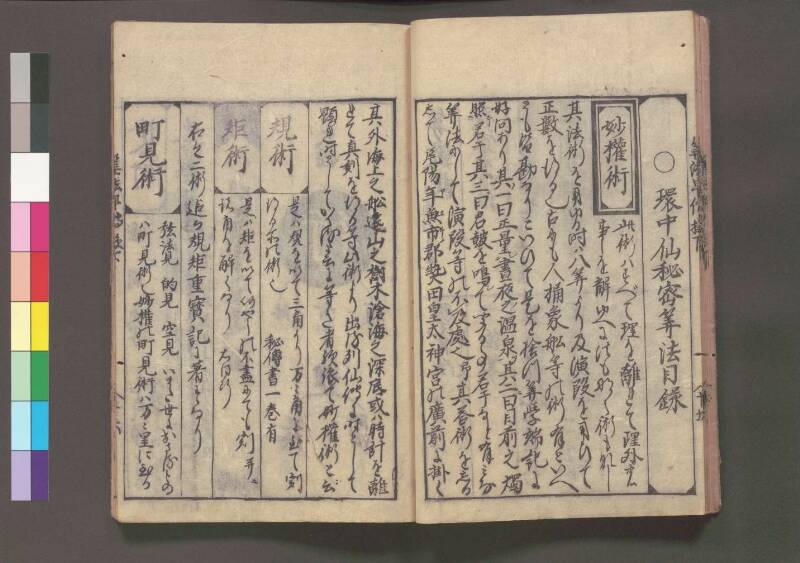
翻刻
《題:○環中仙秘密筭法目録》
《題:妙権術》此術はすべて理を離れて理外の
事を解ゆへに法もなく術もなし
其法術を用ゆる時は八算より演段を用ひて
正数を得る也古にも人桶象船等の術有といへ
とも皆勘なりこいひて是を捨つ筭学端記に
好問あり其ノ一曰正量書夜之温泉其二曰目前之燭
照君于其三曰君鼓を鳴て聞る事若于なと有みな
筭法にして演段等の不及處也予其答術をしる
して尾陽年魚市郡熱田皇太神宮の広前に掛く
其外海上之船遠山之樹木滄海之深底或は時計を離
れて真剣を得る等此術より出る列仙伝に時として
顕れ時としてかゝると云に等き者歟依て妙権術と云
《題:規術》是規を以て三角より万に角に置て割
得る所の術也 秘伝書一巻有
《題:矩術》是は矩を以て何やうの不尽にても割并に
諸角を解くなり 右同断
右之二術追々規矩重宝記に著すなり
《題:町見術》弦法見 的見 空見 いまた世に出さるもの
は町見術也妙権の町見術は万々里に至る
現代語訳
## 環中仙秘密算法目録
### 妙権術
この術はすべて、通常の理(論理・理論)を離れて、理外の事象を解くものであるから、一般的な法も術もない。その法術を用いる時は、八算より演段を用いて正確な数を得るものである。古くにも「人桶」「象」「船」などを題材とした術があるといえども、それらはすべて「勘(カン)」によるものであって、これを(算法として)捨てる。算学端記に良問があり、その一つには「昼夜の温泉の正確な量を測ること」、その二つには「目の前の燈火が照らす範囲を求めること」、その三つには「太鼓を鳴らして聞こえる距離を求めること」などがあり、これらはすべて算法の中でも、演段などでは及ばない領域である。私はその答えと術を記して、尾張国年魚市郡(あゆちぐん)熱田皇太神宮の御前に奉納した。
その他にも、海上の船(までの距離)、遠山の樹木(の高さや距離)、深海の深さを測ること、あるいは時計(時刻の道具)を用いずに正確な時刻を得ること等、この術から生まれるものである。「列仙伝」に「時として現れ、時として隠れる」とあるのに等しいものであろうか。よって「妙権術」と呼ぶ。
### 規術
これは「規(コンパス)」を用いて、三角形より万(あらゆる)角形に対して置いて割り算する術である。 秘伝書一巻あり。
### 矩術
これは「矩(さしがね・直角定規)」を用いて、いかなる不尽(割り切れない数・難問)であっても割ること、および諸角(各種の角度の問題)を解くものである。 右に同じ。
右の二術は、追って「規矩重宝記」に著すものである。
### 町見術
弦法見・的見・空見——いまだ世に出ていないものは「町見術」である。妙権の町見術は、万々里に至るまでも(距離を測ることができる)。
英語訳
## Catalog of Kanchūsen's Secret Mathematical Methods
### Myōken-jutsu (The Art of Wondrous Measurement)
This method deals entirely with matters beyond ordinary reason and logic, and therefore has neither conventional law nor conventional technique. When employing its methods, one uses *endan* (extended calculation steps) derived from the eight arithmetic operations (*hasan*) to obtain accurate numbers. Though ancient works contain methods dealing with topics such as "a person in a bucket," "an elephant," and "a ship," these are all matters of intuition (*kan*), and are therefore set aside here. In the *Sangaku Tanki* (Notes on Mathematical Learning), there are excellent problems: the first asks how to precisely measure the flow of a hot spring day and night; the second asks about the range illuminated by a candle before one's eyes; the third asks about the distance at which a drum can be heard — and similar problems. All of these belong to domains of mathematical inquiry that methods such as *endan* cannot reach. I have recorded the answers and techniques, and dedicated them before the great shrine of Atsuta Kōtaijingū in Ayuchi District, Owari Province.
Beyond these, the measurement of ships at sea, trees on distant mountains, the depth of the ocean floor, or obtaining the accurate time without a clock — all of these arise from this method. Perhaps it resembles what is said in the *Lièxiān Zhuàn* (Biographies of Immortals): "sometimes appearing, sometimes concealing." For this reason, it is called *Myōken-jutsu*.
### Ki-jutsu (The Art of the Compass)
This is a method of calculation using the *ki* (compass) applied to triangles and polygons of any number of sides. *A volume of secret transmission exists.*
### Ku-jutsu (The Art of the Square)
This is a method of using the *ku* (carpenter's square/right-angle ruler) to divide any indivisible or difficult quantity, and to resolve problems involving various angles. *Same as the above.*
The above two methods will be published in due course in the *Kiku Chōhōki* (Treasury of Compass and Square).
### Machimi-jutsu (The Art of Surveying)
*Genho-mi* (chord-based viewing), *Teki-mi* (target viewing), *Sora-mi* (aerial viewing) — what has not yet been released to the world is the *Machimi-jutsu* (Art of Land Surveying). The *Machimi-jutsu* of *Myōken* can reach distances of tens of thousands of *ri*.