翻刻
【右丁上段】
頸(くび)かせを桁(かう)といふ事もあり
又 衣類(いるい)をかくるを衣桁(いかう)といふ
翡翠(ひすい)鳴(なく)_二衣桁(いかうに)_一と杜子美(としみ)が詩(し)に
つくれり
○榱(たるき)は椽(たるき)なりもろこし秦(しん)の
世(よ)には椽(えん)といふ周(しう)の世には榱(さい)と
いふ斉(せい)の世(よ)にはこれを桷(かく)といふ
○藻井(さうせい)は天井(てんじやう)なり藻(も)をゑかく
によつて藻井(さうせい)といふ藻(さう)といひ
井(せい)といふみな火災(くはさい)をさくるこゝろ
なり天井(てんじやう)と書(かく)も此(この)意(こゝろ)なり
みな水(みづ)の縁(ゑん)をとる
○窯(かはらかま)は瓦竃(ぐはそう)なりかはらやくかま
なり窰(よう)同このかまのうちにかは
らを入 柴(しば)にてふすべやくなり
炭(すみ)やくかまも此たぐひなり
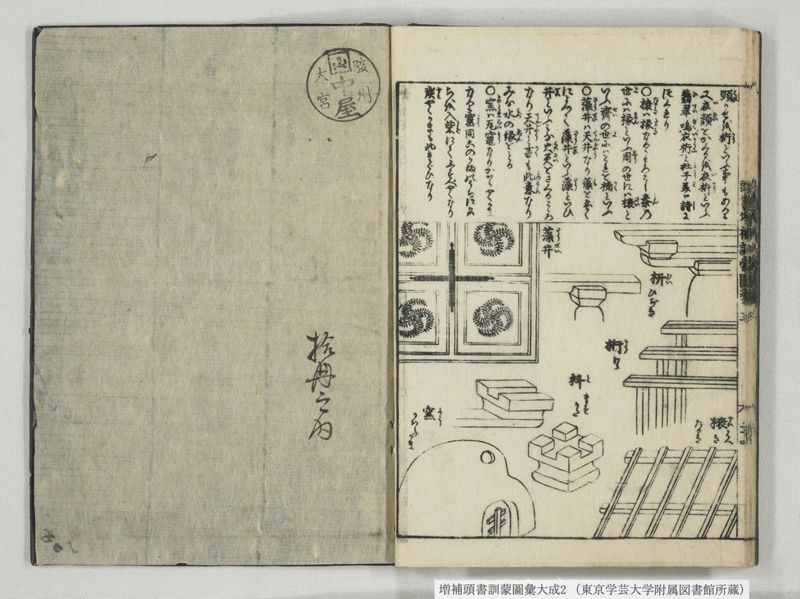
【右丁下段挿絵】
榱(すい)《割書:はへ| き》
《割書:たるき》
枅(けい)《割書: |ひぢき》
桁(かう)《割書:けた| 》
枓(と)《割書:ます| かた》
藻井(さうせい)
窯(よう)
《割書:かはら| がま》
【左丁 裏表紙見返し】
拾冊之内【手書き】
現代語訳
【右丁上段】
首枷を桁(こう)ということもある。また衣類をかけるものを衣桁という。「翡翠鳴く衣桁に」と杜甫の詩に詠まれている。
○垂木(たるき)は椽(たるき)である。中国の秦の時代には椽(えん)といい、周の時代には榱(さい)といい、斉の時代にはこれを桷(かく)という。
○藻井(そうせい)は天井である。藻を描くので藻井という。藻(そう)といい井(せい)というのは、みな火災を避ける心からである。天井と書くのもこの意味で、みな水の縁を取っている。
○窯(かわらがま)は瓦竃(がそう)である。瓦を焼く窯である。窰(よう)も同じ。この窯の中に瓦を入れ、柴で燻して焼く。炭を焼く窯もこの類である。
【挿絵部分】
枅(ひじき)、桁(けた)、枓(ますがた)、榱(たるき)、藻井(そうせい)、窯(かわらがま)
【左丁 裏表紙見返し】
十冊の内【手書き】
英語訳
【Right page, upper section】
Neck shackles are sometimes called "kō" (crossbeams). Also, racks for hanging clothes are called "ikō" (clothing racks). Du Fu composed in his poetry "kingfishers cry at the clothing rack."
○Rafters (taruki) are also written as "en." In China during the Qin period they were called "en," during the Zhou period "sai," and during the Qi period "kaku."
○Coffered ceilings (sōsei) are ceilings. They are called sōsei because aquatic plants are painted on them. Both "sō" (aquatic plants) and "sei" (well) come from the desire to ward off fire disasters. Writing it as "tenjō" (heaven's well) also carries this meaning - all taking associations with water.
○Kilns (kawarakama) are tile kilns. These are kilns for firing tiles. "Yō" means the same thing. Tiles are placed inside these kilns and fired by smoking with brushwood. Charcoal kilns are of the same type.
【Illustration section】
Bracket arms (hijiki), crossbeams (keta), bracket blocks (masugata), rafters (taruki), coffered ceiling (sōsei), kiln (kawarakama)
【Left page, back cover endpaper】
Among ten volumes [handwritten]