翻刻
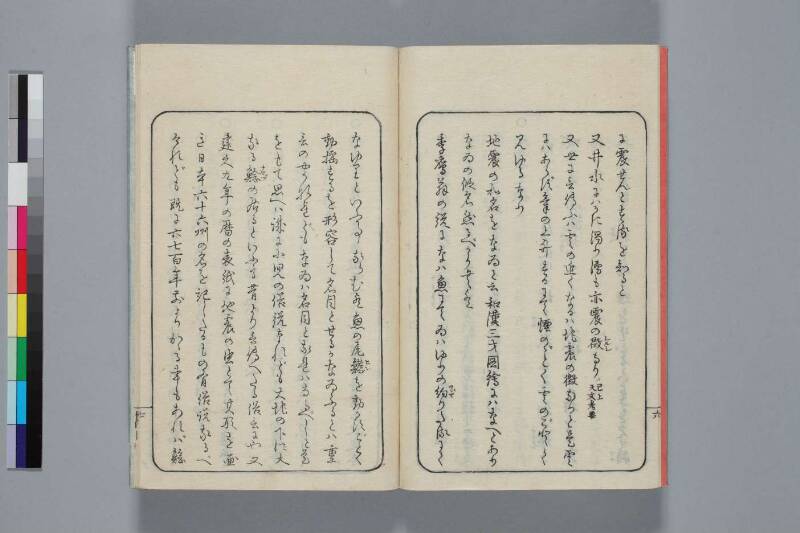
に震せんとするを知ると
又井水にはかに濁り湧も亦震の徴(しるし)なり《割書:已上|天文考要》
又世に言伝ふは雲の近くなるは地震の徴なりと是雲
にはあらず気の上升するにて煙のごとく雲のごとく
見ゆるなり
地震の和名をなゐと云和漢三才図絵にはなへとあり
なゐの仮名然るべからむ歟
季鷹翁の説になは魚にてゐはゆりの約(つゞま)りたるにて
なゆりといふ事ならむ歟魚の尾 鰭(ひれ)を動かすごとく
動揺するを形容して名目とせるかなゐふるとは重
言のやうなれどもなゐは名目となれは守るべしと是
をもて思へは誠に小児の俗説なれども大地の下に大
なる鯰(なまづ)の居るといふも昔より言伝へたる俗言にや又
建久九年の暦の表紙に地震の虫とて其形を画
き日本六十六州の名を記したるもの有俗説なるべ
けれども既に六七百年前よりかゝる事もあれば鯰
現代語訳
に震が起こることを知るという。
また井戸の水が突然濁ったり、湧き水も亦た震の徴候である。《割書:以上天文考要より》
また世間で言い伝えられているのは、雲が近くなるのは地震の徴候であるということ。これは雲ではなく、気が上昇することによって煙のように雲のように見えるのである。
地震の和名を「なゐ」という。和漢三才図絵には「なへ」とある。「なゐ」の仮名が正しいであろうか。
季鷹翁の説によると、「な」は魚で、「ゐ」は「ゆり」が縮まったもので、「なゆり」ということであろうか。魚の尾びれを動かすように動揺することを形容して名前としたのか。「なゐふる」とは重複表現のようであるが、「なゐ」は名詞となったので守るべきであるという。これをもって思えば、誠に小児の俗説ではあるが、大地の下に大きな鯰が居るというのも昔から言い伝えられた俗言であろうか。
また建久九年の暦の表紙に地震の虫としてその形を描き、日本六十六州の名を記したものがある。俗説であるべきだけれども、既に六、七百年前からこのようなこともあれば、鯰
英語訳
knows that an earthquake is about to occur.
Also, when well water suddenly becomes turbid, or when springs bubble up, these are also signs of earthquakes. 《Marginal note: The above from Tenmon Kōyō (Essentials of Astronomy)》
Also, what is commonly passed down is that clouds coming near is a sign of earthquakes. This is not actually clouds, but qi rising upward, appearing like smoke or clouds.
The Japanese name for earthquake is called "nawi." In the Wakan Sansai Zue it appears as "nahe." The kana "nawi" would be appropriate.
According to Master Kitaka's theory, "na" refers to fish, and "wi" is a contraction of "yuri" (shaking), so it would be "nayuri." Perhaps it was named to describe the swaying motion like a fish moving its tail fins. "Naifuru" (earthquake occurring) seems like a redundant expression, but since "nawi" has become a noun, it should be preserved.
Thinking about this, although it is truly a childish folk belief, the idea that a large catfish dwells beneath the earth may also be a folk saying passed down from ancient times.
Also, on the cover of a calendar from Kenkyū 9 (1198), there is something that depicts the form of an "earthquake insect" and records the names of Japan's sixty-six provinces. Although it may be folk belief, since such things existed already six to seven hundred years ago, the catfish...