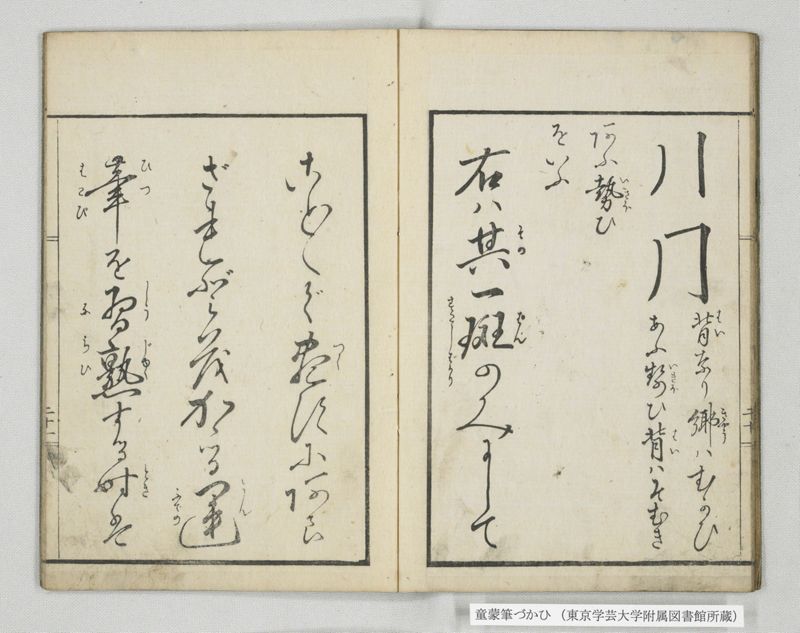
翻刻
【右丁】
川 冂 《割書:背(はい)なり郷(きやう)はむかひ|あふ勢(いきほ)ひ背(はい)はそむき》
《割書:あふ勢(いきほ)ひ|をいふ》
右は其(その)一()斑(ぱん)のみにして
【左丁】
こと〴〵く尽(つく)すにあら
ざれどもかゝる運(うん)
筆(ひつ)を習熟(しうじゆく)する時(とき)は
現代語訳
【右丁】
川・冂(これらは)「背(はい)」である。「郷(きょう)」とは向かい合う勢いのことであり、「背(はい)」とは背き合う勢いのことをいう。
右に述べたことはその一端(いったん)に過ぎず、
【左丁】
すべてを尽くして説明したわけではないが、このような運筆を習熟したならば、
英語訳
【Right page】
The characters 川 (river/three strokes) and 冂 (framing shape) exemplify "hai" (opposing/turning away). "Kyō" refers to the dynamic of strokes facing toward each other, while "hai" refers to the dynamic of strokes turning away from each other.
What has been described above represents only a glimpse of the whole,
【Left page】
and does not cover everything exhaustively; however, when one has thoroughly practiced and mastered such brushwork techniques,