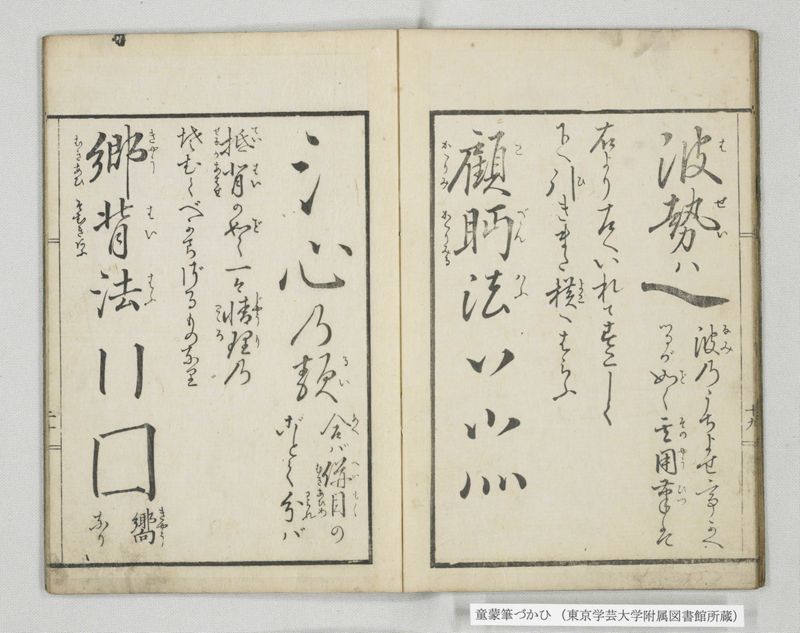
翻刻
【右丁】
波勢は 《割書:波(なみ)のうちよせてかへ|るが如(ごと)く其(その)用(やう)筆(ひつ)は》
《割書:右より左へいれてすこしく|下へ引(ひ)きまた横(よこ)へはらふ》
顧眄法(こべんはふ) 丷 ⺌ 灬
【左丁】
氵 心 の類(るい)《割書:合(あへ)ば併目(へいもく)の|ごとく分(わられ)ば》
《割書:抵背(ていはい)の如(ごと)く一々()情理(じやうり)の|そむくべからざるものなり》
郷背法(きやうはいはふ) 川 口《割書:嚮(きやう)|なり》
現代語訳
【右丁】
波勢(はせ)とは、波が打ち寄せて返るように、その用筆は、右から左へ入れて少し下へ引き、また横へ払うものである。
顧眄法(こべんほう) 丷 ⺌ 灬
【左丁】
氵(さんずい)・心(こころ)の類は、合わせれば「併目(へいもく)」のように向き合い、分かれれば「抵背(ていはい)」のように背き合うもので、一つひとつの点や画が情理(道理と感情)に背いてはならないものである。
郷背法(きょうはいほう) 川 口(嚮(きょう)と同じ意味)
英語訳
**[Right folio]**
The "wave stroke" (*hasei*) is like a wave rolling in and then retreating; the brush technique involves entering from right to left, pulling down slightly, and then sweeping horizontally outward.
**The "Facing-Glance Method" (*Koben-hō*)**: 丷 ⺌ 灬
**[Left folio]**
Radicals such as 氵 (three-dot water) and 心 (heart) — when brought together, they face each other like "併目" (*heimoku*, eyes turned toward one another); when apart, they turn away from each other like "抵背" (*teihaii*, backs turned against one another). Each individual dot and stroke must not deviate from proper principle and feeling (*jōri*).
**The "Facing-and-Turning-Away Method" (*Kyōhai-hō*)**: 川 口 (meaning *kyō*, "facing toward")