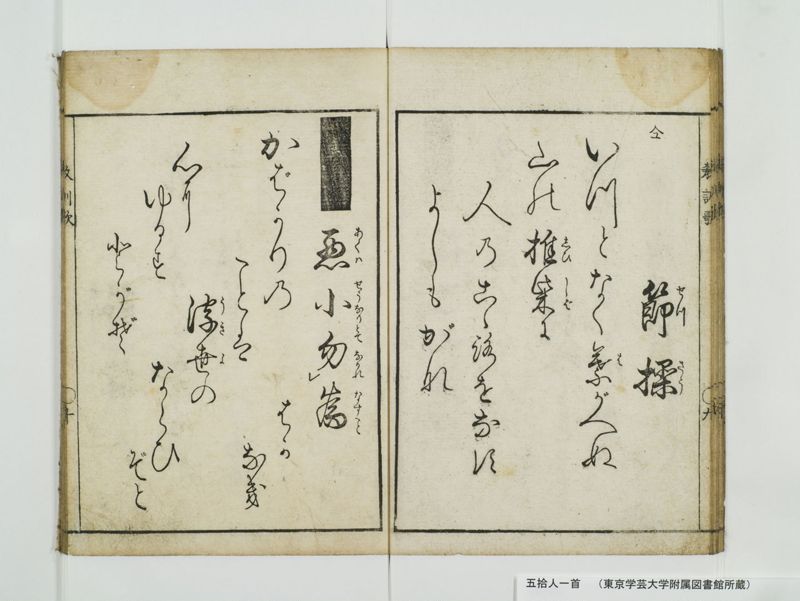
翻刻
【右丁】
仝 節操(せつさう)
いつとなく葉(は)がへぬ
山の椎柴(しひしば)に
人のこゝろをなす
よしもがな
【左丁】
□□□□ 《振り仮名:悪小|あくは せうなりとて》《振り仮名:勿_レ為|なかれ なすこと》
かばかりの
ことは
浮世(うきよ)の
心に ならひ
ゆるす ぞと
とがぞ
はか
なき
現代語訳
【右丁】
《仝(同じく慈鎭和尚)》 〔徳目〕節操(せつそう)
いつとなく
葉(は)がへぬ
山の
椎柴(しひしば)に
人(ひと)の
こころを
なす
よしもがな
(いつの季節も葉を変えることなく青々としている山の椎柴のように、人の心もまた変わらぬ節操を保つことができればよいのだが。)
(椎柴は常緑で、どの季節にも葉を落とさず、色を変えない。そのような揺るぎない一貫性を、人の心も持ち得れば——と、節操の大切さを詠んだ歌である。)
---
【左丁】
《□□□□(作者名、判読不能)》 「悪(あく)は小(せう)なりとて、なすこと勿(なか)れ」
(悪事は小さなことだからといって、行ってはならない)
かばかりの
ことは
浮世(うきよ)の
ならひ
心に
ゆるす
ぞと
とがぞ
はかなき
(「これくらいのことは世の中の習いだ」と心の中で自分に言い聞かせて許してしまうことで、罪咎(つみとが)というのはいつの間にか積み重なってはかなく(軽々しく)なされてしまうものだ。)
(世間の慣習だから、これくらいは許されると心が油断する——まさにその油断のなかにこそ、罪のはかなさ(気づかぬうちに犯してしまうこと)が潜んでいる。小さな悪を「よくあること」と見過ごすことが、やがて大きな過ちへとつながる。)
英語訳
【Right Page】
《Same author (The Monk Jichin / Jien)》 [Virtue] Constancy of Character (*setsusō*)
Would that there were
some way
to fashion
the human heart
after the *shiishiba* oak
of the mountain —
whose leaves
never change,
no matter the season.
(Just as the evergreen *shiishiba* shrub on the mountain keeps its leaves unchanged through every season, how I wish that the hearts of people could likewise hold to an unwavering, constant integrity.)
(The *shiishiba* is an evergreen that does not shed its leaves or change its color with the turning of the seasons. If only human hearts could possess that same steadfast, unshakable constancy — this poem is a meditation on the virtue of *setsusō*: moral integrity and fidelity to one's principles, regardless of circumstance.)
---
【Left Page】
《□□□□ (Author name illegible)》 "Do not commit evil, even if it be a small thing."
(Classical maxim — cf. *Sanguo Zhi* and similar texts)
Telling oneself
that "this much
is merely
the way of the floating world" —
permitting it
within one's heart —
it is in just this way
that transgressions
so carelessly
come to be.
(By saying to oneself, "this is just how the world works — a thing this small is surely permissible," one allows the heart to excuse wrongdoing. And it is precisely in such casual, unguarded self-permission that sins, one by one, accumulate so lightly and thoughtlessly.)
(The most dangerous moment is not when we knowingly choose evil, but when we tell ourselves that a small wrong is no wrong at all — that it is merely "the custom of this fleeting world." It is in that quiet permission granted within the heart that transgressions take root. No evil is too small to refuse.)