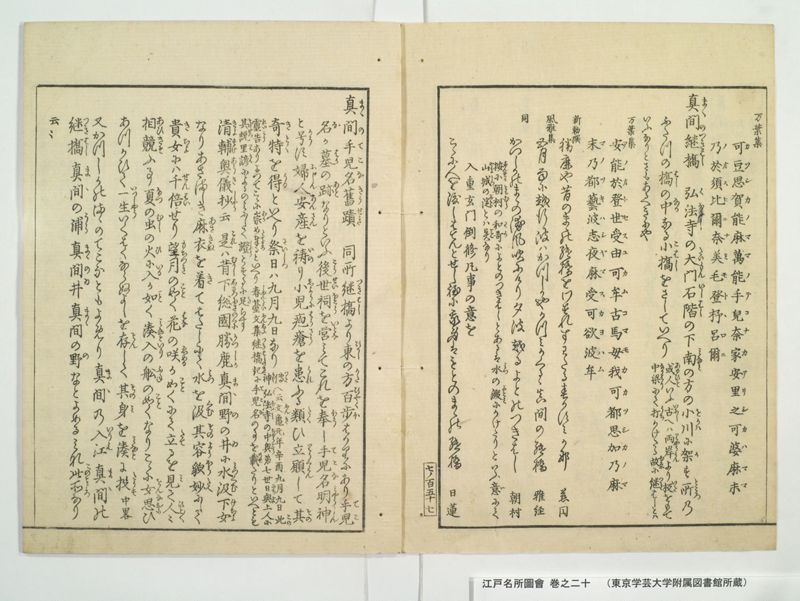
翻刻
万葉集
可豆思賀能(カツシカノ)麻万能(ママノ)手児奈家(テコナカ)安里之可婆(アリシカハ)麻末(ママ)
乃(ノ)於須比爾(オスヒニ)奈美毛(ナミモ)登杼呂爾(トヽロニ)
真間継橋(まゝのつきはし) 弘法寺(くほふし)の大門(たいもん)石段(いしはし)の下 南(みなみ)の方の小川(をかは)に架(か)す所(ところ)の
ふた川の橋(はし)の中(なか)なる小橋(こはし)をさしていへり 《割書:或人(あるひと)いふ古(いにし)へは両岸(りやうかん)より板(いた)をもて|中梁(なかはり)にて打(うち)かけたる故(ゆゑ)に継(つき)はしとは》
《割書: いふなりとさもあるへきにや|》
万葉集
安(ア)能(ノ)於(オ)登(ト)世(セ)受(ス)由(ユ)可(カ)牟(ム)古(コ)馬(マ)母(モ)我(カ)可都思加乃(カツシカノ)麻(マ)
末(マ)乃(ノ)都芸波志(ツキハシ)夜麻受(ヤマス)可欲波牟(カヨハム)
新勅選
勝鹿や昔のまゝの継橋をわすれすわたる春かすみかな 慈円
風雅集
五月雨に越行波はかつしかやかつみかくるゝ真間の継橋 雅経
同
かつしかのまゝの海風吹にけり夕波越るよとのつきはし 朝村
按(あんする)に朝村(ともむら)の和歌(わか)によとのつきはしとあるは水(みつ)の澱(よとみ)にかけたりといふ意(い)にて
山城(やましろ)の淀(よと)とは異(こと)なり
入重玄門修凡事の意を
こゝに人を渡しはてんとせし程に我身はもとのまゝの継橋 日蓮
真間(まゝの)手児名(てこなの)旧蹟(きふせき) 同所 継橋(つきはし)より東(ひかし)の方(かた)百歩(ひやくほ)はかりにあり手児(てこ)
名(な)か墓(はか)の跡(あと)なりといふ後世(こうせい)祠(ほこら)を営(いとな)みてこれを奉(ほう)し手児名明神(てこなみやうしん)
と号(かう)す婦人(ふしん)安産(あんさん)を祈(いの)り小児(しように)疱瘡(はうさう)を患(ふれ)ふる類(たく)ひ立願(りうくわん)して其(その)
奇特(きとく)を得(うる)といへり)祭日(さいしつ)は九月九日なり 《割書:伝(つた)へ云 文亀(ふんき)元年辛酉九月九日 此(この)|神(かみ)弘法寺(くほふし)の中興(ちゆうこう)第七世 日与(にちよ)上人に》
《割書: 霊告(れいこう)ありよつてこゝに崇(あか)め奉(たてまつ)るといへり春台文集(しゆんたいふんしふ)継橋記(つきはしのき)に手児名(てこな)の事を載(のせ)たりといへとも|其説(そのせつ)里諺(りけん)によるのみにして証(しやう)とするに足(た)らす》
清輔奥義抄(きよすけあうきしやう)云 是(これ)は昔(むかし)下総国(しもつふさのくに)勝鹿(かつしか)真間野(
まゝの)の井(ゐ)に水汲(みつくむ)下女(けちよ)
なりあさましき麻衣(あさきぬ)を着(き)てはたしにて水(みつ)を汲(くむ)其(その)容貌(ようほう)妙(たへ)にして
貴女(きちよ)には千倍(せんはい)せり望月(もちつき)の如(こと)く花(はな)の咲(ゑめる)か如(こと)くにて立(たて)るを見(み)て人々(ひと〳〵)
相競(あひきそ)ふ事 夏(なつ)の虫(むし)の火(ひ)に入(いる)か如(ことく)湊入(みなといり)の船(ふね)の如(こと)くなりこゝに女(をんな)思(おも)ひ
あつかひて一生(いつしやう)いくはくならぬよしを存(そん)して其身(そのみ)を湊(みなと)に投(とうす)中略
又かつしかのまゝのてこなともよめり真間(まゝ)の入江(いりえ)真間(まゝ)の
継橋(つきはし)真間(まゝ)の浦(うら)真間井(まゝのゐ)真間(まゝ)の野(の)なとよめるみな此所(このところ)なり
云々
現代語訳
万葉集
「勝鹿の真間の手児奈がありしかば真間の奥津に波も騒がぬ」
真間継橋(ままのつきはし) 弘法寺の大門石段の下、南の方の小川に架かっている二つの川の橋の中にある小橋のことを指している。《ある人が言うには、昔は両岸から板を中梁で打ち掛けたため継橋と言うのだという。そのようなことであろうか。》
万葉集
「あの乙女に行かむ駒も我が勝鹿の真間の継橋止まず通はむ」
新勅撰集
「勝鹿や昔のままの継橋を忘れず渡る春霞かな」慈円
風雅集
「五月雨に越し行く波は勝鹿や勝見が隠る真間の継橋」雅経
「勝鹿の真間の海風吹きにけり夕波越るよとの継橋」朝村
按ずるに朝村の和歌に「よとのつきはし」とあるのは、水の淀みにかけて言ったという意味で、山城の淀とは異なる。
「ここに人を渡し果てんとせし程に我が身はもとのままの継橋」日蓮
真間手児奈の旧跡 同所継橋より東の方百歩ほどにあり、手児奈の墓の跡であるという。後世祠を営んでこれを祀り、手児奈明神と号する。婦人の安産を祈り、小児の疱瘡を患う類いが立願してその霊験を得るという。祭日は九月九日である。《伝えによれば、文亀元年辛酉九月九日、この神が弘法寺の中興第七世日与上人に霊告があったため、ここに祀ったという。春台文集継橋記に手児奈のことを載せているというが、その説は里の言い伝えによるのみで証拠とするには足らない。》
清輔奥義抄に言う。これは昔、下総国勝鹿真間野の井に水を汲む下女である。粗末な麻衣を着て、はだしで水を汲む。その容貌は美しく、貴女には千倍も勝っていた。望月のように、花が咲き笑うように立っているのを見て、人々が競い合うこと、夏の虫が火に入るように、港に入る船のようであった。ここに女は思い悩んで一生がいくばくもないことを思い、その身を港に投じた。中略。
また「勝鹿の真間の手児奈」とも詠んだ。真間の入江、真間の継橋、真間の浦、真間の井、真間の野などと詠んだのはみなこの所である。云々
英語訳
Man'yōshū (Collection of Ten Thousand Leaves)
"Because Tekona of Mama in Katsushika was there, even the waves do not disturb the depths of Mama"
Mama-no-tsukihashi (Mama Connecting Bridge) - This refers to the small bridge in the middle of the two bridges spanning the small stream south of the stone steps at the main gate of Kōbōji Temple. [According to some, in ancient times, planks were laid from both banks and connected with a central beam, hence the name "connecting bridge" (tsukihashi). This seems plausible.]
Man'yōshū
"The horse that would go to that maiden, and I too, would constantly cross the connecting bridge of Mama in Katsushika"
Shinchokusen Collection
"In Katsushika, crossing the connecting bridge unchanged from ancient times, not forgetting the spring mist" - Jien
Fūga Collection
"In the May rains, the waves crossing over - is it Katsushika where Katsumi hides at Mama's connecting bridge?" - Masatsune
"The sea breeze of Mama in Katsushika has blown - the evening waves cross the yoto connecting bridge" - Tomomura
Note: In Tomomura's waka poem, "yoto no tsukihashi" refers to a bridge over stagnant water, which is different from Yodo in Yamashiro Province.
"Here, when I was about to finish ferrying people across, my body remained the same connecting bridge" - Nichiren
Historic Site of Mama no Tekona - Located about one hundred paces east of the connecting bridge at the same place. It is said to be the site of Tekona's grave. In later generations, a shrine was built to enshrine her, called Tekona Myōjin. Women pray for safe childbirth, and those whose small children suffer from smallpox make vows and receive divine blessings. The festival day is September 9th. [According to tradition, on September 9th of the first year of Bunki (1501), this deity gave a divine revelation to Nichyo Shōnin, the seventh-generation restorer of Kōbōji Temple, and was therefore enshrined here. Although the Shundai Literary Collection's "Record of the Connecting Bridge" contains information about Tekona, that account is based only on local folklore and is insufficient as evidence.]
Kiyosuke's Ōgishō states: This was a servant girl who drew water from the well at Mama-no in Katsushika, Shimōsa Province in ancient times. She wore humble hemp clothing and drew water barefoot. Her appearance was so beautiful that she surpassed noble ladies a thousandfold. Standing like the full moon or like a blooming flower, people competed for her attention like summer insects drawn to fire, like ships entering a harbor. The woman, troubled by this attention and realizing that life is brief, threw herself into the harbor. [Omitted text]
Also composed as "Tekona of Mama in Katsushika." Mama Bay, Mama Connecting Bridge, Mama Inlet, Mama Well, Mama Field - all these places mentioned in poems refer to this location, etc.