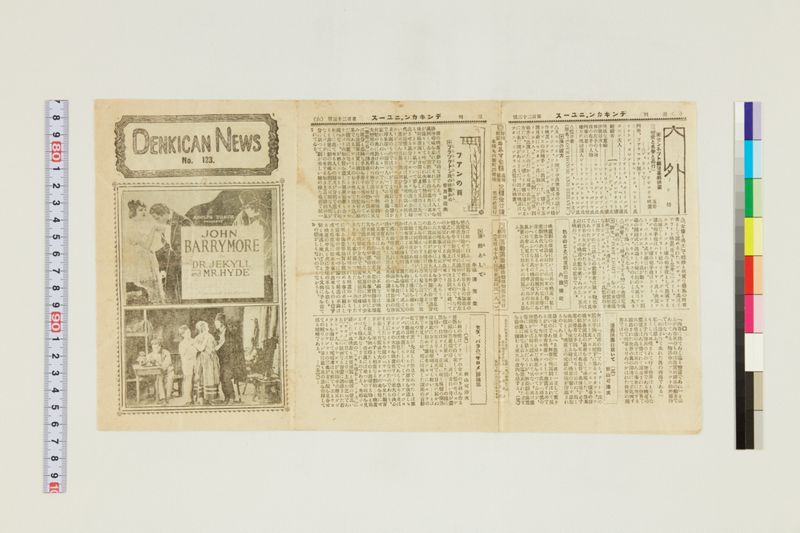
翻刻
(□【五】)
週刊 デンキカン.ニユース 第百二十三号
【五頁上段】
内外
S坊
センネツト新発喜劇映画
「恋愛と名誉と品行」 五巻
フアースト、ナシヨナル映画
ザ、カスト
判事、フアウコツト閣下……………………
……………………チヤールス、マーレー氏
ミルトン、ロピン……………………………
…………………フオード、スターリング氏
ロピン夫人………フイーリス、ヘーバー嬢
新婚者………… マリー、ブレヴオスト嬢
ジヨーヂ、オーハラ氏
快活な寡婦………シヤーロツト、ミノー嬢
詐欺弁護士…………ビリー、ビーヴアン氏
彼の左手の人物…エデイー、グリツボン氏
彼の右手の人物……………カラ、パシヤ氏
判事の妻……………フアンニー、ケリー嬢
地方代理弁護人ビリーアームストロング氏
……………………………ベン、ターピン氏
監督者…………マツク、センネツト氏
(原名"LOVE HONOR AND BEHAVE")
海の彼方
○又々センネツト配下中出世女優の話だが
ヴアージニア、ワーウイツク嬢はメトロ特
作映画ルドルフ、ヴアレンチノ氏主演「アポ
カリプスの四騎手」に出演した。嬢は十五
箇月前にセンネツト氏に加つたがそれより
フオツクス、サンシヤイン喜劇に出演後四
騎手に出演したのだから可成り出世が早い
方だが、スワンスン嬢レーク嬢の様になる
には未だ間がありさうだ。因に同映画はレ
ツクス、イングラム氏監督の大映画。
【五頁中段】
○「女優と兵士」で軽妙と堅実な芸風の所有
者として認めるれたモンテ、プルー氏はリ
アラート映画「月光と忍冬」にメリー、マイ
ルス、ミンター嬢の相手役として出演する
○同じくアラート社のビープ、ダニエルス
嬢の相手役はハリー、メーヤー氏と決定ワ
ンダ、ホーレー嬢の相手役はテイー、ロー
イ、バーネス氏が撰ばれた。
○ウオーレス、リード氏が新キヤピトル劇
場の開館式に出場した時に彼の人気はプリ
ンス、オヴ、ウエールスのそれよりも大き
かつたと伝へられてゐる。
○「神聖にして神聖ならざる恋」を此程完成
したパ社のエルシー、フアーグスン嬢は今
■【「回」の誤植か】「脚光」"FOOT LIGHT"をパ社東部撮
影所で「ジーキル博士とハイド氏」の監督者
なるジヨン、エス、ロバートソン氏監督の下
に製作するさうである。
○ドーグの「三銃士」の監督者は兼々物色中
であつたがどうやらフレツド、ニブロー氏
に白羽の矢が当つたらしい。ニブロー氏は
以前ドークの映画の監督者であつた。又D
上映の「セツクス」も氏の監督である。
色々のこと(映画劇の価値)
内田徳司
映画劇の価値に附いては其の映画(私し
は映画なる語を以てこの一文中は特に映
画劇を代表せしめる(【「)」の誤植か】が如何に私し等に
深く食入つて居るか?の問題である語を
かへて云ふたなら其の映画自身が如何に
真の社会(私は敢てそう呼ぶ)其のもを
真実に表現して居るかの問題であると思
ふ。
【五頁下段】
「内容に於てあく迄も豊富であれ」と云
ふが内容其のものは真実的描出の働きで
あつてある一物語中のプロツト的外面物
ではない。
「創造されて生れた真の再出である」
私しは思ふ。
そうして再現されて行く世界はとりもな
ほさず内容其のものゝ世界である映画の
価値とはある撰ばれて描出された世界で
其の価値の高下は其のある事象に対する
描出された世界の真の深浅にて正比例す
るもので何等とりあつかはれた世界の優
劣ではない。
優秀映画に就いて (三)
秋山可津次
次には「連理の枝」である。ドミーユ氏の
監督手腕と、其配下に集るエリオツト、デ
キスター氏グロリア、スワンスン嬢等の俳
優が各演技の最善を尽して構成した、芸術
の結晶である、私は名監督、名俳優が必ず
常に優秀な手腕を見せるとは云はぬ、而し
此映画を後顧する時は、映画の齎らす思想
を始とし、映画上の交錯の価値が浮出され
るのである。
最後に「狂へる悪魔」に就て一言して置き
度いのである。舞台の模写劇と云はれて居
るが私は優秀映画一つとして推賞するので
ある。先年シエルドンルイズ氏が「暗黒の
恐怖」なる前と同じ映画をやつてゐるが、
世間からは余り認められて居ない。其は広
告にも確かに依るだろうが、舞台劇の俳優
と映画に就てと云ふ。今迄発表された諸文
を繰返し読むと至大の皮肉を感ずる。(完)
【五頁と六頁の間】
《割書:旬刊|雑誌》キネマ旬報《割書:高尚|優美》定価金廿銭
本郷丸山新町四番地 黒甕社発行
《割書:月刊|雑誌》活動倶楽部《割書:活動倶楽部社発行|電話下谷五〇七〇番》
(定価七十銭・振替東京四四一八一)
大正十年五月五日発行 定価一部三銭郵税二銭
発行編輯兼印刷人 森田勝祐
浅草公園六区三号八番 デンキカン社
電話下谷三六二二・五七七七
週刊 デンキカン.ニユース 第百二十三号
(六)
【六頁上段】
フアンの頁
ブラツクトン氏の映画から
香月日出夫
彼の映画は夢幻的な詩である。そして軽
妙滑稽味を忘れず、それでゐて巧に人生を
諷刺してゐる。突然に来る山的場面は無い
が徐々として吟ぜられ次第に熱烈となつて
後尚余韻嫋々と谷間に反響して又消え失せ
る、とホツト気がついて夢を辿る様に思ひ
出させる気分にブルーバード映画の全盛時
代が追懐される。彼は気分表現の為め美し
い景色等を背景に屡々用ひる。それはター
ナーがよくやるトテモ目立つ様な―単なる
素人向のものではないが―より以上に静か
で印象深い「路傍の人に」での霧の場合は
忘れられぬものゝ一つである。
紅恋の炎に於けるあのジプシーの熱情的な
失恋男の心理過程の巧妙で落付いた描写又
「禁断の谷」の薄馬鹿―そのくせ恋の為めに
は随分と悪辣な手段を弄する男の極めて巧
みな描写等は実に彼の手に入つた監督の結
果である。デミールの如き些細で突き込ん
だ技巧は更にない、又フイツツモーリスや
ウエバーの如き贅を尽した舞台装置も全々
覗へない、が然しストローハイムのそれの
如くに出て来る人々の個性が分明で悪くす
ると非常に劇の興味を削ぐ不可解な人物が
なくバイダーの有する如き上品で詩的の気
分に依つて劇が美しい絵の様な場面で統一
されてゐる。
【六頁中段】
漫然として
牛込 清芳生
私は敢へて曰ふ「活写に対する当事者の
感覚力は余りに鈍く开は彼等自身の無能さ
を裏書すべく余りに適切である」と事程左
様に昨今の斯界は平凡極まるもので、など
か之れを以て向上せしと沈思黙考に総べて
の嘱望を託する事が出来やう………………
一大痛嘆事なりと云ふべきであらう。
六区の真ツ中に大入袋を夢に見て青息吐
息の当事者が針小棒大なる外観に衒ひ過分
の利に齷齪たる様は苦笑の限りである。
二兎を得んとするには乃ち量を以て量に当
るてふ何等かの報酬があらねばならぬ。
観客は正直である。而して活写を観る眼
は当事者よりも超越した的確さと云ふもの
を有つ故に非芸術的映画を喰物に、或は冗
漫にして実も味もない駄作品を並べて偖良
い獲物御座んなれと方味返へる等無謀の沙
汰である。全く凡作又凡作の誹りは免れな
い事実である。
某週報に「近頃の写真に不満なのは映画
を構成する作者、役者、監督、技師等が雄
大美麗な自然や悲痛な人生の事実やらに未
だ感激が足りない、出来た写真に詩味が少
ない。彼等は金力で映画を価値附け様とす
ると恁んな事が載つて居た………共鳴した
………併し私は封切られる映画の一から十
に至る迄是等論旨を当嵌める事は至難にし
て当事者の肝魂一つに拠つて前述の不満は
或る程度迄に脱去る事が出来るものと信ず
る映画の平凡と共に音楽の不振を悲む。
斯く陳述し来ればDとても又胸に手を当て
るの感がしもないのでもなからう。
【六頁下段】
セダ、バラの「サロメ」評論集
(五) 秋山可津次
お前の体はアラビアの女王の香料を作る
薔薇にも増して白く美しく、髪の毛はエデ
ンの園の黒葡萄の房――或は青白い月が姿
を隠し物怖えた星が滅した闇………の様に
黒い、口はナイル 花園に咲く柘榴の爛熟
し切つた実よりも、晴天でも日光の届かぬ
深海底に存する枝珊瑚よりも紅い――とは
サロメが初めて預言者ジヨンにジユダヤの
野で会見した時、彼に附与した讃美の言辞
であつた。
私は此映画が失敗した作品であつたとは第
一に断言する、ワイルドの原作を改造しセ
ダバラの映画たらしむべくアドリアンジヨ
ンソン氏は脚色したのであらう恐らく氏は
ワイルドの大作を映画化すべく至大の決心
の下にシイナリオーとなつたのであらう、
そうしたなら今回の「サロメ」を見た観客
が果して有価値な大ワイルドの名を他にせ
ざる――至らずとも相当なる劇的――映画
――効果を納め得たものと推奨する物と為
すならんか、否其処には幾つかの破綻を見
るべく余義【儀】なくされるのである、先般ジヨ
ンバリモア氏の「ゼキル博士とハイド氏」に
接したが此映画も舞台描写と批難の声高い
が「サロメ」に於てはより以上のお芝居であ
る「サロメ」の妖艶なる容姿に誘惑された若
きシリア人セジヤンヌが沐浴中の僧正ダビ
ツトを溺殺して死体横はる前で、王とサロ
メとセジヤンヌとの三名が互に顔を見合せ
ての絞りシーン等は最も其の愚を発揮して
居る標榜である。 ―(未完)―
【表紙頁:1枚目の画像と重複するため省略】
現代語訳
(五)
週刊 デンキカン・ニュース 第百二十三号
【五頁上段】
内外ニュース
S坊
センネット新発表喜劇映画
「恋愛と名誉と品行」 五巻
ファースト・ナショナル映画
キャスト
判事ファウコット閣下……………………
……………………チャールス・マーレー氏
ミルトン・ロピン……………………………
…………………フォード・スターリング氏
ロピン夫人………フィリス・ヘーバー嬢
新婚者………… マリー・ブレヴォスト嬢
ジョージ・オーハラ氏
快活な寡婦………シャーロット・ミノー嬢
詐欺弁護士…………ビリー・ビーヴァン氏
彼の左手の人物…エディー・グリボン氏
彼の右手の人物……………カラ・パシャ氏
判事の妻……………ファニー・ケリー嬢
地方代理弁護人ビリー・アームストロング氏
……………………………ベン・ターピン氏
監督者…………マック・センネット氏
(原題"LOVE HONOR AND BEHAVE")
海の彼方から
○また再びセンネット配下から出世した女優の話だが、
ヴァージニア・ワーウィック嬢はメトロ特作映画、
ルドルフ・ヴァレンティノ氏主演「黙示録の四騎士」
に出演した。嬢は十五ヶ月前にセンネット氏に加わった
がそれよりフォックス・サンシャイン喜劇に出演後、
四騎士に出演したのだからかなり出世が早い方だが、
スワンソン嬢、レーク嬢のようになるにはまだ間が
ありそうだ。ちなみに同映画はレックス・イングラム氏
監督の大作映画である。
【五頁中段】
○「女優と兵士」で軽妙と堅実な芸風の所有者として
認められたモンテ・ブルー氏はリアラート映画
「月光と忍冬」にメリー・マイルス・ミンター嬢の
相手役として出演する。
○同じくアラート社のベーブ・ダニエルス嬢の相手役は
ハリー・メイヤー氏と決定、ワンダ・ホーリー嬢の
相手役はテイー・ロイ・バーネス氏が選ばれた。
○ウォレス・リード氏が新キャピトル劇場の開館式に
出場した時に彼の人気はプリンス・オブ・ウェールズの
それよりも大きかったと伝えられている。
○「神聖にして神聖ならざる恋」をこの程完成した
パラマウント社のエルシー・ファーガソン嬢は今回
「脚光」"FOOT LIGHT"をパラマウント社東部撮影所で
「ジキル博士とハイド氏」の監督者である
ジョン・S・ロバートソン氏監督の下に製作するそうである。
○ダグラスの「三銃士」の監督者はかねがね物色中で
あったが、どうやらフレッド・ニブロー氏に白羽の矢が
当たったらしい。ニブロー氏は以前ダグラスの映画の
監督者であった。またD社上映の「セックス」も氏の監督である。
色々のこと(映画劇の価値)
内田徳司
映画劇の価値については、その映画(私は
映画なる語をもってこの一文中は特に映画劇を
代表させる)がいかに私したちに深く食い込んで
いるか?の問題である。語を変えて言うならば、
その映画自身がいかに真の社会(私は敢えて
そう呼ぶ)そのものを真実に表現しているか
の問題であると思う。
【五頁下段】
「内容において飽くまでも豊富であれ」と言うが、
内容そのものは真実的描出の働きであって、
ある一物語中のプロット的外面物ではない。
「創造されて生まれた真の再現である」
私は思う。
そうして再現されていく世界はとりもなおさず
内容そのものの世界である。映画の価値とは
ある選ばれて描出された世界でその価値の
高下はその、ある事象に対する描出された
世界の真の深浅にて正比例するもので、
何等取り扱われた世界の優劣ではない。
優秀映画について (三)
秋山可津次
次には「連理の枝」である。デミル氏の監督手腕と、
その配下に集まるエリオット・デクスター氏、
グロリア・スワンソン嬢等の俳優が各演技の最善を
尽くして構成した、芸術の結晶である。私は名監督、
名俳優が必ず常に優秀な手腕を見せるとは言わぬ。
しかしこの映画を振り返る時は、映画の齎らす思想を
始めとし、映画上の交錯の価値が浮き出されるのである。
最後に「狂える悪魔」について一言しておきたいのである。
舞台の模写劇と言われているが、私は優秀映画一つとして
推奨するのである。先年シェルドン・ルイス氏が
「暗黒の恐怖」なる前と同じ映画をやっているが、
世間からはあまり認められていない。それは広告にも
確かに依るだろうが、舞台劇の俳優と映画についてと
言う。今まで発表された諸文を繰り返し読むと
至大の皮肉を感ずる。(完)
【五頁と六頁の間】
旬刊雑誌キネマ旬報(高尚・優美)定価金二十銭
本郷丸山新町四番地 黒甕社発行
月刊雑誌活動倶楽部(活動倶楽部社発行 電話下谷五〇七〇番)
(定価七十銭・振替東京四四一八一)
大正十年五月五日発行 定価一部三銭郵税二銭
発行編集兼印刷人 森田勝祐
浅草公園六区三号八番 デンキカン社
電話下谷三六二二・五七七七
週刊 デンキカン・ニュース 第百二十三号
(六)
【六頁上段】
ファンのページ
ブラックトン氏の映画から
香月日出夫
彼の映画は夢幻的な詩である。そして軽妙滑稽味を
忘れず、それでいて巧に人生を風刺している。突然に
来る山場的場面はないが、徐々として吟ぜられ
次第に熱烈となって、後なお余韻嫋々と谷間に
反響してまた消え失せる、とハッと気がついて
夢を辿るように思い出させる気分にブルーバード
映画の全盛時代が追懐される。彼は気分表現の
ため美しい景色等を背景に屡々用いる。それは
ターナーがよくやるとても目立つような—単なる
素人向けのものではないが—より以上に静かで
印象深い「路傍の人に」での霧の場合は忘れられぬ
もののひとつである。
紅恋の炎におけるあのジプシーの熱情的な失恋男の
心理過程の巧妙で落ち着いた描写、また「禁断の谷」
の薄馬鹿—そのくせ恋のためには随分と悪辣な
手段を弄する男の極めて巧みな描写等は実に
彼の手に入った監督の結果である。デミルのような
些細で突き込んだ技巧は更にない、またフィッツモーリス
やウェーバーのような贅を尽くした舞台装置も全々
窺えない、がしかしストローハイムのそれのように
出て来る人々の個性が分明で、悪くすると非常に
劇の興味を削ぐ不可解な人物がなく、バイダーの
有するような上品で詩的の気分によって劇が
美しい絵のような場面で統一されている。
【六頁中段】
漫然として
牛込 清芳生
私は敢えて言う「活写に対する当事者の感覚力は
あまりに鈍く、或いは彼等自身の無能さを裏書
すべくあまりに適切である」と。事程左様に昨今の
斯界は平凡極まるもので、などかこれを以って
向上せしと沈思黙考にすべての嘱望を託する
ことができよう………………一大痛嘆事なりと
言うべきであろう。
六区の真ん中に大入り袋を夢に見て青息吐息の
当事者が針小棒大なる外観に衒い、過分の利に
齷齪たる様は苦笑の限りである。
二兎を得んとするには乃ち量を以って量に当たる
という何等かの報酬がなければならぬ。
観客は正直である。そして活写を観る眼は
当事者よりも超越した的確さというものを有つ
故に、非芸術的映画を食い物に、或いは冗漫にして
実も味もない駄作品を並べて、さて良い獲物
ございませんなれと舌なめずりする等無謀の
沙汰である。全く凡作また凡作の誹りは免れない
事実である。
某週報に「近頃の写真に不満なのは映画を
構成する作者、役者、監督、技師等が雄大美麗な
自然や悲痛な人生の事実やらに未だ感激が足りない、
出来た写真に詩味が少ない。彼等は金力で映画を
価値付けようとする」とこんな事が載っていた…
……共鳴した………併し私は封切られる映画の
一から十に至るまでこれ等論旨を当てはめる
ことは至難にして、当事者の肝魂ひとつによって
前述の不満はある程度まで脱却することができる
ものと信ずる。映画の平凡と共に音楽の不振を悲む。
斯く陳述し来ればDとしても胸に手を当てるの
感がしないのでもなかろう。
【六頁下段】
セダ・バラの「サロメ」評論集
(五) 秋山可津次
お前の体はアラビアの女王の香料を作る薔薇にも
増して白く美しく、髪の毛はエデンの園の黒葡萄の
房——或いは青白い月が姿を隠し物怖えた星が
滅した闇………のように黒い、口はナイル、花園に
咲く柘榴の爛熟し切った実よりも、晴天でも
日光の届かぬ深海底に存する枝珊瑚よりも紅い
——とはサロメが初めて預言者ヨハネにユダヤの
野で会見した時、彼に付与した讃美の言辞であった。
私はこの映画が失敗した作品であったとは第一に
断言する、ワイルドの原作を改造しセダ・バラの
映画たらしむべくエイドリアン・ジョンソン氏は
脚色したのであろう。恐らく氏はワイルドの大作を
映画化すべく至大の決心の下にシナリオとなった
のであろう、そうしたなら今回の「サロメ」を見た
観客が果たして有価値な大ワイルドの名を他にせざる
——至らずとも相当なる劇的——映画——効果を
納め得たものと推奨する物とするだろうか、否
そこには幾つかの破綻を見るべく余儀なくされる
のである、先般ジョン・バリモア氏の「ジキル博士と
ハイド氏」に接したがこの映画も舞台描写と批難の
声高いが「サロメ」においてはより以上のお芝居
である「サロメ」の妖艶なる容姿に誘惑された
若きシリア人セジャンヌが沐浴中の僧正ダビデを
溺殺して死体横たわる前で、王とサロメとセジャンヌ
との三名が互いに顔を見合わせての絞りシーン
等は最もその愚を発揮している標榜である。
—(未完)—
英語訳
(Five)
Weekly DENKICAN NEWS No. 123
[Page 5 Upper Section]
Domestic and Foreign News
S-bō
Sennett's New Comedy Film
"Love Honor and Behave" 5 reels
First National Pictures
The Cast
Judge Hon. Fawcett……………………
……………………Charles Murray
Milton Robin……………………………
…………………Ford Sterling
Mrs. Robin………Phyllis Haver
Newlyweds………… Marie Prevost
George O'Hara
Merry Widow………Charlotte Mineau
Shyster lawyer…………Billy Bevan
His left-hand man…Eddie Gribbon
His right-hand man……………Kalla Pasha
Judge's wife……………Fanny Kelly
Country deputy Billy Armstrong
……………………………Ben Turpin
Director…………Mack Sennett
(Original title "LOVE HONOR AND BEHAVE")
From Overseas
○Another story of an actress advancing from Sennett's ranks,
Virginia Warwick appeared in Metro's special production
"The Four Horsemen of the Apocalypse" starring
Rudolph Valentino. She joined Sennett fifteen months ago
and after appearing in Fox Sunshine comedies, appeared in
Four Horsemen, so her advancement is quite rapid, but
there's still some distance before she becomes like
Swanson or Lake. Incidentally, this film is a major
production directed by Rex Ingram.
[Page 5 Middle Section]
○Monte Blue, recognized as possessing light and solid
acting style in "The Actress and the Soldier," will appear
as Mary Miles Minter's leading man in the Realart film
"Moonlight and Honeysuckle."
○Likewise, Bebe Daniels' leading man for Realart has been
decided as Harry Meyers, and Wanda Hawley's leading man
has been chosen as T. Roy Barnes.
○When Wallace Reid appeared at the opening ceremony of
the new Capitol Theatre, his popularity was reportedly
greater than that of the Prince of Wales.
○Elsie Ferguson of Paramount, who recently completed
"Sacred and Profane Love," will now produce "Footlights"
at Paramount's Eastern studio under the direction of
John S. Robertson, director of "Dr. Jekyll and Mr. Hyde."
○The director for Douglas's "The Three Musketeers" had
been under consideration for some time, but it appears
Fred Niblo has been selected. Niblo was previously a
director of Douglas films. "Sex," currently showing at
D company, is also directed by him.
Various Matters (The Value of Film Drama)
Uchida Tokuji
The value of film drama concerns the problem of how
deeply that film (I use the word "film" to specifically
represent film drama throughout this essay) penetrates
us. In other words, it is a question of how truthfully
the film itself expresses true society (I dare call it
that).
[Page 5 Lower Section]
"Be thoroughly rich in content," but content itself
is the work of truthful depiction, not plot-driven
external elements within a story.
"It is true reproduction born from creation"
I think.
And the world being reproduced is nothing other than
the world of content itself. The value of film is
a selected and depicted world, and its high or low
value is directly proportional to the true depth or
shallowness of the depicted world regarding certain
phenomena, not the superiority or inferiority of
the treated world.
On Excellent Films (Three)
Akiyama Katsuji
Next is "Why Change Your Wife." It is an artistic
crystallization composed by DeMille's directorial skill
and actors like Elliott Dexter and Gloria Swanson
under his command, each giving their best performance.
I don't say that famous directors and actors always
show excellent skill. However, when looking back at
this film, the value of cinematic intersection emerges,
beginning with the thoughts the film brings.
Finally, I want to say a word about "Dr. Jekyll and
Mr. Hyde." Though it's called a stage adaptation,
I recommend it as an excellent film. Sheldon Lewis
previously made the same film called "The Horror of
Darkness," but it wasn't well-received by the public.
This is certainly due to advertising, but regarding
stage actors and cinema... Reading the various essays
published so far repeatedly, I feel great irony. (End)
[Between Pages 5 and 6]
Semi-monthly magazine Kinema Junpo (High-class, Elegant) Price 20 sen
Hongo Maruyama Shinmachi 4, Kurogan-sha Publishing
Monthly magazine Katsudo Club (Katsudo Club Publishing, Phone Shitaya 5070)
(Price 70 sen, Postal transfer Tokyo 44181)
Published May 5, Taisho 10 Price 3 sen per copy, postal tax 2 sen
Publisher, Editor and Printer Morita Katsusuke
Asakusa Park Ward 6, Section 3, No. 8 Denkican Co.
Phone Shitaya 3622, 5777
Weekly DENKICAN NEWS No. 123
(Six)
[Page 6 Upper Section]
Fan Page
From Blackton's Films
Kazuki Hideo
His films are dreamlike poetry. They don't forget
light humor and wit while cleverly satirizing life.
There are no sudden climactic scenes, but they are
gradually sung, becoming increasingly passionate,
and afterwards the lingering echoes reverberate in
valleys and disappear again, making one suddenly
realize and recall like tracing a dream, bringing
back memories of Bluebird Pictures' golden age.
He frequently uses beautiful scenery as backgrounds
for emotional expression. Unlike Turner's very
conspicuous style—not mere amateur-oriented—it is
more quiet and impressive. The fog scene in "The
Man by the Roadside" is one of the unforgettable ones.
The skillful and calm depiction of the psychological
process of the passionate gypsy's lovelorn man in
"Flames of Passion," and the extremely skillful
portrayal of the fool in "The Forbidden Valley"—
who despite his foolishness uses quite wicked means
for love—are truly the result of his accomplished
direction. He lacks DeMille's minute and penetrating
technique, nor can one glimpse the lavish stage
settings of Fitzmaurice or Weber, but like Stroheim's
work, the personalities of the characters are clear,
without incomprehensible characters that would greatly
diminish dramatic interest, and the drama is unified
in beautiful picture-like scenes through the elegant
and poetic atmosphere that Wider possesses.
[Page 6 Middle Section]
Rambling Thoughts
Ushigome Seihōsei
I dare say "The sensitivity of those involved toward
motion pictures is too dull, or too apt to underscore
their own incompetence." Indeed, the current state of
this field is extremely mediocre, and how can one
entrust all hopes to contemplation and silent
reflection for improvement............ It should be
called a great lamentable matter.
The sight of those gasping for breath, dreaming of
packed houses in the middle of the sixth district,
showing off with exaggerated appearances and being
obsessed with excessive profits, is laughably pathetic.
To catch two rabbits, there must be some reward
equivalent to meeting quantity with quantity.
Audiences are honest. And the eye that watches
motion pictures has an accuracy transcending that of
those involved, so making non-artistic films into
fodder, or lining up tedious works with neither
substance nor flavor, then licking one's lips saying
"what fine prey we have here" is reckless behavior.
It's truly a fact that cannot escape criticism as
mediocre work after mediocre work.
A certain weekly reported: "What's unsatisfactory
about recent pictures is that the authors, actors,
directors, technicians who compose films still lack
sufficient inspiration from magnificent natural beauty
and painful facts of human life. The completed pictures
lack poetic flavor. They try to value films with
financial power"...I sympathized...However, I believe
it's extremely difficult to apply these arguments to
every single released film from one to ten, and that
the aforementioned dissatisfaction can be overcome
to some degree by the spirit of those involved.
I mourn the mediocrity of films along with the decline
of music. Having stated this, even D must feel some
need for self-reflection.
[Page 6 Lower Section]
Reviews of Theda Bara's "Salome"
(Five) Akiyama Katsuji
Your body is whiter and more beautiful than the roses
from which Arabian queens make perfume, your hair is
black like clusters of black grapes in Eden's garden—
or like darkness where the pale moon hides and
frightened stars are extinguished, your mouth is
redder than the fully ripened pomegranate fruit
blooming in Nile gardens, redder than the coral
branches existing in the deep sea bottom where sunlight
never reaches even on clear days—these were the words
of praise that Salome bestowed upon the prophet John
when she first met him in the Judean wilderness.
I first declare that this film was a failed work.
Adrian Johnson probably adapted Wilde's original to
make it a Theda Bara film. Probably he became a
scenario writer with the greatest determination to
cinematize Wilde's masterpiece. If so, would audiences
who saw this "Salome" recommend it as having achieved
worthy dramatic—cinematic—effects not inferior to the
great Wilde's name—though falling short, at least
adequate? No, there we are forced to see several
breakdowns. I recently encountered John Barrymore's
"Dr. Jekyll and Mr. Hyde," which also faces loud
criticism as stage description, but "Salome" is even
more theatrical. The young Syrian Sejanne, seduced by
Salome's bewitching appearance, drowns the bathing
bishop David, and the scene where the king, Salome,
and Sejanne look at each other's faces before the
corpse is the most foolish display of this kind.
—(To be continued)—