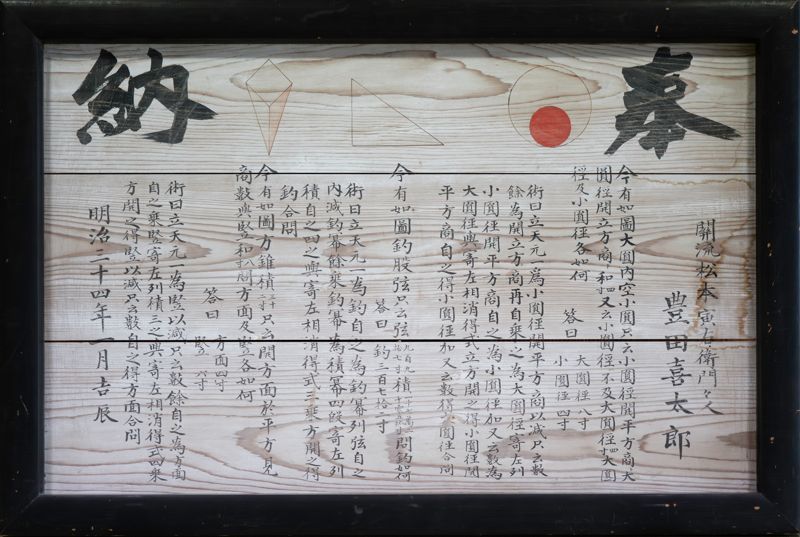
翻刻
【上段 横書き】
《題:奉納》
【下段】
《流派:關流》《人物*門人:松本寅右衛門》々人
《人物*奉納者:豊田喜太郎》
今有如圖大圎内空小圎只云小圎徑開平方商 ̄ト大
圎徑開立方商 ̄ト和《割書:四|寸》又云小圎徑 ̄ハ不及大圎徑《割書:四|寸》大圎
徑及小圎徑各如何
答曰 大圎徑八寸
小圎徑四寸
術曰立天元一爲小圎徑開平方商以减只云數
餘為開立方商再自乘之為大圎徑寄左列
小圎徑開平方商自之為小圎徑加又云數為
大圎徑與寄左相消得式立方開之得小圎徑開
平方商自之得小圎徑加又云數得大圎徑合問
今有如圖釣股弦只云弦《割書:九百九|拾七寸》積《割書:一十七萬二|千零五拾寸》問釣如何
答曰 釣三百七拾二寸
術曰立天元一為釣自之為釣幂列弦自之
内減釣幂餘乘釣幂為積幂四段寄左列
積自之四之與寄左相消得式三乘方開之得
釣合問
今有如圖方錐積《割書:三十|二寸》只云開方面於平方見
商𢿘與竪和《割書:八|寸》問方面及竪各如何
答曰 方面四寸
竪 六寸
術曰立天元一為竪以減只云𢿘餘自之為方面
自之乘竪寄左列積三之與寄左相消得式四乘
方開之得竪以減只云𢿘自之得方面合問
《日時:明治三十四年一月𠮷𫝕》
現代語訳
【上段・横書き】
《題:奉納》
【下段】
關流門人 松本寅右衛門 門人
豊田喜太郎
**【問題一】**
今、図のように大円の中に小円がある。ただし、小円の直径の平方根と大円の直径の立方根の和が4寸、また小円の直径は大円の直径より4寸少ないとする。大円の直径と小円の直径はそれぞれいくらか。
答:大円の直径 8寸
小円の直径 4寸
術(解法):天元一を立てて小円の直径の平方根の商とする。「ただし云う数」(条件の値)を引いた余りを立方根の商とし、それを二乗したものを大円の直径として左に寄せて列する。小円の直径の平方根の商を二乗したものを小円の直径とし、また云う数(第二の条件値)を加えたものを大円の直径とする。左に寄せたものと消去して式を得る。その式を立方開(三乗根)すると小円の直径の平方根の商が得られ、それを二乗して小円の直径を得る。また云う数を加えると大円の直径が得られ、問に合う。
**【問題二】**
今、図のように直角三角形(釣・股・弦)がある。ただし弦が997寸、積(面積)が172050寸²であるとする。釣(短辺)はいくらか。
答:釣 372寸
術:天元一を立てて釣とする。それを二乗して釣の冪とする。弦を二乗し、そこから釣の冪を引いた余りに釣の冪を掛けたものを積の冪の4倍として左に寄せる。積を二乗して4倍したものと左に寄せたものとを消去して式を得る。三乗方(三次方程式)を開いて釣を得る。問に合う。
**【問題三】**
今、図のように方錐(四角錐)があり、積が32寸³である。ただし、開方面(底面の一辺の長さの平方根)と竪(高さ)の和が8寸であるとする。方面(底面の一辺)と竪はそれぞれいくらか。
答:方面 4寸
竪 6寸
術:天元一を立てて竪とする。「ただし云う数」(8寸)から竪を引いた余りを二乗したものを方面とする。それを二乗して竪に掛けたものを左に寄せる。積の3倍と左に寄せたものを消去して式を得る。四乗方(四次方程式)を開いて竪を得る。「ただし云う数」から引いて二乗したものが方面となり、問に合う。
明治三十四年一月吉日
英語訳
**[Upper section, horizontal writing]**
*Title: Votive Offering (Hōnō)*
**[Lower section]**
Seki School disciple: Matsumoto Toraemon, his disciple:
Toyota Kitarō
---
**[Problem 1]**
As shown in the figure, there is a small circle inside a large circle. It is given that the sum of the square root of the small circle's diameter and the cube root of the large circle's diameter equals 4 *sun*, and furthermore that the small circle's diameter falls short of the large circle's diameter by 4 *sun*. What are the respective diameters of the large and small circles?
> **Answer:** Diameter of large circle: 8 *sun*
> Diameter of small circle: 4 *sun*
**Method:** Set the celestial element (unknown) as the square root of the small circle's diameter. Subtract the given value (first condition) to obtain the cube root of the large circle's diameter; square this to obtain the large circle's diameter, and place it on the left. Square the square root of the small circle's diameter to obtain the small circle's diameter, then add the second given value to obtain the large circle's diameter. Equate this with the left-side expression and solve. Taking the cube root yields the square root of the small circle's diameter; squaring it gives the small circle's diameter, and adding the given value gives the large circle's diameter. This satisfies the problem.
---
**[Problem 2]**
As shown in the figure, there is a right triangle with sides *kō* (shorter leg), *ko* (longer leg), and *gen* (hypotenuse). Given that the hypotenuse is 997 *sun* and the area is 172,050 square *sun*, what is the length of *kō* (the shorter leg)?
> **Answer:** *Kō* = 372 *sun*
**Method:** Set the celestial element as *kō*. Square it to obtain *kō*'s power. Square the hypotenuse and subtract *kō*'s power from it; multiply the remainder by *kō*'s power to obtain four times the square of the area, and place it on the left. Square the area and multiply by four; equate with the left-side expression to obtain an equation. Solving the cubic equation (*sanjōhō*) yields *kō*. This satisfies the problem.
---
**[Problem 3]**
As shown in the figure, there is a square pyramid with a volume of 32 cubic *sun*. Given that the sum of the square root of the base side length (*kaihōmen*) and the height (*tate*) equals 8 *sun*, what are the base side length and height?
> **Answer:** Base side (*hōmen*): 4 *sun*
> Height (*tate*): 6 *sun*
**Method:** Set the celestial element as the height. Subtract the height from the given value (8 *sun*), square the remainder, and this gives the base side length. Square this and multiply by the height; place on the left. Multiply the volume by 3 and equate with the left-side expression to obtain an equation. Solving the quartic equation (*yojōhō*) yields the height. Subtract from the given value and square to obtain the base side length. This satisfies the problem.
---
*Meiji 34 (1901), January, an auspicious day*