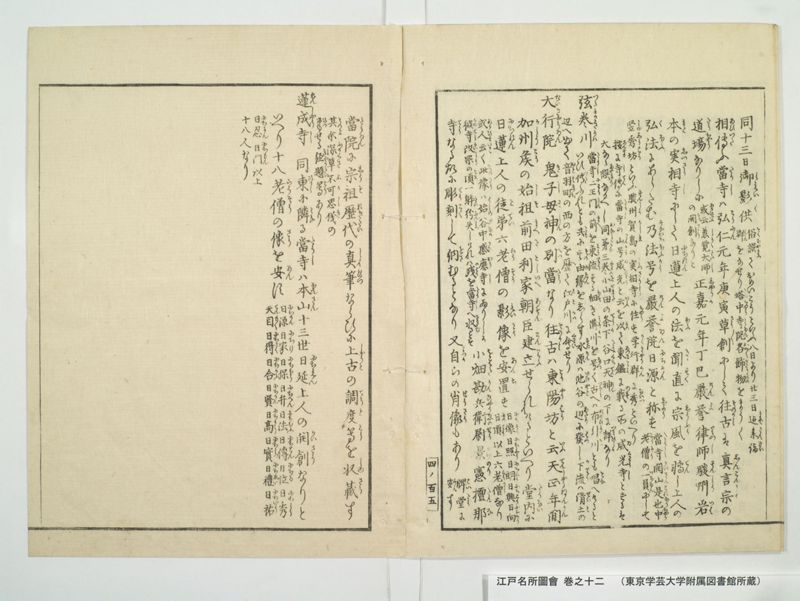
翻刻
【右丁】
同十三日 御影供(みえいく)《割書:俗(そく)誤(あやまつ)ておめいこうといふ八日より廿三日 迠(まで)参詣(さんけい) |群(くん)をなせり塔中(たつちゆう)寺院(しゐん)各(おの〳〵)飾物(かさりもの)をまうく》
相傳(あひつた)ふ當寺(たうし)は弘仁(こうにん)元年庚寅 草創(さう〳〵)にして往古(そのかみ)は真言宗(しんこんしう)の
道塲(たうちやう)なりしか《割書:或云(あるひいふ)慈覚大師(しかくたいし)|の開創(かいさう)なりと》正嘉(しやうか)元年丁巳 嚴誉律師(けんよりつし)駿州(すんしう)岩(いは)
本(もと)の実相寺(しつさうし)にして日蓮上人(にちれん )の法(ほふ)を聞(きゝ)直(すく)に宗風(しうふう)を轉(てん)し上人の
弘法(くほふ)にあらたむ乃(すなはち)法号(ほふかう)を嚴誉院日源(けんよゐんにちけん)と称(しよう)す《割書:當寺(たうし)開山(かいさん)是也(これなり)中(ちゆう)|老僧(らうそう)の一員(いちゐん)にして》
《割書:竪秀坊(しゆしうはう)といふ駿州(すんしう)賀島(かしま)の実相寺(しつさうし)に住(ちゆう)す学行(かくきやう)群(くん)に秀(ひいつ)といへり》
《割書:按(あんする)に寺傳(してん)に當寺(たうし)の山号(さんかう)威光(ゐくわう)と云(いふ)を以(もつ)て東鑑(あつまかゝみ)に載(のす)る所の威光寺(ゐくわうし)とするは|大なる誤(あやまり)なるへし同(おなし)弟三巻(たい くわん)小山田(をやまた)の条下(てうか)谷口天神(たにくちてんしん)の下に詳(つまひらか)なり》
弦巻川(つるまきかは)《割書:當寺(たうし)二王門(にわうもん)の前(まへ)を東流(とうりう)する細(ほそ)き溝川(みそかは)を号(なつ)く古(いにし)へは布引川(ぬのひきかは)とも唱(とな)へけると|いひ傳(つた)ふれとも共(とも)に其(その)由縁(ゆゑん)をしらす水源(すゐけん)は池谷(いけやと)の辺(あたり)に發(はつ)し下流(かりう)の清土(せいと)の》
《割書:辺へ出て音羽町(おとはまち)の西の方を歴(へ)て江戸川(えとかは)に會(くわい)せり》
大行院(たいきやうゐん) 鬼子母神(きしもしん)の別當(へつたう)なり往古(そのかみ)は東陽坊(とうやうはう)と云(いふ)天正年間(てんしやうねんかん)
加州矦(かしうこう)の始祖(しそ)前田利家朝臣(まへたとしいへあそん)建立(こんりふ)せられけるといへり堂内(たうない)に
日蓮上人(にちれん )の徒弟(とてい)六老僧( らうそう)の影像(えいさう)を安置(あんち)す《割書:日像(にちそう)日照(にちしやう)日朗(にちらう)日興(にちこう)日向(にちかう) |日頂(につてう)以上 六老僧( らうそう)なり》
《割書:或人(あるひと)云(いは)く此像(このさう)は始(はしめ)谷中(やなか)感應寺(かんおうし)にありしか|彼寺(かのてら)改宗(かいしう)の頃(ころ)一躰( たい)紛失(ふんしつ)しけれは残(のこり)を當寺(たうし)へ収(をさむ)るとそ》小畑勘兵衛尉景憲(をはたかんひやうゑのせうかけのり)檀那(たんな)
寺(てら)なる故に彫刻(てうこく)して納(をさ)むるとなり又 自(みつか)らの肖像(せうさう)もあり《割書:牌堂(はいたう)に|安(あん)す》
【左丁】
當院(たうゐん)に宗祖(しうそ)歴代(れきたい)の真筆(しんひつ)ならひに上古(しやうこ)の調度(てうと)等(とう)を収蔵(しゆさう)す
《割書:其余(そのよ)深草(ふかくさ)不可思儀(ふかしき)の|筆(ひつ)せる経題(きやうたい)等(とう)あり》
蓮成寺(れんしやうし) 同 東(ひかし)に隣(とな)る當寺(たうし)は本山(ほんさん)十三世 日延上人(にちえん )の開創(かいさう)なりと
いへり十八老僧( らうそう)の像(さう)を安(あん)す《割書:日源(にちけん)日家(にちけ)日保(にちほう)日弁(にちへん)日法(にちほふ)日傳(にちてん)日位(にちゐ)日秀(にちしう)|天目(てんもく)日得(にちとく)日合(にちかふ)日賢(にちけん)日髙(にちかう)日實(にちしつ)日禮(にちれい)日裕(にちいう)》
《割書:日忍(にちにん)日門(にちもん)以上|十八人なり》
現代語訳
【右丁】
同十三日 御影供(みえいく)(俗に誤って「おめいこう」という。八日より二十三日まで参詣が群をなす。塔中の寺院それぞれが飾り物を設ける。)
伝えによれば、当寺は弘仁元年庚寅に草創にして、往古は真言宗の道場であったが(ある説では慈覚大師の開創なりという)、正嘉元年丁巳に、厳誉律師が駿州岩本の実相寺において日蓮上人の法を聞き、直ちに宗風を転じて上人の弘法に改めた。すなわち法号を厳誉院日源と称す。(当寺の開山はこの人である。中老僧の一員にして、竪秀坊という。駿州賀島の実相寺に住す。学行、群に秀でといえり。)
(按ずるに、寺伝に当寺の山号「威光」と云うをもって、『吾妻鏡』に載せる所の威光寺とするのは大いなる誤りであるべし。同書第三巻、小山田の条下、谷口天神の下に詳しい。)
弦巻川 当寺二王門の前を東流する細き溝川を号く。古くは布引川とも唱えたと言い伝えられているが、ともにその由縁を知らず。水源は池谷の辺りに発し、下流の清土の辺へ出て、音羽町の西の方を経て江戸川に合流する。
大行院 鬼子母神の別当である。往古は東陽坊と云う。天正年間に加州侯の始祖・前田利家朝臣が建立されたといえり。堂内に日蓮上人の徒弟六老僧の影像を安置する。(日像・日照・日朗・日興・日向・日頂、以上六老僧なり。)
(ある人が言うには、この像は初め谷中の感応寺にあったが、かの寺が改宗した頃、一体が紛失したため、残りを当寺へ収めたとぞ。)
小畑勘兵衛尉景憲の檀那寺であるゆえに、彫刻して納めることになった。また、自らの肖像もある。(牌堂に安置する。)
【左丁】
当院に宗祖歴代の真筆ならびに上古の調度等を収蔵する。(その他、深草不可思議の筆せる経題等あり。)
蓮成寺 同じく東に隣る。当寺は本山十三世・日延上人の開創なりといえり。十八老僧の像を安置する。(日源・日家・日保・日弁・日法・日伝・日位・日秀・天目・日得・日合・日賢・日高・日実・日礼・日裕・日忍・日門、以上十八人なり。)
英語訳
**[Right folio]**
**Thirteenth day of the same month**: *Miei-ku* [memorial service for the founder's portrait] (Commonly mispronounced by people as "*omei-kō*." From the eighth through the twenty-third day, worshippers come in great crowds. Each of the sub-temples within the precinct sets out decorations.)
It is transmitted that this temple was founded in the first year of Kōnin (810), the year of *kanoe-tora*, and that in ancient times it was a training ground (*dōjō*) of the Shingon sect. (According to one account, it was founded by the Great Master Jikaku [Ennin].) In the first year of Shōka (1257), the year of *hinoto-mi*, the Vinaya master Genyo, upon hearing the teachings of the Venerable Nichiren at Jissōji Temple in Iwamoto, Suruga Province, immediately converted the temple's sectarian affiliation and reformed it into a place for the Venerable Nichiren's propagation of the Dharma. He accordingly took the religious name Genyoin Nichigen. (He is the founding abbot of this temple. He was one of the *chūrōsō* [middle-ranking senior monks], and bore the name Jushūbō. He resided at Jissōji Temple in Kashima, Suruga Province. His learning and practice were said to excel all others.)
(Upon examination: the temple tradition holds that the mountain name of this temple is "Ikō," and on this basis some identify it with Ikōji Temple mentioned in the *Azuma Kagami* [Mirror of the East], but this would be a great error. The matter is treated in detail in Volume Three of the same work, under the entry for Oyamada, beneath the section on Taniguchi Tenjin.)
**Tsurumaki-gawa River** — The narrow channel flowing eastward before the Niōmon [Two Kings Gate] of this temple is so named. It is handed down that in antiquity it was also called the *Nunohiki-gawa* (Cloth-drawing River), but the origin of either name is unknown. The river's source rises near Ikeya, flows out toward the Seido area downstream, passes along the western side of Otowa-machi, and joins the Edo River.
**Daikyōin** — This is the *bettō* [administrative temple] of the Kishimojin. In former times it was called Tōyōbō. It is said that during the Tenshō era (1573–1592), Maeda Toshiie, the founding lord of the Kaga domain (*Kashū-kō*), had it constructed. Enshrined within the hall are portrait images of the Six Elder Monks (*Roku Rōsō*), disciples of the Venerable Nichiren. (They are: Nichizō, Nichishō, Nichirō, Nikkō, Nichikō, and Nittō — these are the Six Elder Monks.)
(One person says that these images were originally at Kan'ōji Temple in Yanaka, but at the time of that temple's conversion to another sect, one image was lost, so the remainder were transferred to this temple.)
As this was the family temple (*dannaji*) of Obata Kanbei-no-jō Kagenori, [the images] were carved and dedicated here. There is also a portrait likeness of Kagenori himself. (It is enshrined in the memorial tablet hall [*haidō*].)
**[Left folio]**
This temple preserves in its collection autograph manuscripts (*shinpitsu*) of successive generations of the sect's founder [and patriarchs], as well as furnishings and utensils from ancient times. (Among other items, there are sutra title inscriptions written by the incomprehensible brush of Fukakusa [Nichiren].)
**Renshōji Temple** — Adjoining [Daikyōin] to the east. It is said that this temple was founded by the Venerable Nichien, the thirteenth patriarch of the head temple. Images of eighteen elder monks are enshrined here. (They are: Nichigen, Nichike, Nichihō, Nichiben, Nichihō [法], Nichiten, Nichii, Nichishū, Tenmoku, Nichitoku, Nichigō, Nichiken, Nichikō, Nichijitsu, Nichire, Nichiyū, Nichinin, and Nichimom — eighteen persons in all.)