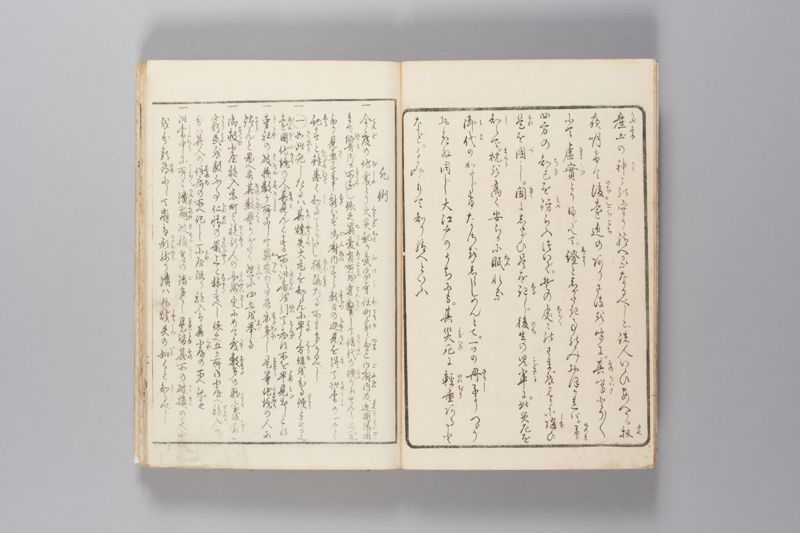
翻刻
【右丁】
産土(うぶすな)の神(かみ)らの守り給へるなるべしと。諸人いひあへり。扨(さて)
夜明けて後(のち)。遠近(をちこち)のありさまを聞に。其(その)噂(うはさ)とり〳〵
にて虚実(きよじつ)とりまじへて。証(しよう)としがたき事のみおほかれば。予(おのれ)
四方の知己(ちき)を訪(とぶ)らふついで。その処々(しよ〳〵)のさまを見るに随(したが)ひ
是(これ)を図(づ)し。聞(きく)にしたがひ是を記(しる)し。後(のち)生の児輩(こどもら)に。此災厄を
知(し)らで。枕(まくら)を高く安らかに眠(ねふ)れる
御代(みよ)のかたじけなさをしらしめんとて。一ツの冊子(さうし)につゞり
おきぬ同じ大江戸のうちにも。其 災厄(わざはひ)に軽重(けいぢう)あること
など。よみもて知り給へといふ
【左丁】
凡 例
一 今度(こんど)の地震(ぢしん)より火災(くわざい)起(おこ)り武家(ぶけ)寺社(じしや)町家(てうか)に至(いたる)迄 御府内(ごふない)及 近国(きんこく)隣国(りんごく)
まで響(ひゞか)ざる所(ところ)なし依之 異変(ゐへん)有(ある)所(ところ)を穿鑿(せんさく)して後代(こうたい)の便(たよ)りにせんと思へば
至り見 尽(つく)す事 能(あた)はず御府内(ごふない)すら数日(すじつ)の巡見(じゆんけん)を得(え)て此(この)書(しよ)のごとく
記(しる)すと雖(いへども)悉(こと〴〵)く知(し)ることかたし猶(なほ)漏(もれ)たる所も多かるべし
一㊀如此(かくのごとく)記したるは其(その)消失(しやうしつ)火元を知らんに早(はや)く方位(はうゐ)を分る便(たより)とする也
遠国(ゑんごく)他境(たけう)の人 其(その)見(み)んとする所は此(この)番(ばん)を引(ひい)て志(こゝろざ)す所を早見出(はやみだ)しとす
一 寺社(じしや)の破損(はそん)《振り仮名:数ケ所|すかしよ》にして異変(いへん)の事共 亦(また)多(おほ)し是等(これら)他境(たぎやう)の人に
談(かたら)んと思へ共 其(その)数(かず)量(はか)りがたく些(わづか)に四五を挙(あく)る
一御 救(すくひ)小屋施入亦町々 施行(せぎやう)人の丹誠(たんせい)更(さら)にめて度(たく)数多(あまた)の財宝(たから)を散(ちら)し
窮民(きうみん)を救ふ事 仁情(じんせい)の最上(さいじやう)と称(しよう)すべし依之五ヶ所御小屋へ施入(せにふ)の
分は其人の住居(すまゐ)の所へ記し一 小屋(こや)限り施入は其 小屋(こや)の所へ記す
一此 書中(しよちう)に所々(しよ〳〵)潰(つふれ)崩(くつれ)破損(はそん)等(とう)の語(ご)多し是(これ)皆(みな)其(その)所の破損(はそん)の大小
を分る為(ため)にして崩は形(かたち)残(のこ)り潰は凡 消失(しやうしつ)の如(ごと)くと知(し)るべし
現代語訳
【右丁】
産土の神々がお守りくださったのであろうと、人々は口々に語り合った。さて夜が明けてから、あちこちの様子を聞くと、その噂はさまざまで、真実と虚偽が入り混じり、確かなこととして言いがたいことばかりが多かった。そこで私は四方の知人を訪ねるついでに、その各所の様子を目にするにしたがってこれを図に描き、聞くにしたがってこれを記録し、後世の子どもたちに、この災厄を知らずに枕を高くして安らかに眠れる御代のありがたさを知らしめようと思い、一冊の冊子にまとめておくことにした。同じ大江戸の中でも、その災厄に軽重があることなどを、読んでお知りいただきたい。
【左丁】
凡 例
一、今回の地震から火災が起こり、武家・寺社・町家に至るまで、御府内および近隣諸国まで影響の及ばなかった所はない。これにより、異変のあった所を詳しく調べて後代の参考にしようと思えば、すべてを見て回ることはとてもできない。御府内でさえ数日間の巡見を重ねてこの書のように記したが、それでもすべてを知ることは難しく、なお漏れた所も多いであろう。
一、①のように記したのは、その消失・火元を知るにあたって、早く方角を把握する手がかりとするためである。遠方他国の人が見ようとする所は、この番号を引いて目当ての場所を素早く見つけ出すことができる。
一、寺社の破損は数か所にして、異変のことどももまた多い。これらを他国の人に語ろうと思うが、その数は計り知れないので、わずかに四、五か所を挙げるにとどめる。
一、御救い小屋への施し入れ、また町々での施行(ほどこし)をした人の丹誠は、まことにめでたく、数多くの財宝を散じて窮民を救ったことは、仁情の最たるものと称えるべきである。これにより、五か所の御小屋への施し入れの分は、その人の住居の所に記し、一小屋限りの施し入れは、その小屋の所に記す。
一、この書中にはあちこちに「潰れ」「崩れ」「破損」などの語が多い。これはすべてその場所の破損の大小を区別するためであり、「崩れ」は形が残っており、「潰れ」はほぼ跡形もなく消え失せたようなものと知るべきである。
英語訳
【Right page】
People spoke among themselves, saying that it must have been the protection of the local tutelary deities. When morning came and the author inquired about conditions in various places near and far, the rumors circulating were diverse and mixed truth with falsehood, making it difficult to be certain of anything. And so, as the author visited acquaintances in all directions and happened to observe conditions at each location, he sketched what he saw into diagrams, and wrote down what he heard, with the intention of letting future generations of children come to appreciate the blessedness of an age in which one may sleep peacefully, with one's head resting high on a pillow, ignorant of such a disaster. For this purpose, the account was compiled into a single volume. It is hoped that readers will learn, among other things, that even within the single city of Edo, the severity of the disaster varied greatly from place to place.
【Left page】
Preface / Notes on Conventions
1. From this earthquake arose fires, and there was no place — from the residences of samurai to temples, shrines, and townspeople's homes — within the city proper or in the surrounding provinces that was left unaffected. With the intention of investigating all the sites of unusual damage as a reference for future generations, it proved impossible to visit and observe everything in full. Even within the city proper, multiple days of inspection tours were required to produce a record such as this, and even so it is difficult to know everything; there are likely many places that have been omitted.
2. The numbering system (①) used in this volume is intended to provide a quick means of identifying the direction and location of sites that were destroyed or where fires originated. Those from distant provinces who wish to look up a particular place can use this numbering system to locate their desired information quickly.
3. The damage to temples and shrines extended to several locations, and there were many instances of unusual events. Although the author wishes to relate these to readers from other provinces, the number is beyond measure, and only four or five examples are given here.
4. The dedicated effort of those who contributed to the official relief shelters, as well as those who distributed aid at various town locations, is most admirable; they scattered vast amounts of their own wealth to relieve the destitute, and this should be praised as the highest expression of benevolence. Accordingly, contributions made to the five official shelters are recorded at the entries for the respective donors' residences, while contributions made to individual shelters are recorded at the entries for those shelters.
5. Throughout this volume, words such as "collapsed" (潰れ), "crumbled" (崩れ), and "damaged" (破損) appear frequently. These are used to distinguish the varying degrees of destruction at each location. It should be understood that "crumbled" (崩れ) means the structure's form still remains to some degree, while "collapsed" (潰れ) means it has been almost entirely obliterated, as though it had vanished.