翻刻
○七九といふ事は円さしわたし一尺あれは一寸の坪七十九あり
一尺を二つにわれは五寸有又一分を二つにわれは五りと
なるこれに五寸をかくれは廿五となるこれに三尺壱寸
六分をかくれは七十九坪になるゆへに七九をかける也
○一尺三寸四方有物をまるくなしてさしわたしは何
程といふ〽一尺四寸六分二り五毛 法に一一二五と置是に
一尺三寸をかくれはさしわたし一尺四寸六分二り五毛となる也
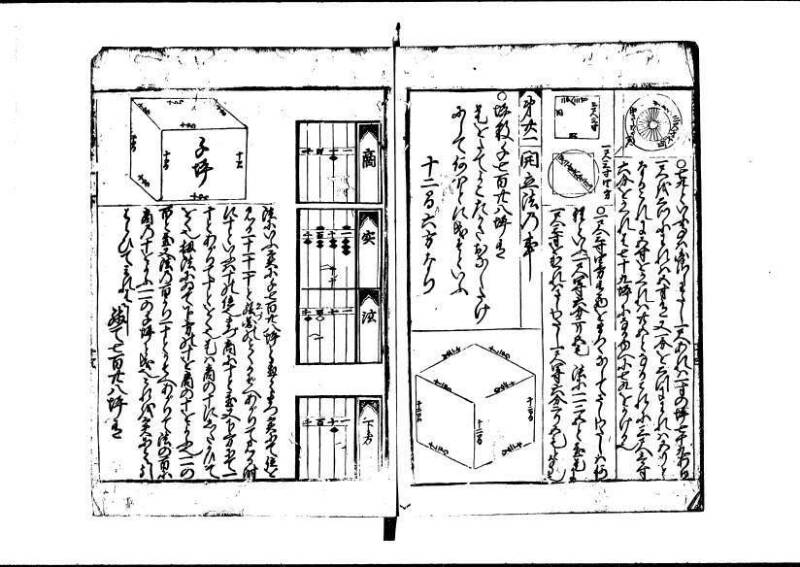
第廿一 開立法の事
○坪数千七百廿八坪有
是をたてよこたかさおなしたけ
にして何ほとに成そといふ
十二間六方なり
法にいふ実に千七百廿八坪と置てまつ実にて位を
見る一十一十一十と絵図(ゑづ)のことくかぞへあがりて見る時
に十といふは十の位也まづ商に十と置又下方にて一
十とあがりて十とをく也是は商の十にしたかひて
をく也扨法にゐて下方の十を商の十をよふ也一一の
百と置又法の百より一十とかそへあがりて法の百に
商の十をよふ一一の千坪と成也これを実にて引
はらひてみれは
〽残て七百廿八坪有
現代語訳
○七九というのは、円の差し渡し(直径)が一尺あれば、一寸の坪が七十九あるということである。
一尺を二つに割れば五寸有り、また一分を二つに割れば五厘となる。これに五寸を掛ければ二十五となる。これに三尺一寸六分を掛ければ七十九坪になる。ゆえに七九を掛けるのである。
○一尺三寸四方の物を円くなして、差し渡しは何程というに〽一尺四寸六分二厘五毛 法に一一二五と置く。これに一尺三寸を掛ければ、差し渡し一尺四寸六分二厘五毛となる。
第二十一 開立法の事
○坪数千七百二十八坪有り
これを縦横高さ同じ丈にして何ほどになるぞというに
十二間六方なり
法にいう。実に千七百二十八坪と置いて、まず実にて位を見る。一、十、百、千と絵図のごとく数え上がって見る時に、十というのは十の位也。まず商に十と置く。また下方にて一、十と上がって十と置く也。これは商の十に従って置く也。さて法にて下方の十を商の十で掛ける也。一×一の百と置く。また法の百より一、十と数え上がって、法の百に商の十を掛ける。一×一の千坪となる也。これを実にて引き払って見れば
〽残って七百二十八坪有り
英語訳
○The meaning of "79" is that when a circle has a diameter of 1 shaku, there are 79 square sun areas.
When 1 shaku is divided by 2, there are 5 sun. When 1 bu is divided by 2, it becomes 5 rin. When this is multiplied by 5 sun, it becomes 25. When this is multiplied by 3 shaku 1 sun 6 bu, it becomes 79 tsubo. Therefore, we multiply by 79.
○When a square object of 1 shaku 3 sun per side is made circular, what is its diameter? 〽1 shaku 4 sun 6 bu 2 rin 5 mō. In the method, place 1125. When this is multiplied by 1 shaku 3 sun, the diameter becomes 1 shaku 4 sun 6 bu 2 rin 5 mō.
Chapter 21: The Method of Cube Root Extraction
○There are 1,728 tsubo in area
When this is made into equal length, width, and height, what does it become?
It becomes 12 ken on each of six sides
The method states: Place 1,728 tsubo as the dividend, and first examine the place values in the dividend. Count up as ones, tens, hundreds, thousands like a diagram. The "ten" refers to the tens place. First place 10 in the quotient. Also, count up as 1, 10 from below and place 10. This is placed according to the 10 in the quotient. Then, using the method, multiply the 10 below by the 10 in the quotient. Place 1×1 = 100. Also, count up as 1, 10 from the hundreds in the method, and multiply the hundreds in the method by 10 in the quotient. This becomes 1×1 = 1,000 tsubo. When this is subtracted from the dividend:
〽728 tsubo remain