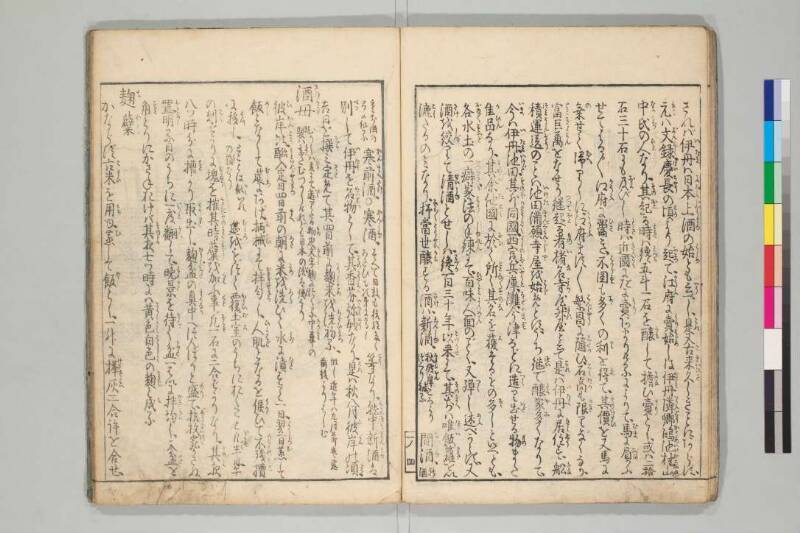
翻刻
【右丁】
されば伊丹(いたみ)は日本(にほん)上酒(じやうしゆ)の始(はじめ)とも云(いう)べし。是(これ)又/古来(こまい)#1久(ひさ)しきことにあらず。
元(もと)は文録(ぶんろく)#2。慶長(けいちやう)の頃(ころ)より起(おこつ)て。江府(かうふ)に売(うり)始(はじめ)しは伊丹(いたみ)隣郷(りんごう)鴻池(かうのいけ)村(むら)。山(やま)
中氏(なかうぢ)の人(ひと)なり。其(その)起(おこ)る時(とき)は纔(わづか)五斗一石を醸(かも)して担(にな)ひ売(うり)とし。或は二拾
石三十石にも及(およ)びし時(とき)は。近国(きんこく)にだに売(うり)あまりけるによりて。馬(むま)に負(おほ)#3ふ
せてはる〴〵江府(かうふ)に鬻(ひさ)き。不図(はからず)も多(おゝ)くの利(り)を得(ゑ)て。其(その)価(あたひ)を又馬に
乗(の)せて帰(かへ)りしに。江府(こうふ)ます〳〵繁昌(はんじやう)に随(したが)ひ。石高(こくたか)も限(かき)りなくなり。
富(とみ)巨万(きよはん)をなせり継(ついで)起(おこ)る者(もの)猪名寺(いなてら)屋。舛(ます)屋と云て是(これ)は伊丹(いたみ)に居住(きよじう)す。船(ふな)
積(つみ)運送(うんそう)のことは池田(いけた)満願寺屋(まんぐわんじや)を始(はじ)めとす。うち継(つい)で醸家(さかや)多(お[ゝ])くなりて。
今(いま)は伊丹(いたみ)。池田(いけだ)。其外(そのほか)同国(とうこく)。西宮(にしのみや)。兵庫(ひやうこ)。灘(なだ)。今津(いまず)などに造(つく)り出(いだ)せる物(もの)また
佳品(かひん)なり。其余(そのよ)他国(たこく)に於(おひ)て所(ところ)〳〵( 〳〵 )其(その)名(な)を獲(え)たるもの多(おゝ)しといへとも。
各(おの〳〵)水土(すいと)の一癖(いつへき)。家法(かはう)の手練(しゆれん)にて。百味(ひやくみ)人面(にんめん)のごとく。又/殫(つく)し述(のふ)べからず。又
酒(さけ)を絞(しぼ)りて清酒(せいしゆ)とせしは。纔(わづか)百三十年/以来(このかた)にて。其(その)前(まへ)は唯(たゞ)飯籮(いかき)を以
漉(こし)たるのみなり。抑(そも〳〵)当世(とうせい)醸(かも)する酒(さけ)は。新酒(しんしゆ)。《割書:秋(あき)彼岸(ひがん)ころより|つくり初(そめ)る》間酒(あいしゆ)。《割書:新|酒》
【左丁】
《割書:寒前酒の|間に作る》寒前酒(かんまへさけ)。○寒酒(かんしゆ)。《割書:すへて日数も後程多く|あたひも次第に高し》等(とう)なり。就中(なかんつく)新酒(しんしゆ)は
別(べつ)して伊丹(いたみ)を名物(めいぶつ)として。其(その)香芬(かうふん)弥(いよ〳〵)妙(めう)なり。是(これ)は秋八月/彼岸(ひがん)の頃(ころ)。
吉日を撰(ゑら)み定(さだ)めて其四日前に麹米(こうしこめ)を洗初(あらひそめ)る。《割書:但し近年は九月節寒露|前後よりはしむ》
酒母(さけかうじ)《割書:むかしは麦(むき)にて造(つく)りたる物(もの)ゆへ文字(もんし)麹につくる中華(ちうくわ)の|製(せい)は甚(はなは)たむつかしけれども日本の法(はう)は便(べん)なり》
彼岸(ひかん)比(ころ)。《振り仮名:■入|もといれ》#4定日(じやうじつ)四日/前(まへ)の朝(あさ)に米(こめ)を洗(あら)ひて水(みづ)に漬(ひた)すこと一日。翌日(よくじつ)蒸(む)して
飯(めし)となして筵(むしろ)にあげ。柄械(えかひ)にて拌匀(かきませなら)し。人肌(ひとはだ)となるを候(うかゞ)ひて不残(のこらす)槽(とこ)
に移(うつ)し。《割書:とことは飯(めし)いれ|の箱(はこ)なり》筵(むしろ)をもつて覆(おゝひ)土室(むろ)のうちにおくこと凡(およそ)半日。午
の刻(こく)ばかりに塊(かたまり)を摧(くたき)其時(そのとき)糵(もやし)を加(くは)ふ事(こと)凡(およそ)一石に二合ばかりなり。其(その)夜(よ)
八ツ時分に槽(とこ)より取出(とりいだ)し。麹盆(かうじふた)の真中(まんなか)へつんぼりと盛(もり)て。拾枚(じうまい)宛(つゝ)かさね
置(おき)。明(あく)る日のうちに一度(いちと)翻(かへ)して。晩景(はんかた)を待(まち)て盆(ふた)一はいに拌均(かきなら)し。又/盆(ふた)を
角(すみ)とりにかさねおけば其(その)夜(よ)七ツ時には黄色(わうしよく)白色(はくしよく)の麹(かうじ)と成(な)る
麹糵(もやし)
かならず古米(こまひ)を用(もち)ゆ。蒸(む)して飯(めし)とし。一升に欅灰(けやきはい)二合許を合せ。
現代語訳
【右丁】
さて、伊丹は日本における上酒(じょうしゅ)の発祥の地とも言うべきである。しかしこれもまた、古来より続く長い歴史があるわけではない。
もとは文禄・慶長の頃(16世紀末〜17世紀初め)より始まり、江戸で売り始めたのは、伊丹の隣郷・鴻池村の山中氏という人物であった。その始まりの頃はわずか五斗から一石を醸造して担い売りをしており、やがて二十石・三十石にも及ぶようになると、近国だけでは売れ余るほどになったため、馬に載せてはるばる江戸へと運んで売り、思いがけず多くの利益を得た。その代金をまた馬に乗せて帰ったが、江戸がますます繁盛するにつれて、石高も際限なく増え、巨万の富を成した。続いて起こった者に猪名寺屋・升屋というものがあり、これらは伊丹に居住していた。船積みや運送のことは池田の満願寺屋を始めとする。次々と酒造家が増えて、今では伊丹・池田、その他同国(摂津国)の西宮・兵庫・灘・今津などで造り出されるものもまた佳品である。その他、他国においても各地で名声を得たものは多いとはいえ、それぞれの水土(水と風土)の特性と、各家の製法の習熟によって、百の味わいが人の顔のようにそれぞれ異なり、すべてを述べ尽くすことはできない。
また、酒を搾って清酒とするようになったのは、わずか百三十年ほど前からのことであり、それ以前はただ飯籮(いかき・竹籠)で漉したのみであった。そもそも当世で醸造される酒は、新酒(秋の彼岸の頃より造り始める)・間酒(新酒と寒前酒の間に造る)・寒前酒・寒酒(いずれも日数が後になるほど多く、価格も次第に高くなる)などがある。中でも新酒は特に伊丹を名物として、その香りはいよいよ妙なるものがある。これは秋八月の彼岸の頃に、吉日を選び定めて、その四日前に麹米を洗い始める(ただし近年は九月の節気・寒露の前後から始める)。
酒母(麹)――昔は麦で造ったものであるため、文字は「麹」と書く。中国の製法は非常に複雑であるが、日本の方法は便利である――
彼岸の頃、もと入れ(仕込み)の定日の四日前の朝に米を洗い、水に一日浸す。翌日に蒸して飯とし、筵(むしろ)の上に広げ、柄械(えかい・かき混ぜる道具)でかき混ぜて均し、人肌の温かさになるのを見計らって残らず槽(とこ・飯を入れる箱)に移し、筵で覆って麹室(むろ)の中に置くこと凡そ半日。午の刻(正午)ごろに塊を砕き、その時に糵(もやし・種麹)を加えること、凡そ一石につき二合ほどである。その夜の八つ時分(午前二時ごろ)に槽から取り出し、麹蓋(こうじふた)の真ん中へこんもりと盛り、十枚ずつ重ねて置く。翌日のうちに一度返して、夕方を待って蓋一杯にかき均し、また蓋を角取りに重ねて置けば、その夜の七つ時(午前四時ごろ)には黄色・白色の麹となる。
糵(もやし・種麹)
必ず古米を用いる。蒸して飯とし、一升に欅灰(けやきはい)二合ほどを合わせて……
英語訳
**[Right Page]**
Itami may indeed be called the birthplace of fine sake (*jōshu*) in Japan. However, this too is not a tradition of great antiquity.
It originally began around the Bunroku and Keichō eras (late 16th to early 17th century). The first person to sell sake in Edo was a man named Yamanaka, from Kōnoike village, a neighboring village to Itami. When the enterprise began, he brewed merely five *to* to one *koku* at a time and sold it as a peddler. When production grew to twenty or thirty *koku*, there was more than enough to sell in the surrounding provinces, so he loaded it onto horses and traveled all the way to Edo to sell it. Unexpectedly, he gained great profit, and the payment too was loaded onto horses and brought back. As Edo grew increasingly prosperous, the volume of *koku* grew without limit, and he amassed a great fortune. Those who followed in his footsteps included establishments called Inatera-ya and Masu-ya, which were based in Itami. For shipping and transport, Ikeda's Manganji-ya was the pioneer. As sake brewers multiplied one after another, today fine products are also made in Itami, Ikeda, and others in the same province (Settsu), such as Nishinomiya, Hyōgo, Nada, and Imazū. Although there are many others in other provinces that have gained renown in their respective localities, the unique character of each region's water and soil, combined with each household's refined techniques, means that a hundred different flavors exist — as varied as human faces — and it is impossible to describe them all exhaustively.
Furthermore, it has only been about 130 years since sake began to be pressed (*shiboru*) to produce clear sake (*seishu*); before that, it was merely strained through a bamboo basket (*ikaki*). As for the sake brewed in the current era, there is *shinshu* (new sake; brewing begins around the autumn equinox), *aishu* (brewed between new sake and *kanmaezake*), *kanmaezake* (pre-cold-season sake), and *kanshū* (cold-season sake; in general, the later in the season, the more is produced and the higher the price). Among these, new sake is especially famous as a specialty of Itami, and its fragrance is exceptionally fine. It is made by selecting an auspicious day around the autumn equinox in the eighth month, and washing the koji rice four days before that day (though in recent years it has begun around the solar term of *kanro* [Cold Dew] in the ninth month).
**Sake mold (***sakekōji***)**
*Annotation in original: In the past, it was made from wheat, which is why the character 麹 is used. The Chinese method is extremely complex, but the Japanese method is convenient.*
Around the equinox, on the morning four days before the set day of adding the *moto* (yeast starter), the rice is washed and soaked in water for one full day. The following day it is steamed into cooked rice, spread out on a straw mat, stirred and leveled with a paddle tool (*ekai*), and when it has cooled to body temperature, it is transferred entirely into the *toko* (a wooden box for rice), covered with a straw mat, and left inside the koji chamber (*muro*) for approximately half a day. Around the Hour of the Horse (noon), the clumps are broken up, and at that point *moyashi* (seed koji / koji spores) is added — approximately two *gō* per one *koku*. At around the Hour of the Ox that night (approximately 2 a.m.), it is removed from the *toko*, heaped in a mound in the center of koji trays (*kōji futa*), and stacked ten trays at a time. During the following day it is turned once, and waiting until evening, it is spread evenly across the full surface of the trays. When the trays are stacked again at an angle, by the Hour of the Tiger that night (approximately 4 a.m.), the koji will have turned yellow and white.
**Moyashi (Seed Koji)**
Old rice (*furugome*) must always be used. It is steamed into cooked rice, and approximately two *gō* of zelkova ash (*keyaki hai*) is mixed in per one *shō*…