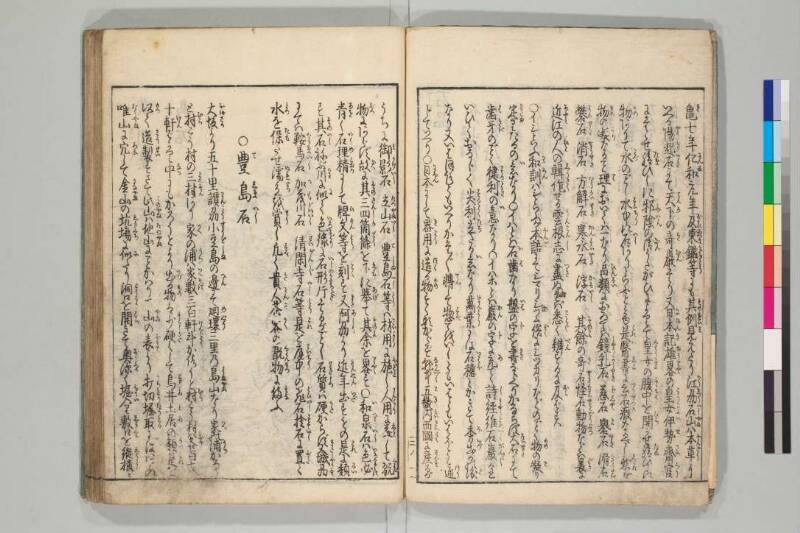
翻刻
【右丁】
亀(き)七年/仁和(にんな)元年/及(およひ)東鑑(あつまかゞみ)等(とう)にも其例(そのれい)見(み)えたり江州(かうしう)石山(いしやま)は本草(ほんざう)に
いへる陽起石(やうきせき)にて天下(てんか)の奇巌(きかん)たり又/日本記(にほんき)雄略(ゆうりやく)の皇女(こうによ)伊勢(いせ)斎宮(さいくう)
にたゝせ給(たま)ひしに邪陰(しやいん)の御(おん)うたがひによりて皇女(くわうによ)の腹中(ふくちう)を開(ひら)かせ給(たま)ひしに
物(もの)ありて水(みづ)のごとし水中(すいちう)に石(いし)ありといふことみゆ是(これ)医書(いしよ)に云(いう)石瘕(せつか)なるべし然(しかれ)ば
物(もの)の凝(こり)なること理(り)においては一なり品類(ひんるい)におゐては鍾乳石(しやうにうせき)慈石(じしやく)礜石(よせき)滑石(くわつせき)
礬石(はんせき)消石(せうせき)方解石(はうかいせき)寒水石(かんすいせき)浮石(かるいし)其余(そのよ)の奇石(きせき)怪石(くわいせき)動物(どうぶつ)などは曩(さき)に
近江(あふみ)の人(ひと)の輯作(しうさく)せる雲根志(うんこんし)に尽(つき)ぬれば悉(こと〴〵)く弁するに及(およ)ばす
○イシといふ和訓(わくん)ハシといふが本語(ほんご)にてシマリ/シツム(沈)俗(ぞく)にシツカリなどのごとく物(もの)の凝(こ)り
定(さたま)りたるの意(い)なり○イハとは石歯(いは)なり盤(いは)の字(じ)を書(かき)ならへりかならず大石(たいせき)にて
歯牙(はきば)のごとく健利(するとき)の意(い)なり○イハホとは巌(かん)の字(じ)に充(あ)てゝ詩経(しきやう)維石巌々(これいしがん〴〵)と
いひておなじく尖利(するとく)立(たち)たる意(い)なり万葉(まんよう)には石穂(いはほ)とかきて秀出(ほいづ)るの儀(ぎ)
なり又いはほろともいへりかた〴〵転(てん)して惣(すべ)てをいしともいはともいはほとも通(つう)
じていへり○日本(にほん)にして器用(きよう)に造(つく)る物(もの)すくなからず就中(なかんづく)五畿内(こきない)西国(さいこく)に産(さんす)るが
【左丁】
うちに御影石(みかけいし)立山石(たつやまいし)豊島石(てしまいし)等(とう)は材用(さいよう)に施(ほどこ)し人用(にんよう)に益(ゑき)して翫(くわん)
物(ぶつ)にあらず故(ゆへ)に其(その)三四(さんし)箇條(かでう)を下(しも)に挙(あげ)て其余(そのよ)を略(りやく)す○和泉石(いつみいし)は色(いろ)必(かならす)
青(あお)く石理(いしめ)精(こまか)にして牌文(ひもん)等(とう)を刻(こく)す又(また)阿州(あしう)より近年(きんねん)出(いだ)すもの是(これ)に類(るい)
す其石(そのいし)ねぶ川(かわ)に似(に)て色(いろ)緑(みどり)に石形(いしのかたち)片(ゝぎ)たるがごとし石質(せきしつ)は硬(かた)からず又(また)城州(しやうしう)
にては鞍馬石(くらまいし)加茂川石(かもがはいし)清閑寺石(せいがんじいし)等(とう)是(これ)を庭中(ていちう)の飛石(とひいし)捨石(すていし)に置(おき)て
水(みつ)を保(たも)たせ濡色(ぬれいろ)を賞(せう)し凡(すべ)て貴人(きにん)茶客(さかく)の翫物(くわんもつ)に備(そな)ふ
○豊島石(てしまいし)
大坂(おほさか)より五十里/讃州(さんしう)小豆島(せうどしま)の辺(へん)にて廻環(めぐり)三里の島山(しまやま)なり家(いへ)の浦(うら)かろう
と村(むら)こう村(むら)の三村(さんそん)あり家(いへ)の浦(うら)は家数(いへかず)三百/軒(けん)斗(ばかり)かろうと村(むら)こう村は各(おの〳〵)百七八
十/軒(けん)ばかり中(なか)にもかろうとより出(いづ)る物(もの)は少(すこし)硬(かた)くして鳥井(とりゐ)土居(とゐ)の類(るい)是(これ)を
以(もつ)て造製(さうせい)すさて此山(このやま)は他山(たのやま)にことかはり□#1山(やま)の表(おもて)より打切(うちきり)堀取(ほりとる)にはあらず
唯(たゝ)山(やま)に穴(あな)して金山(かなやま)の坑場(しきくち)に似(に)たり洞口(とうこう)を開(ひら)きて奥深(おくふか)く堀入(ほりい)り敷口(しきくち)を縦横(しうわう)に
現代語訳
【右丁】
亀七年・仁和元年、および『吾妻鏡』等にもその例が見えている。江州(近江国)の石山は、『本草』にいう陽起石であり、天下の奇岩である。また『日本書紀』によれば、雄略天皇の皇女が伊勢の斎宮に奉仕されていたところ、邪淫の疑いにより皇女の腹中を開かせたところ、何かがあって水のようであり、水中に石があったということが見える。これは医書にいう「石瘕(せっか)」であろう。そうであれば、物が凝り固まることは、理においては一つである。品類においては、鍾乳石・磁石・礜石・滑石・礬石・消石・方解石・寒水石・軽石、その他の奇石・怪石・動物(化石)などは、以前に近江の人が編纂した『雲根志』に尽くされているので、ことごとく弁じるには及ばない。
○「イシ」という和訓は「ハシ」というのが本来の語であり、「シマリ」「シツム(沈む)」、俗に「シッカリ」などのように、物が凝り固まったという意味である。○「イハ」とは「石歯(いわ)」であり、「盤」の字を書き並べており、必ず大きな石であって、歯や牙のように堅く鋭いという意味である。○「イハホ」とは「巌」の字に当てて、『詩経』の「維石巌々(これ石巌々たり)」と同じく、尖って鋭く立っているという意味である。『万葉集』では「石穂(いはほ)」と書いて、秀でて出るという意味である。また「いはほろ」ともいう。各々が転じて、すべてを「いし」とも「いは」とも「いはほ」とも通じて言う。○日本において有用に造られる物は少なくない。なかでも五畿内・西国に産するものの
【左丁】
うち、御影石・立山石・豊島石などは材料として用いられ、人々の役に立つものであり、鑑賞物ではない。それゆえ、その三・四箇条を以下に挙げてその余は略す。○和泉石は色が必ず青く、石理(石目)が精緻で、牌文(碑文)などを刻む。また阿波国から近年産出するものもこれに類する。その石は粘土川(ねぶ川)に似て、色は緑で石の形が片状のようである。石質は硬くない。また山城国では、鞍馬石・加茂川石・清閑寺石などを庭中の飛び石・捨て石として置いて、水分を保たせて濡れた色合いを賞で、おおむね貴人・茶人の鑑賞物として備える。
○豊島石(てしまいし)
大坂より五十里、讃岐国小豆島の辺で、周囲三里の島山である。家の浦・かろうと村・こう村の三村がある。家の浦は家数三百軒ほど、かろうと村・こう村はそれぞれ百七・八十軒ほどである。なかでも「かろうと」から産出するものは少し硬くて、鳥居・土居(石垣の基礎)の類をこれで造る。さて、この山は他の山と異なり、山の表面から打ち切って掘り取るのではなく、ただ山に穴を開けて金山(鉱山)の坑場に似ている。洞口を開いて奥深く掘り入り、敷口(坑道の入口)を縦横に…
英語訳
【Right page】
...examples of this can also be found in records from the seventh year of Jōgan and the first year of Ninna, as well as in the "Azuma Kagami" and other texts. Ishiyama in Gōshū (Ōmi Province) is what the "Bencao" (Materia Medica) calls "yangqi stone" (a type of actinolite), and it is a remarkable rock formation of the realm. Furthermore, according to the "Nihon Shoki" (Chronicles of Japan), when a princess of Emperor Yūryaku was serving as the Saigū (high priestess) at Ise, she came under suspicion of improper conduct, and her abdomen was opened, whereupon it was found that there was something like water inside, and within that water there was a stone. This is likely what medical texts call "shika" (a stone-like pathological concretion in the abdomen). Thus, the principle by which things congeal and harden is, in essence, one and the same. As for the varieties — stalactites, magnetite, arsenopyrite, talc, alum stone, saltpeter, calcite, gypsum, pumice, and other rare and unusual stones, as well as petrified animals — these have already been thoroughly covered in the "Unkonshi" (Record of Cloud-Roots), compiled by a person from Ōmi, so there is no need to enumerate them all here.
○The Japanese reading "ishi" (stone) has "hashi" as its original root word, and like "shimari" (tightening), "shizumu" (sinking), or the colloquial "shikkari" (firm, solid), it carries the meaning of something that has congealed and become fixed. ○"Iwa" means "stone tooth" (ishi-ha), written with the character 盤 (pan), and always refers to a large stone, with the sense of being firm and sharp like teeth or fangs. ○"Iwaho" is written with the character 巌 (gan, meaning crag), as in the "Shijing" (Book of Odes) phrase "the stone stands towering and majestic," conveying the sense of something pointed and sharply erect. In the "Man'yōshū," it is written as "石穂" (iwaho), meaning something that towers and stands out. It is also called "iwaboro." Each of these terms has shifted and all are used interchangeably to mean stone — "ishi," "iwa," and "iwaho." ○In Japan, there are no small number of things usefully made from stone. Among those produced particularly in the Kinai region and the western provinces,
【Left page】
...Mikage stone, Tateyama stone, and Teshima stone are applied as building materials and are of benefit to people in practical ways; they are not objects of aesthetic appreciation. Therefore, I shall list three or four entries below and omit the rest. ○Izumi stone is always blue in color, with a fine grain, and is used for carving inscriptions on tombstones and monuments. Stone recently produced from Awa Province (Tokushima) is similar to this. That stone resembles clay from the Nebu River, is green in color, and appears in flat, slab-like pieces. The stone quality is not particularly hard. In Yamashiro Province, Kurama stone, Kamo River stone, and Seikanji stone are placed in gardens as stepping stones and scattered stones; they are kept moist to be appreciated for their wet sheen, and are generally kept as objects of aesthetic appreciation for noblemen and tea ceremony practitioners.
○Teshima Stone
Located fifty ri from Ōsaka, near Shōdoshima in Sanuki Province, this is an island mountain with a circumference of three ri. It consists of three villages: Ie no Ura, Karōto village, and Kō village. Ie no Ura has approximately three hundred households, while Karōto village and Kō village each have around one hundred seventy or eighty households. Among these, stone from Karōto is slightly harder and is used to make torii (shrine gates) and stone foundations. Now, this mountain differs from other mountains — rather than cutting and quarrying from the surface of the mountain, one simply makes tunnels into the mountain, resembling the pit entrances of mines. The tunnel openings are made and one digs deep inside, extending the pit entrances in all directions...