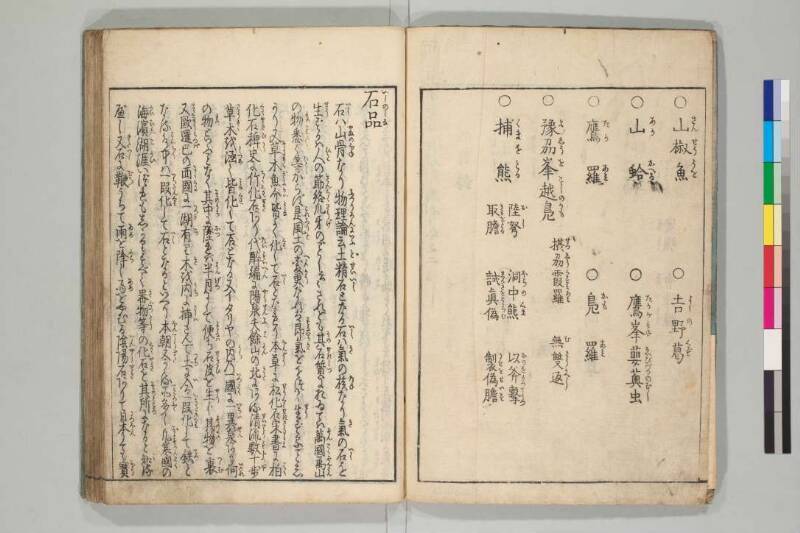
翻刻
【右丁】
○山椒魚(さんせううを) ○吉野葛(よしのくず)
○山蛤(あかかへる) ○鷹峯(たかがみね)蘡薁虫(ゑびづるのむし)
○鷹羅(たかあみ) ○ 鳧羅(かもあみ)
○予州(よしう)峯越鳧(をこしのかも) 《割書:摂州(せつしう)霞羅(かすみあみ) 無雙返(むさうかへし) |》
○捕熊(くまをとる) 《割書:墮弩(おし)|取膽(きもをとる)》 《割書:洞中熊(ほらのくま)|試真偽(しんきをこゝろむ)》 《割書:以斧撃(おのをもつてうつ)|製偽膽(にせをせいす)》
【左丁】
石品(いしのしな)
石(いし)は山骨(やまのほね)なり物理論(ふつりろんに)云(いふ)土精(どせい)石(いし)となる石(いし)は気(き)の核(たね)なり気(き)の石(いし)を
生(せう)ずるは人(ひと)の筋絡(きんらく)爪牙(さうげ)のごとし云々されども其(その)石質(せきしつ)におゐては万国(ばんこく)万山(ばんさん)
の物(もの)悉(こと〴〵)く等(ひとし)からず是(これ)風土(ふうと)の変更(へんかう)なれば即(すなはち)気(き)をもつて生(せう)ずることし
かり又 草木(そうもく)魚介(ぎよかい)皆(みな)よく化(くわ)して石(いし)となれり本草(ほんざう)に松化石(せうくわせき)宋書(さうしよ)に柏(はく)
化石(くわせき)稗史(ひし)に竹化石(ちくくわせき)あり代酔編(たいすいへん)に陽泉(やうせん)夫余山(ふよさん)の北(きた)にある清流(せいりう)数十歩(すじつぼ)
草木(そうもく)を涵(しつめ)て皆(みな)化(くわ)して石(いし)となる又イタリヤの内(うち)の一国(いつこく)に一(いち)異泉(いせん)あり何(いつれ)
の物(もの)といふことなく其中(そのうち)に墜(おつ)れば半月(はんげつ)にして便(すなは)ち石皮(せきひ)を生(せう)じ其物(そのもの)を裹(つゝむ)#1
又(また)《振り仮名:欧𨗴巴|わうらつば》の西国(にしくに)に一湖(いつこ)有(あ)り木(き)を内(うち)に插(さしは)#3んで土(つち)に入(い)る一段(いちたん)#2化(くわ)して鉄(てつ)と
なる水中(すいちう)は一段(いちたん)#2化(くわ)して石(いし)となるといへり本朝(ほんてう)又(また)かゝる所(ところ)多(おゝ)く凡(およそ)寒国(かんこく)の
海浜(かいひん)湖涯(こがひ)いずれもしかりすべて器物(きぶつ)等(とう)の化石(くわせき)も其所(そのところ)になると知(し)る
べし又(また)石(いし)に鞭(むち)うちて雨(あめ)を降(ふら)し雨(あめ)をやむる陰陽石(いんやうせき)ありて日本(につほん)にても宝(ほう)
現代語訳
【右丁】
○山椒魚(さんしょううお) ○吉野葛(よしのくず)
○山蛤(あかがえる) ○鷹峯(たかがみね)蘡薁虫(えびづるのむし)
○鷹羅(たかあみ) ○鳧羅(かもあみ)
○予州(よしゅう)峯越鴨(をこしのかも) 《割書:摂州(せっしゅう)霞羅(かすみあみ) 無双返し(むそうがえし) |》
○熊を捕る 《割書:落とし弩(おし)|胆を取る》 《割書:洞中の熊(ほらのくま)|真偽を試む》 《割書:斧をもって撃つ|偽胆を製す》
【左丁】
石の品(いしのしな)
石は山の骨である。『物理論』に「土の精が石となる。石は気の核(たね)である。気が石を生ずるのは、人の筋絡・爪牙のようなものである」云々とある。しかしながら、その石の質においては、万国万山の物はことごとく等しくはない。これは風土の変更(違い)によるものであり、すなわち気によって生ずることもまたそのとおりである。また草木・魚介はみなよく化して石となる。『本草』に松化石、『宋書』に柏化石、稗史(はいし)に竹化石がある。『代酔編』に「陽泉・夫余山の北にある清流は数十歩にわたって草木を浸し、みな化して石となる」とある。またイタリアの内の一国に一つの異泉(ふしぎな泉)があり、いかなるものでもその中に落ちれば、半月(はんつき)にして石の皮を生じ、その物を包む。また欧羅巴(ヨーロッパ)の西の国に一つの湖があり、木をその中に差し込んで土に入れると、(土中の)一段は化して鉄となり、水中の一段は化して石となるという。本朝(日本)にもまたかかる所が多く、およそ寒国の海浜・湖畔はいずれもそのようである。すべて器物等の化石もその所によると知るべきである。また石に鞭打って雨を降らし、雨をやめる陰陽石があって、日本においても宝(として扱われ)…
英語訳
【Right page】
○Giant salamander ○Yoshino arrowroot
○Red frog (mountain toad) ○Takagamine grapevine moth
○Hawk net ○Duck net
○Yoshū (Iyo Province) ridge-crossing duck 《divided text: Settsū Province mist net Double-return technique》
○Bear hunting 《divided text: Deadfall trap | Extracting bile》 《divided text: Cave bear | Testing authenticity》 《divided text: Striking with an axe | Making fake bile》
【Left page】
On the Varieties of Stone
Stone is the bone of mountains. The "Wuli Lun" (Treatise on Natural Philosophy) states: "The essence of earth becomes stone. Stone is the seed of qi (vital energy). The way qi produces stone is like the sinews, tendons, claws, and teeth of the human body," and so forth. However, the quality of stone is not uniform across every country and every mountain. This is due to the variations in climate and local conditions, and thus it follows that stone is also produced through qi. Moreover, plants, trees, and aquatic creatures can all transform into stone. The "Bencao" (Materia Medica) mentions petrified pine; the "Song Shu" (History of the Song) mentions petrified cypress; and miscellaneous histories mention petrified bamboo. The "Daizui Bian" (Record of Inebriation) states: "North of Yangquan and Fuyu Mountain, there is a clear stream spanning several dozen paces that submerges plants and trees, all of which transform into stone." Furthermore, in one country within Italy, there is a remarkable spring, and whatever falls into it will, within half a month, develop a stone skin that encases the object. Also, in a western country of Europe, there is a lake where, if a wooden stake is inserted into the ground within it, the portion underground transforms into iron, while the portion submerged in water transforms into stone. Japan too has many such places, and in general, the coastal beaches and lakeshores of cold regions all have this property. It should be understood that petrified artifacts and other objects also depend on the particular location where they are found. Furthermore, there exist "yin-yang stones" that, when struck with a whip, can bring rain or stop rain, and in Japan they are treasured…