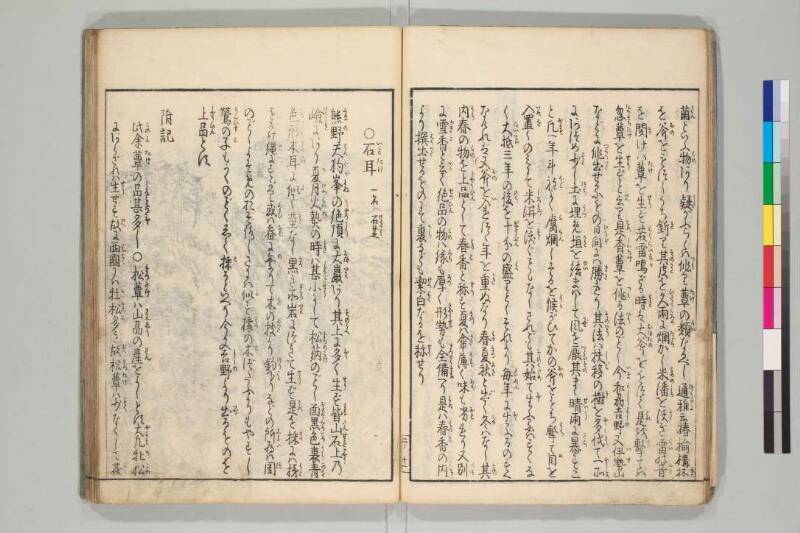
翻刻
【右丁】
菌(きん)といふ物(もの)あり疑(うた)がふらくは作(つく)り蕈(たけ)の類(るい)なるべし通雅(つうがに)云椿榆構/抔(なと)
を斧(おの)をもつてうち釿(き)り其皮(そのかわ)を久(ひさしく)雨(あめ)に爛(たゞら)かし米潘(こめのしる)を沃(そゝ)ぎ雷(らい)の音(おと)
を聞(き)けは蕈(たけ)を生(せう)ず若(もし)雷(らい)鳴(なら)ざる時(とき)は大斧(おほおの)をもつて是(これ)を撃(う)てば
忽(たちまち)蕈(たけ)を生(せう)ずと云(いへ)り是(これ)香蕈(しいたけ)を作(つく)る法(はう)のごとし今(いま)和州(わしう)吉野(よしの)又/伊勢(いせ)山
などに作出(つくりいだ)せるもの日向(ひうが)には勝(まさ)れり其法(そのはう)は扶移(しで)の樹(き)を多(おゝく)伐(きり)て一所(ひとゝころ)
にあつめ少(すこ)し土(つち)に埋(うづ)め垣(かき)を結(ゆい)まはして風(かぜ)を厭(いとひ)其(その)まゝ晴雨(せいう)に暴(さら)すこ
と凡(およそ)一年斗/程(ほど)よく腐爛(ふらん)したるを候(うか)がひてかの斧(おの)をもち撃(うち)て目(め)を
入置(いれを)くのみにて米泔(しろみず)を沃(そゝ)ぐこともなしされども其(その)始(はじめ)て生(おゝ)ふるはすくな
く大抵(たいてい)三年の後(のち)を十分(じうぶん)の盛(さか)りとしそれより毎年(まいねん)に生(おゝ)ふるのすく
なければ又/斧(おの)を入(い)れつゝ年を重(かさ)ぬなり春夏秋(はるなつあき)と出(い)て冬(ふゆ)はなし其(その)
内(うち)春の物(もの)を上品(じやうひん)として春香(はるこ)と称(せう)す夏(なつ)は傘(かさ)薄(うす)く味(あぢ)も劣(おと)れり又/別(べつ)
に雪香(ゆきこ)と云(いゝ)て絶品(せつひん)の物(もの)は縁(ふち)も厚(あつ)く形勢(きやうせい)も全(まつたく)備(そな)へり是(これ)は春香(はるこ)の内(うち)
より撰(えり)出(いだ)せるものにて裏(うら)なども潔白(けつはく)なるを称(せう)せり
【左丁】
○石耳(いわたけ)《割書:一名 石芝(せきし)|》
熊野(くまの)天狗峯(てんぐがみね)の絶頂(せつてう)に大巌(おほいわ)あり其上(そのうえ)に多(おゝ)く生(せう)ず皆(みな)山石上(さんせきじやう)の
嶮(けはしき)にあり夏月(かげつ)火熱(くはねつ)の時(とき)は甚(はなはだ)小(せう)にして松蒳(まつのこけ)のごとし面(おもて)黒色(くろいろ)裏(うら)青(あを)
色(いろ)形(かたち)木耳(きくらけ)に似(に)て茎(くき)なし黒(くろ)き所(ところ)岩(いわ)につきて生(せう)ず是(これ)を採(とる)には梯(はしこ)
をかけ縄(なは)にすがり或(あるひ)は畚(ふご)に乗(の)りて木(き)の枝(えた)より釣下(つりさか)りなどの所為(しよい)は図(つ)
のごとしよそめのおそろしさには似(に)す猿(さる)の木(こ)づたふよりもやすし
鶯(うくひす)の子(こ)もかくのごとくして採(と)るといへり今又/吉野(よしの)より出(いづ)るものを
上品(しやうひん)とす
附記
此余(このよ)蕈(たけ)の品(しな)甚(はなはだ)多(おゝ)し○松蕈(まつたけ)は山州(さんしう)の産(さん)をよしとす大凡(およそ)牝松(めまつ)
にあらざれは生(せう)ぜす故(ゆへ)に西国(さいこく)には牡松(おまつ)多(おゝ)き故(ゆへ)松蕈(まつたけ)は少(すく)なくして茯(ぶく)
現代語訳
菌というものがある。推察するに作り茸の類であろう。通雅に言う「椿や榆、構などを斧で打ち切り、その皮を久しく雨に腐らせ、米の研ぎ汁を注ぎ、雷の音を聞けば茸を生ずる。もし雷が鳴らない時は大斧でこれを撃てば、忽ち茸を生ずる」と言う。これは香茸(椎茸)を作る方法のようである。今、大和国吉野、また伊勢山などで作り出されるものは日向産には勝る。その方法は、シデの木を多く伐って一箇所に集め、少し土に埋め、垣を結い回して風を避け、そのまま晴雨に晒すこと凡そ一年ばかり。よく腐爛したのを見計らって、かの斧で撃って目(傷)を入れ置くだけで、米の研ぎ汁を注ぐこともない。されども、その初めて生えるのは少なく、大抵三年の後を十分の盛りとし、それより毎年に生えるのが少なくなれば、また斧を入れつつ年を重ねる。春夏秋と出て冬はない。その内、春のものを上品として春香と称す。夏は傘薄く味も劣る。また別に雪香というて絶品のものは縁も厚く形勢も完全に備わる。これは春香の内より選り出されたもので、裏なども潔白なるを称したものである。
○石耳《一名:石芝》
熊野の天狗峰の絶頂に大巌があり、その上に多く生ずる。皆山石上の険しい所にある。夏月火熱の時は甚だ小さくて松苔のようである。表面黒色、裏面青色、形は木耳に似て茎なし。黒い所が岩につきて生ずる。これを採るには梯子をかけ、縄にすがり、或いは籠に乗りて木の枝より吊り下がりなどの所業は図のごとし。「よそ目の恐ろしさには似ず、猿の木づたうよりも易し、鶯の子もかくのごとくして採る」と言う。今また吉野より出るものを上品とする。
附記
この他、茸の品は甚だ多い。○松茸は山城国の産をよしとする。大凡そ雌松でなければ生ぜず。故に西国には雄松多き故に松茸は少なくして茯苓...
英語訳
There is something called "rai-kin" (thunder fungi). It is suspected to be a type of cultivated mushroom. The Tsūga states: "Strike椿 (tsubaki), elm, kōzo and such with an axe and cut them, let their bark rot in rain for a long time, pour rice-washing water on them, and when thunder sounds, mushrooms will grow. If thunder does not sound, strike them with a large axe and mushrooms will immediately sprout." This is similar to the method of cultivating shiitake mushrooms. Now, those produced in Yamato Province's Yoshino and also in the mountains of Ise surpass those from Hyūga. The method is to cut many hornbeam trees, gather them in one place, bury them slightly in soil, build fences around them to ward off wind, and expose them to sun and rain for about one year. When they are well rotted, strike them with the aforementioned axe to make cuts, and this alone suffices - there is no need to pour rice-washing water. However, those that first grow are few, and generally the third year after is considered the full prime. After that, as the yearly growth decreases, axes are applied again year after year. They appear in spring, summer, and autumn, but not in winter. Among these, spring ones are considered top quality and called "spring fragrance" (haruko). Summer ones have thin caps and inferior taste. Separately, there is an exquisite variety called "snow fragrance" (yukiko) which has thick edges and complete form. This is selected from among the spring fragrance variety and is prized for having pure white undersides.
○Stone Ear (Iwatake) 《Also known as: Stone Reishi》
On the summit of Tengu Peak in Kumano, there is a great rock, and many grow on top of it. They are all in precipitous places on mountain rocks. During summer's fiery heat, they become very small like pine moss. The surface is black, the underside blue-green, shaped like wood ear but without stems. The black part attaches to rock and grows. To harvest these, ladders are set up, ropes are used for support, or one rides in baskets suspended from tree branches - such activities are as shown in the illustration. "Though it looks frightening to onlookers, it is easier than monkeys climbing trees, and even young nightingales are said to be harvested in this manner." Now, those from Yoshino are considered top quality.
Additional Notes
Besides these, mushroom varieties are extremely numerous. ○For matsutake, those produced in Yamashiro Province are considered best. Generally they only grow on female pine trees. Therefore, since male pines are numerous in the western provinces, matsutake are scarce there, while bukuryō (poria)...